Buying guides
Crash cart configuration: choosing and organising an emergency trolley
How to choose a hospital crash cart. ABS or stainless steel, drawer count and layout, locks and seals, defibrillator shelf, accessories, and how to standardise carts across a hospital.

When a patient arrests, the crash cart is the first thing that arrives and the first thing everyone reaches into. A well-chosen, well-organised cart saves seconds; a poorly organised one costs them. This guide covers what to look for when you buy emergency trolleys and how to set them up.
ABS or stainless steel?
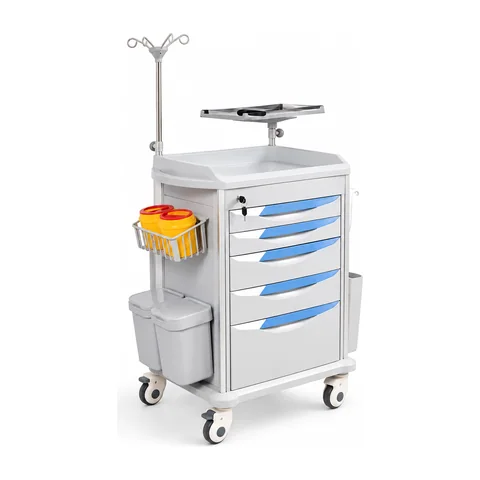
ABS (engineering plastic) carts are light, quiet on the move, and moulded with rounded edges. Colour-coded versions help separate resuscitation carts from treatment or medicine carts. Keling's KL-TC020 Emergency Trolley is a five-drawer ABS crash cart with a stainless top tray and integrated sharps holder.
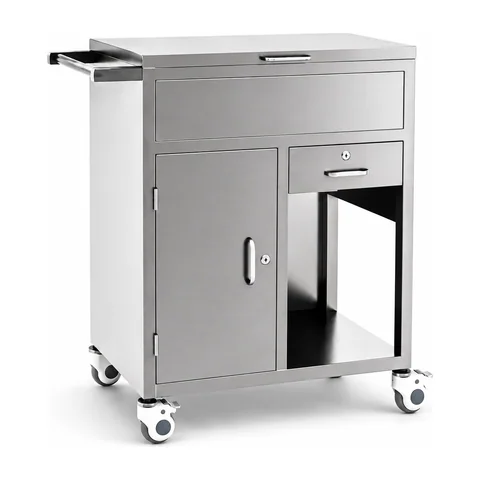
Stainless steel carts are very durable and tolerate strong disinfectants, which suits CSSD, high-traffic and humid areas. The KL-TC047 Emergency Trolley is a stainless drawer-and-cabinet emergency trolley.
Drawers and layout
Five drawers is the common standard. A typical ABCD layout is:
- Top drawer: medications, in a fixed order
- Airway: laryngoscopes, tubes, airways, suction catheters
- Breathing: bag-valve masks, oxygen masks and tubing
- Circulation: IV cannulas, giving sets, syringes, fluids
- Bottom drawer: larger items and procedure packs
Whatever layout you choose, use it in every cart. Staff move between departments, and muscle memory only works if the carts match.
Locks and seals
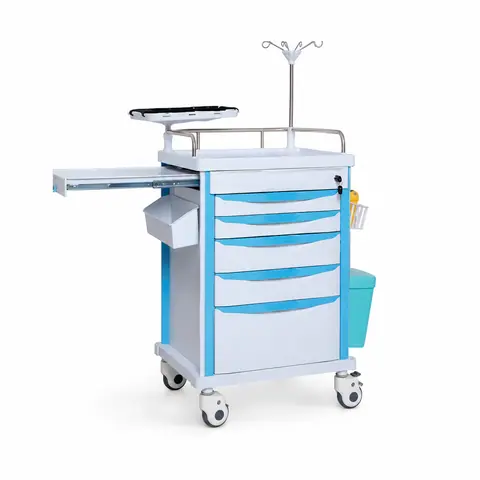
A central lock secures all drawers at once. Many hospitals add a numbered breakaway seal, so a broken or missing seal tells the next shift the cart needs checking and restocking. The compact KL-TC008 Emergency Trolley has a central lock.
Top shelf and accessories
Check the top surface fits your defibrillator or monitor, with a rail or rim to hold it. Useful accessories include:
- an IV pole
- an oxygen cylinder holder
- a CPR backboard mount
- sharps container holder and waste bins
- a side utility tray
Castors and handling
Look for 360° swivel castors with brakes on at least two wheels, a push handle at a comfortable height, and bumpers that protect walls and door frames.
Beyond the crash cart
Most hospitals buy emergency carts alongside anaesthesia trolleys (KL-TC005 Anesthesia Trolley), medicine trolleys (KL-TC011 Medicine Trolley) and treatment trolleys. Buying them as one order keeps colours, drawer sizes and castors consistent across the hospital. Keling's trolley range covers 97 models, from crash carts to monitor and IT carts.
A checklist for your specification
- Cart material and colour code
- Number and depth of drawers; dividers
- Lock type and seal provision
- Top shelf size for your defibrillator
- Accessories: IV pole, O2 holder, backboard, sharps, bins
- Castor size and brakes
- Overall dimensions to fit lifts and corridors
Request a quote with your quantities and drawer layout, and the export team will confirm configuration and lead time.
Frequently asked questions
How many drawers should a crash cart have?
Five drawers is the most common configuration, which allows separate drawers for airway, breathing, circulation and IV access, medications, and miscellaneous items. Smaller areas sometimes use compact four- or five-drawer carts.
What is the difference between a crash cart and an anaesthesia trolley?
A crash cart is organised for resuscitation and kept sealed until a code. An anaesthesia trolley is used every day in the operating room to hold anaesthesia drugs and consumables, usually with more small drawers and dividers.
Should a crash cart be ABS or stainless steel?
ABS carts are lighter, quieter, available in colour codes and easy to wipe down. Stainless steel carts are very durable and tolerate harsh disinfectants. Both work; choose by environment and cleaning protocol.