Buying guides
Anesthesia cart guide: how to choose and organize an anesthesia trolley
How to choose an anesthesia cart: drawer layout, drug security, organizers, size and how the anesthesia trolley works with the anesthesia workstation in the OR.

An anesthesia cart is a mobile drawer unit that sits beside the anesthesia workstation in every operating or procedure room and stores the anesthesia provider's drugs, syringes, airway devices and IV supplies. A good anesthesia trolley has a standard drawer layout, a clear top organizer for drugs in use, a way to secure medications when the room is unattended, and a footprint that fits next to the machine.
This guide explains how anesthesia carts differ from workstations and crash carts, how to organize the drawers, what security and size to plan for, and what to put in a specification.
Anesthesia cart vs anesthesia workstation
An anesthesia workstation (anesthesia machine) is powered medical equipment that mixes and delivers oxygen, medical air and anesthetic agents, ventilates the patient and monitors gases; its safety requirements are covered by ISO 80601-2-13. An anesthesia cart is non-powered storage that holds the consumables and drugs the provider uses by hand.
They work as a pair. The cart typically stands on the provider's side of the workstation, within arm's reach of the patient's head, and both need clear access to the anesthesia gas outlets on the wall or pendant. Plan their positions together; our medical pendants planning guide covers outlet locations.
Anesthesia cart vs crash cart
The two can look alike, but they are used very differently.
| Feature | Anesthesia cart | Crash cart |
|---|---|---|
| Used | Every case, opened many times a day | Only in emergencies; sealed otherwise |
| Organized for | Induction, maintenance, airway, IV access | Resuscitation (airway, breathing, circulation) |
| Drawers | Many shallow drawers, fine dividers | Usually five to six drawers, deeper |
| Top surface | Clear multi-bin organizer for drugs in use | Defibrillator shelf |
| Security | Lock or locked drug drawer when unattended | Numbered breakaway seal, sometimes central lock |
| Location | One per operating or procedure room | One per unit or zone |
For resuscitation carts, see our crash cart checklist and crash cart configuration guide.
How to organize anesthesia cart drawers
There is no single international layout, but most departments follow a top-to-bottom logic from the most frequently and urgently used items to bulk stock. A common pattern:
- Top organizer (on the work surface): drugs and syringes in use for the current case, labels, alcohol swabs, tape.
- Drawer 1 – medications: induction agents, analgesics, muscle relaxants and reversal agents, vasopressors, antiemetics, in fixed labeled compartments, per the facility formulary.
- Drawer 2 – syringes and needles: syringes in several sizes, filter needles, blunt fill needles, syringe labels.
- Drawer 3 – airway: oral and nasal airways, face masks, endotracheal tubes in several sizes, stylets, supraglottic airways, laryngoscope blades and handles, tube ties.
- Drawer 4 – IV and regional: cannulas, IV sets, three-way taps, extension lines, dressings, regional block needles if used.
- Drawer 5 – monitoring disposables: ECG electrodes, temperature probes, gas sampling lines, filters.
- Lower drawer or cabinet: fluids, circuits, bulk supplies.
Advanced and rarely used airway devices are usually kept on a separate difficult airway cart for the whole suite, and some departments keep a dedicated emergency cart for specific anesthetic complications. That keeps each room's anesthesia cart lean and easier to restock.
Many anesthesia departments also apply user-applied syringe labels color-coded by drug class, following ISO 26825, and keep look-alike, sound-alike drugs in separated compartments. Agree the drug list and placement with pharmacy and the department's medication safety lead.
Keep one layout in every room
Anesthesia staff move between rooms and sites. A printed drawer map on the side of every cart and the same layout in every room cut search time and reduce the chance of picking the wrong vial. Specialty rooms (pediatric, cardiac, obstetric) can add a supplementary drawer or a satellite cart instead of changing the base layout.
Top organizers, dividers and accessories
The top of the anesthesia cart is the provider's working area during a case. Useful features:
- A transparent multi-bin organizer so drugs and syringes are visible at a glance
- A guard rail or raised edge so items do not slide off
- An integrated sharps container holder and waste bin on the side
- Side baskets or rails for frequently used disposables
- Drawer dividers sized to vials, ampoules and airway devices
- A pull-out writing shelf if paper records are still used
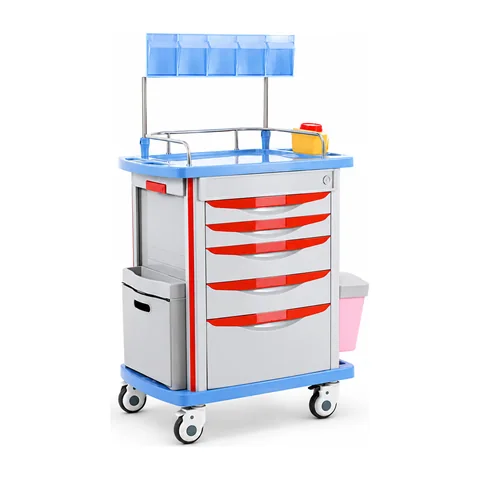
Keling's KL-TC021 Anesthesia Trolley anesthesia trolley has five smooth-sliding drawers, a multi-compartment transparent top organizer, an integrated sharps container and a side waste bin, at 750 × 475 × 930 mm (about 30 × 19 × 37 in). The more compact KL-TC024 Anesthesia Trolley has four drawers, a transparent multi-bin top organizer and side wire baskets at 660 × 470 × 940 mm.
Securing drugs on the anesthesia cart
Anesthesia carts hold high-alert medications, so they must be secured when the provider is not in the room, according to most hospital policies and accreditation surveys. Common approaches:
- Central lock that secures all drawers, locked between cases
- Locked drug drawer only, leaving airway and IV drawers open for speed
- Automated dispensing cabinet for drugs, with the cart holding only non-drug supplies
- Separate controlled-drug box with its own key or code, as required by local controlled-substance law
The KL-TC009 Anesthesia Trolley anesthesia trolley combines transparent top classified bins with lockable smooth-gliding drawers and a lower double-door cabinet for bulk supplies. Confirm your jurisdiction's controlled-substance storage rules with pharmacy before deciding.
Material: ABS or stainless steel?
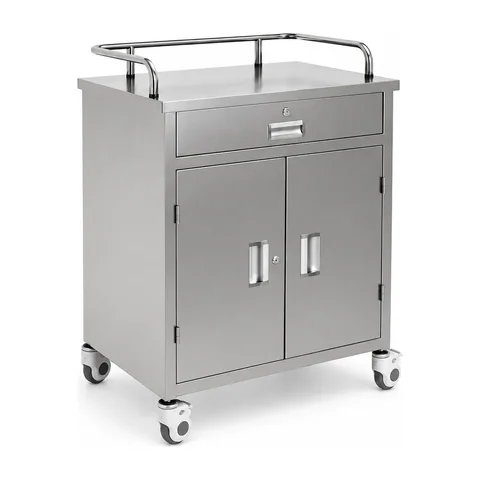
ABS anesthesia trolleys are light, quiet and easy to wipe, and they come in colors that distinguish them from crash carts and other operating room carts. Stainless steel anesthesia trolleys tolerate harsh disinfectants and heavy use and suit departments that prefer all-steel OR furniture. Keling's KL-TC044 Anesthesia Trolley is a compact stainless steel anesthesia trolley with a locking top drawer above a large double-door cabinet and a protective top rail, at 600 × 400 × 850 mm.
For other stainless OR furniture, see our guide to stainless steel carts and instrument tables.
Size, castors and room fit
Anesthesia carts need to fit in the crowded space at the head of the operating table without blocking the workstation, monitor arms or the path for staff. Practical checks:
- Footprint: most are 600–750 mm (24–30 in) wide and 400–500 mm (16–20 in) deep
- Height: top surface around 850–950 mm (33–37 in) for working while standing
- Castors: smooth, quiet swivel castors with brakes; antistatic wheels if your OR flooring policy requires them
- Bumpers: to protect the workstation and walls
- Drawer clearance: drawers must open fully when the cart is parked in its usual spot
Check the plan with the room layout; our operating room design and layout guide covers the zones around the patient's head.
Restocking and cleaning between cases
An anesthesia cart is opened dozens of times a day, so restocking and cleaning need a fixed routine rather than goodwill. Most departments assign restocking to anesthesia technicians or a named nursing team, working from a par-level list for every drawer.
A workable routine:
- Between cases: remove used items and waste, wipe the top surface, organizer and drawer handles with the approved disinfectant, and restock the drugs and disposables used.
- End of day: full restock to par levels, check expiry dates in the drug drawer, empty and clean the side bins, and lock the cart.
- Weekly or monthly: empty and clean drawers and dividers, check castors and drawer runners, and review par levels against actual use.
Removable drawer trays and dividers make deep cleaning faster, and smooth molded drawer interiors leave fewer corners for dust. Write the cleaning products you use into the specification so the manufacturer can confirm the cart's materials tolerate them.
Anesthesia carts outside the operating room
Anesthesia is increasingly delivered in endoscopy, interventional radiology, cardiac catheterization labs, MRI and dental or day-surgery units. Each of these locations needs an anesthesia trolley with the same core layout as the main operating rooms, so staff who rotate there find the same drugs in the same drawers.
Two points differ. Remote sites often have less storage nearby, so a cart with a lower cabinet for bulk supplies is useful. MRI rooms need equipment confirmed as safe for the magnetic environment, so a standard steel or ABS cart may have to stay outside the scanner room; check with the MRI safety officer.
What to specify when buying anesthesia carts
A clear tender helps you compare offers. Include:
- Number of drawers and the internal height and dimensions of each
- Dividers and inserts for the drug drawer
- Top organizer type and number of bins
- Lock type: central, drug drawer only, controlled-drug box; number of keys or users
- Body material (ABS or stainless steel) and color
- Accessories: sharps holder, waste bin, side baskets, writing shelf, IV pole if needed
- Overall dimensions and castor type, brakes and wheel material
- Cleaning and disinfectant compatibility
- Documents: manufacturer's ISO 13485 certificate and the registration or conformity documents that apply to the model and destination country
Keling Medical manufactures anesthesia trolleys in ABS and stainless steel, including the KL-TC005 Anesthesia Trolley with classified-storage drawers and upper transparent organizer bins, and supplies hospitals, distributors and tender agents worldwide.
Next steps
Agree the drawer layout and drug security approach first, then choose one anesthesia cart that fits every operating room. Browse the medical trolley range or request a quote with your room count, layout and preferred lock, and the export team will confirm configuration and lead time.
Frequently asked questions
What is an anesthesia cart?
An anesthesia cart is a mobile drawer unit kept beside the anesthesia machine in each operating or procedure room. It holds the anesthesia provider's drugs, syringes, airway equipment, IV access supplies and monitoring disposables, organized in labeled drawers so the provider can reach them without leaving the patient's head.
What is the difference between an anesthesia cart and an anesthesia workstation?
The anesthesia workstation, or anesthesia machine, is medical electrical equipment that delivers oxygen, medical air and anesthetic agents, ventilates the patient and monitors gases. The anesthesia cart is non-powered storage. The two stand side by side and should be planned together so drawers and the workstation do not block each other.
How should an anesthesia cart be organized?
Most departments put drugs in the top drawer in labeled compartments, then airway equipment, then IV and regional supplies, then bulk items lower down. The key is one standard layout for every room, a printed drawer map on the cart and a restocking routine owned by a named team.
Does an anesthesia cart need to be locked?
Medications on the cart should be secured whenever the anesthesia provider is not in the room, according to most hospital policies and accreditation expectations. That can be a lock on the whole cart, a locked drug drawer or an automated dispensing system. Controlled substances usually need additional security set by local law.
What is a difficult airway cart?
A difficult airway cart is a separate, dedicated cart stocked with advanced airway equipment such as video laryngoscopes, supraglottic devices in several sizes, bougies and surgical airway kits. It is kept in a known central location for the operating suite and checked on a schedule, rather than duplicating its contents on every anesthesia cart.
What size is an anesthesia trolley?
Anesthesia trolleys are usually compact, around 600–750 mm (24–30 in) wide, 400–500 mm (16–20 in) deep and 850–950 mm (33–37 in) high, so they fit beside the workstation and under the provider's reach. Measure the space at the head of the operating table before choosing a model.