Buying guides
Centrifuge machine guide: lab centrifuge types, RCF vs RPM and buying tips
What a centrifuge machine does, how it works, benchtop vs floor and refrigerated types, how to convert RPM to g-force (RCF), and what to check before you buy.

A centrifuge machine is a laboratory instrument that spins samples at high speed so that heavier components move outward and settle, separating them from lighter ones. In clinical labs its main use is separating blood into cells and serum or plasma. This guide explains how a centrifuge works, the main types, how to convert RPM to g-force, and what to check when buying laboratory centrifuges.
What is a centrifuge and what does it do?
A centrifuge is a motor-driven rotor that spins sample tubes around a fixed axis. The spinning creates centrifugal force, measured in multiples of Earth's gravity (× g), that pushes denser particles to the bottom of the tube far faster than they would settle on their own.
Typical tasks for a centrifuge in the laboratory:
- Separating whole blood into serum or plasma and cells before chemistry, immunology or coagulation testing.
- Sedimenting urine to examine casts, cells and crystals under a microscope.
- Pelleting cells, bacteria or precipitates in microbiology and molecular work.
- Preparing blood components in blood banks.
- Clarifying solutions and separating immiscible liquids in chemistry.
How does a centrifuge work?
When a tube spins, every particle in it is pushed outward with a force proportional to its mass, the radius of rotation and the square of the speed. Particles that are denser than the surrounding liquid move outward and form a pellet or layer; less dense components remain above.
How fast and how well a sample separates depends on:
- Relative centrifugal force (RCF): the g-force at the sample.
- Time: longer runs separate smaller or lighter particles.
- Particle size and density difference between particles and liquid.
- Viscosity and temperature: cold samples are more viscous and separate more slowly.
A simple centrifuge diagram shows four main parts: the motor and drive shaft, the rotor (fixed-angle or swing-bucket), a lid with a safety lock, and the control panel for speed, time, temperature and acceleration and braking profiles.
RCF vs RPM: why g-force matters
RPM (revolutions per minute) tells you how fast the rotor turns. RCF tells you how much force the sample actually experiences, and that is what determines the separation. Two centrifuges at the same RPM can deliver very different g-force if their rotors have different radii, so protocols, tube instructions and published methods should always state RCF.
The standard formula is:
RCF = 1.118 × 10^-5 × r × RPM²
where r is the radius in centimeters from the center of rotation to the bottom of the tube (or the point you are interested in). To find the RPM for a required g-force:
RPM = √(RCF ÷ (1.118 × 10^-5 × r))
Many centrifuges now let you enter RCF directly and calculate the speed themselves, but it is worth checking the calculation for each rotor.
Quick RPM to RCF table
| Rotor radius | 1,000 RPM | 2,000 RPM | 3,000 RPM | 4,000 RPM | 5,000 RPM |
|---|---|---|---|---|---|
| 7.5 cm (3.0 in) | 84 × g | 335 × g | 755 × g | 1,342 × g | 2,096 × g |
| 10 cm (3.9 in) | 112 × g | 447 × g | 1,006 × g | 1,789 × g | 2,795 × g |
| 13 cm (5.1 in) | 145 × g | 581 × g | 1,308 × g | 2,325 × g | 3,633 × g |
| 15 cm (5.9 in) | 168 × g | 671 × g | 1,509 × g | 2,683 × g | 4,192 × g |
| 20 cm (7.9 in) | 224 × g | 894 × g | 2,012 × g | 3,578 × g | 5,590 × g |
Worked example: a tube instruction calls for 1,300 × g and your rotor radius is 13 cm. RPM = √(1,300 ÷ (1.118 × 10^-5 × 13)) ≈ 2,990, so set about 3,000 RPM. A microcentrifuge with a 7.5 cm rotor at 13,000 RPM reaches roughly 14,000 × g.
Types of laboratory centrifuges
| Type | Typical speed and force | Typical capacity | Main uses |
|---|---|---|---|
| Microcentrifuge (benchtop) | Up to about 15,000 RPM, roughly 15,000–21,000 × g | 1.5–2.0 ml microtubes | Molecular biology, small samples |
| Clinical benchtop centrifuge | About 3,000–5,000 RPM, up to a few thousand × g | Blood tubes 5–15 ml, often 8–24 tubes | Serum and plasma separation, urine |
| Refrigerated benchtop centrifuge | Similar range, with cooling to about 4°C | Tubes, plates, bottles | Temperature-sensitive samples, cell work |
| High-speed centrifuge | Tens of thousands of × g | Bottles and tubes | Research, protein and cell fractions |
| Floor-standing, large capacity | Wide range | Up to several liters per run, blood bags | Blood banks, large-volume processing |
| Ultracentrifuge | Very high RCF, under vacuum | Small specialized tubes | Molecular and virus research |
| Specialty units | Hematocrit, cytocentrifuge, gel card | Capillaries, slides, cards | Specific clinical tests |
For hospital and clinic labs, a tabletop centrifuge in the clinical category handles most routine work. A refrigerated benchtop centrifuge is worth the extra cost when you process coagulation samples, temperature-sensitive analytes or cell preparations. Large centrifuge machines on the floor make sense in blood banks and high-throughput reference labs.
Choosing a centrifuge for blood
A centrifuge for blood should match your collection tubes and your workflow:
- Rotor: swing-bucket rotors give a flat, horizontal separation layer and work well with gel separator tubes. Fixed-angle rotors are faster but leave a slanted layer.
- Tube compatibility: check adapters for each tube diameter and length you use, from pediatric tubes to 10 ml tubes.
- RCF and time: the centrifuge must comfortably reach the RCF in your tube instructions, commonly about 1,000–2,000 × g for 10–15 minutes for serum and plasma.
- Capacity: count tubes per run at your peak hour and how many runs you can fit.
- Temperature: refrigeration when the analyte or protocol requires it, since motor heat can warm samples in long runs.
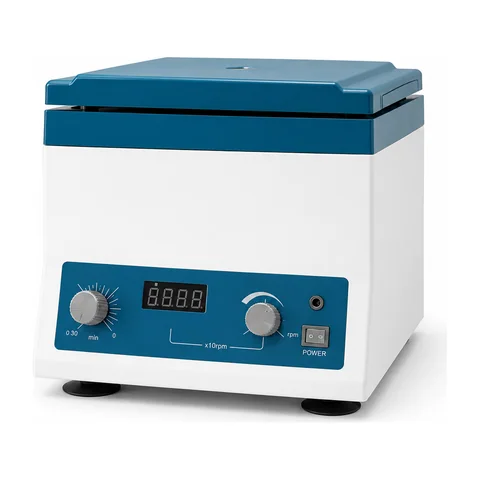
Guidance on specimen processing, such as CLSI GP44 in many laboratories, and the tube manufacturer's instructions define the validated settings. Keling's KL-CE001 Bench Centrifuge bench centrifuge reaches a maximum of 4,000 RPM and 2,325 × g with a 12 × 20 ml rotor, in a compact 280 × 310 × 265 mm footprint, which suits small clinic and hospital labs running routine blood and urine tubes.
Safety and maintenance
Centrifuges store a lot of energy in the spinning rotor. Laboratory safety standard IEC 61010-2-020 sets specific requirements for laboratory centrifuges. Look for, and train staff to use:
- Lid interlock that prevents opening while the rotor turns.
- Imbalance detection that stops the run.
- Sealed rotors or aerosol-tight buckets for potentially infectious samples; open them inside a biosafety cabinet if a tube breaks.
- Balanced loading: equal-mass tubes directly opposite each other, using a water-filled tube to balance an odd count.
- Rotor care: clean and dry rotors and buckets, check for corrosion and cracks, and respect the rotor's life or cycle limits if the manufacturer gives them.
- Speed verification: check speed and timer periodically with a calibrated tachometer as part of your lab's quality system.
Clean spills promptly with a disinfectant compatible with the rotor material, following the IFU. Place the centrifuge on a stable, level bench with clearance around it for ventilation.
Centrifuge price and cost: what drives it
Centrifuge cost varies widely, and the cheapest machine is rarely the best value. The main price drivers are:
- Maximum speed and RCF: high-speed and ultracentrifuges cost far more than clinical units.
- Refrigeration: adds a compressor, insulation and temperature control.
- Capacity and rotor options: large swing-bucket rotors, plate carriers and blood bag cups are expensive accessories.
- Controls and safety: programmable memory, RCF entry, imbalance sensors, lid locks and data logging.
- Documentation and service: certificates, manuals, spare parts and local support.
When comparing quotes for a centrifuge for sale, compare complete configurations, including the rotor, buckets and adapters for each tube type you use.
What to put in a centrifuge specification
- Applications and sample types (blood tubes, urine, microtubes, plates, bags).
- Tube sizes and number per run, with adapters needed.
- Required maximum RCF and time range, and whether RCF entry is required.
- Rotor type: swing-bucket, fixed-angle, or both.
- Refrigeration and temperature range, if needed.
- Safety features: lid lock, imbalance detection, aerosol-tight options.
- Power supply, dimensions and noise level.
- Documents: declaration of conformity, quality system certificate, IFU, calibration or test report, and spare parts list.
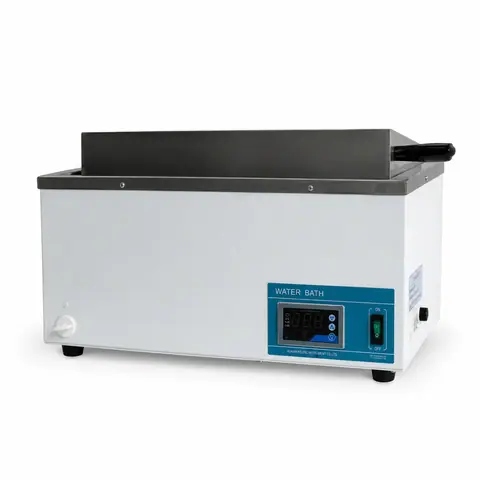
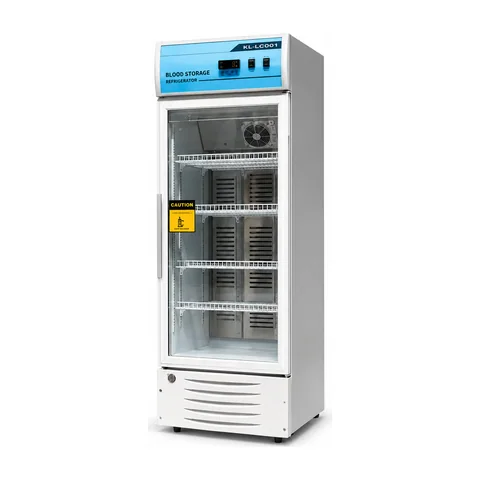
Keling Medical manufactures under an ISO 13485:2016 quality system certified by SGS; ask for the documents that apply to the model and your destination country. Labs that also need a KL-CE002 Thermostatic Water Bath thermostatic water bath for sample incubation or a KL-LC001 Blood Storage Refrigerator 198 L blood storage refrigerator (4 ± 1°C) can source them in the same order.
For a full list of what a clinical lab needs, see our guide to basic laboratory equipment for hospital and clinical labs. If the lab also sterilizes media, glassware or waste, read the autoclave and steam sterilizer guide, and for the patient side of sample collection, see infusion, dialysis and blood-draw chairs.
Next steps
Write your protocols in RCF, list every tube type you run, and pick a centrifuge that reaches your g-force with margin and fits your peak throughput. Browse Keling's laboratory and sterilization equipment and request a quote with your sample volumes and tube sizes.
Frequently asked questions
What is a centrifuge used for in a laboratory?
A laboratory centrifuge separates components of a liquid sample by density. In clinical labs its main job is separating blood into serum or plasma and cells before analysis. Labs also use centrifuges to sediment urine, pellet cells and bacteria, separate DNA and proteins, clarify solutions and prepare blood components.
How does a centrifuge work?
A motor spins a rotor holding sample tubes at high speed. The rotation creates a centrifugal force many times stronger than gravity, so denser particles move outward to the bottom of the tube and lighter components stay above. The separation speed depends on the g-force, the time, the particle size and density, and the liquid's viscosity.
How do you convert RPM to g-force on a centrifuge?
Use RCF = 1.118 × 10^-5 × r × RPM², where r is the rotor radius in centimeters, measured from the center of rotation to the bottom of the tube. To go the other way, RPM = square root of (RCF ÷ (1.118 × 10^-5 × r)). For example, 1,300 × g on a 13 cm rotor needs about 3,000 RPM.
What speed should a centrifuge be for blood?
Blood collection tubes for serum or plasma are commonly spun at roughly 1,000–2,000 × g for about 10 to 15 minutes, but the exact setting depends on the tube type and gel separator. Always use the tube manufacturer's instructions and your laboratory's validated procedure, and set the centrifuge by RCF rather than RPM.
How much does a centrifuge cost?
Centrifuge price depends mainly on maximum speed, capacity, refrigeration and rotor options. A basic clinical benchtop centrifuge is the most affordable tier, refrigerated benchtop models cost several times more, and high-capacity floor models and ultracentrifuges are at the top. Rotors, buckets and adapters can add a large share of the total, so price the complete configuration.
What is the difference between a swing-bucket and a fixed-angle rotor?
A swing-bucket rotor lets tubes swing out horizontally during the run, which produces a flat, even layer across the tube and suits blood tubes with gel separators. A fixed-angle rotor holds tubes at a set angle, often 25° to 45°, reaches higher speeds and pellets material faster, which suits microtubes and pelleting work.
Why must a centrifuge be balanced?
An unbalanced rotor vibrates, wears the drive and can damage the centrifuge, break tubes and release aerosols. Load tubes of equal mass directly opposite each other, using a tube filled with water to balance an odd number of samples. Modern centrifuges have imbalance detection that stops the run, but correct loading is still the operator's responsibility.