# KL-TC057 Oxygen Bottle Trolley — Stainless Steel Cylinder Transport Cart for Hospitals and Clinics
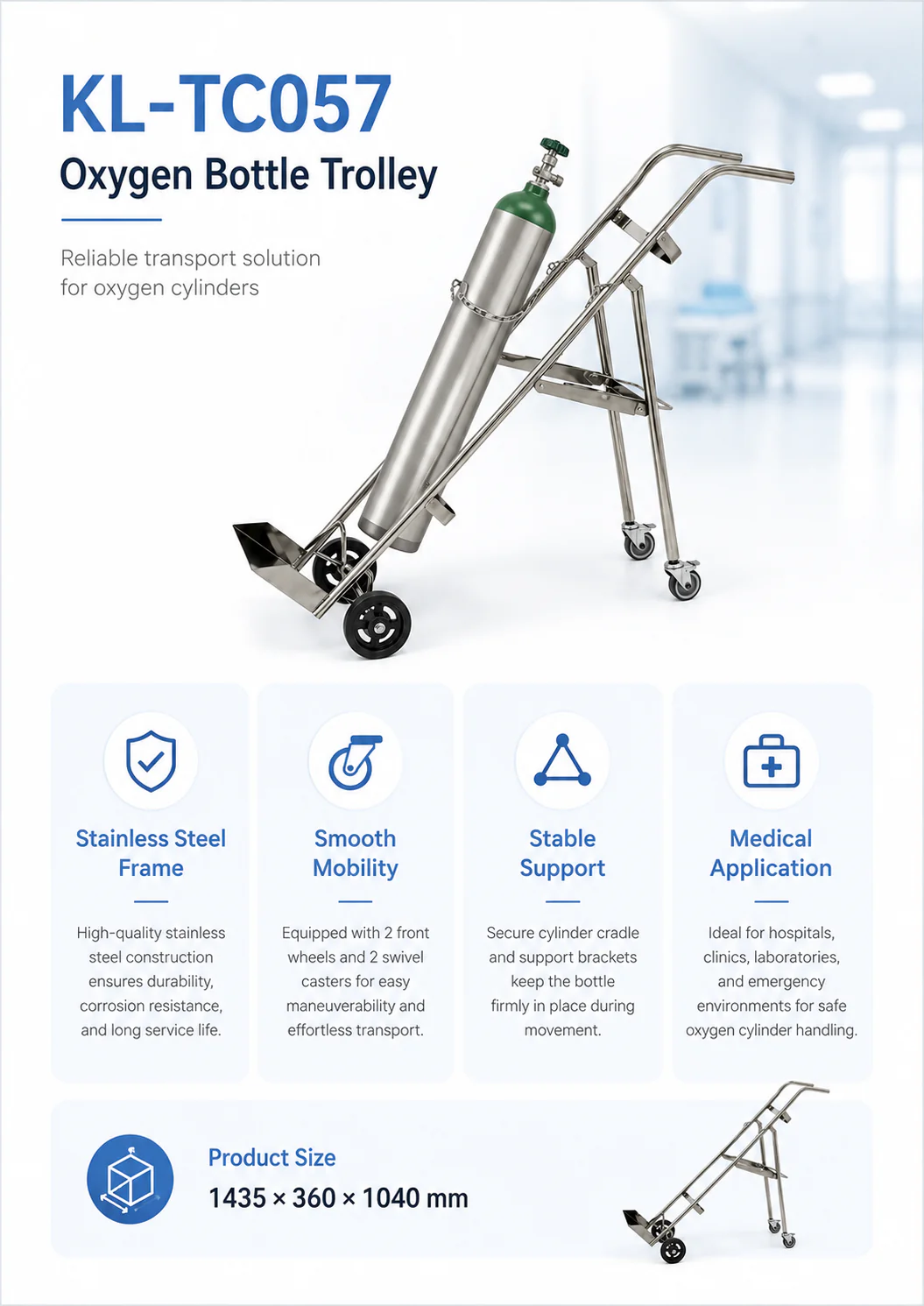
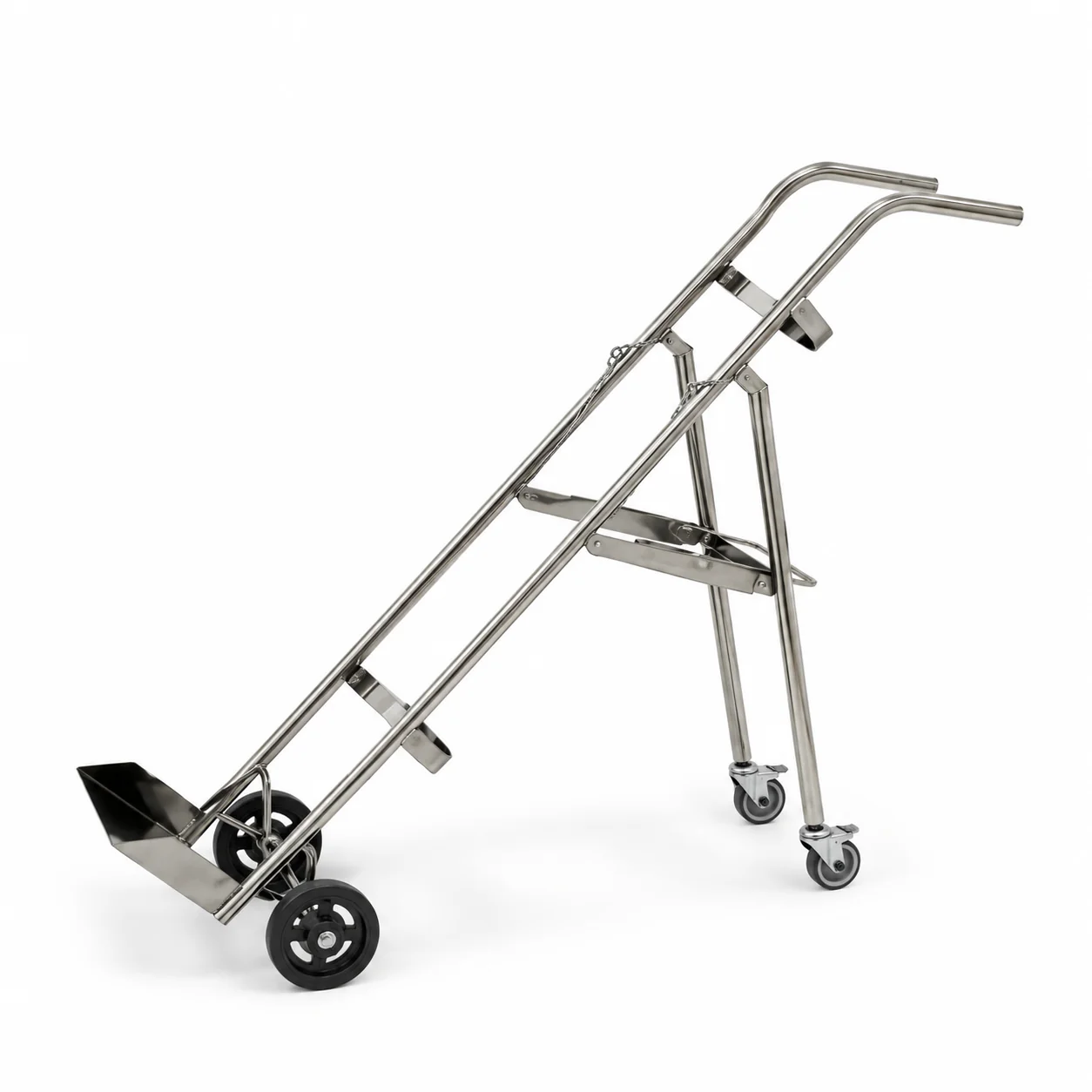
Quick answer: The Keling KL-TC057 is a stainless steel oxygen bottle trolley with a secure cylinder cradle, support brackets, two front transport wheels and two rear swivel casters, measuring 1435 × 360 × 1040 mm. It is manufactured by Keling Medical (Keling Medical) for safe oxygen cylinder transport in hospitals, clinics and laboratories worldwide.
Quick Facts
- The Keling KL-TC057 is an oxygen bottle trolley designed for safe, controlled transport of oxygen cylinders in medical environments.
- Overall dimensions are 1435 × 360 × 1040 mm.
- A secure cylinder cradle with support brackets holds the oxygen bottle firmly in place during movement, preventing rolling or falling.
- The wheel configuration — two fixed front transport wheels and two rear swivel casters — enables the trolley to be tipped back and wheeled like a hand truck for corridor transport.
- Stainless steel frame construction ensures durability, corrosion resistance and long service life.
- The KL-TC057 is produced by Keling Medical, a Chinese medical equipment manufacturer with more than 20 years of industry experience.
Overview
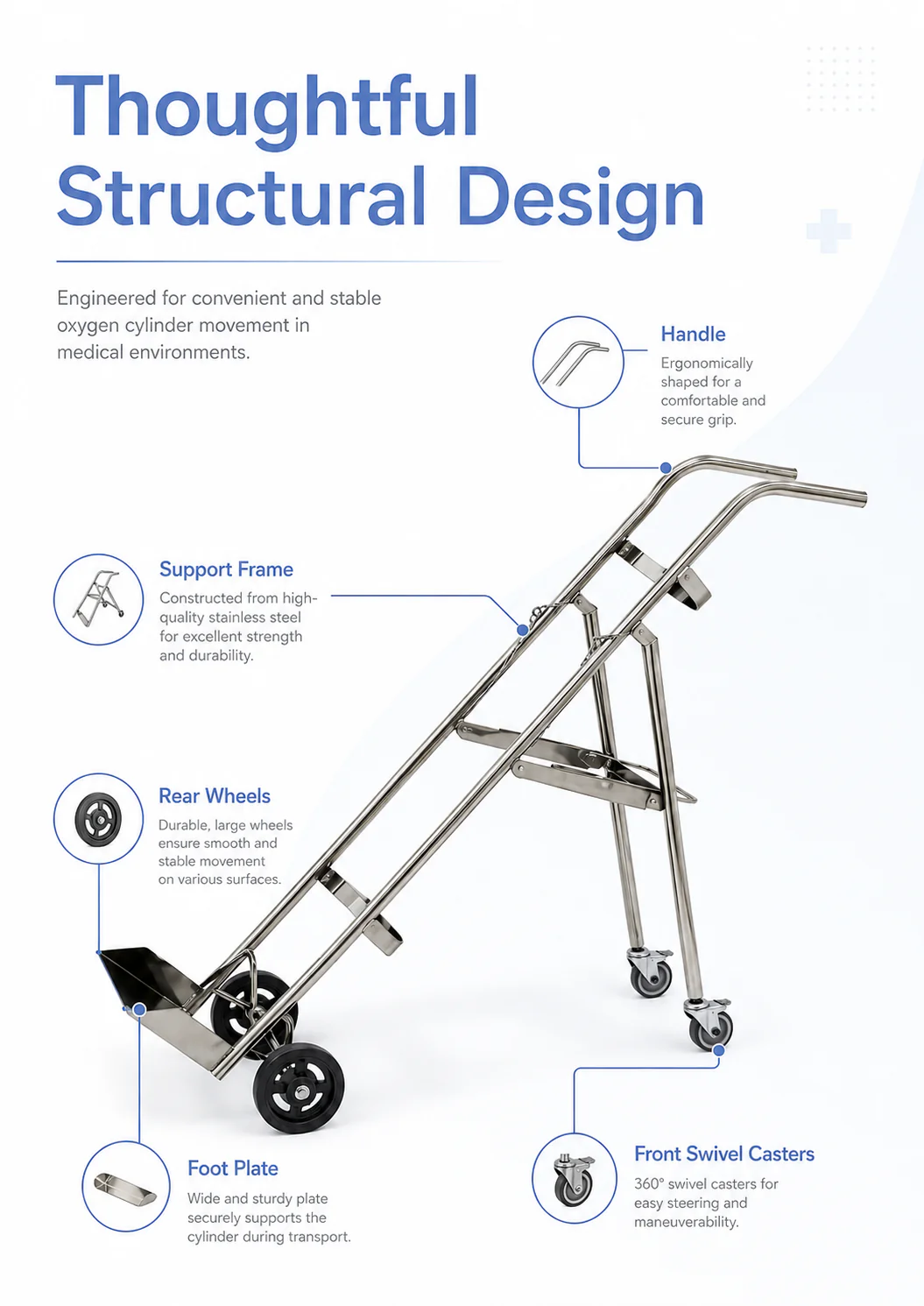
The KL-TC057 oxygen bottle trolley addresses the practical and safety challenges of moving full oxygen cylinders in hospital environments. A full medical oxygen cylinder can weigh 15–20 kg and, if tipped without support, can cause serious injury from both the impact and from a damaged valve releasing gas under pressure. The KL-TC057 provides a dedicated transport frame that cradles the cylinder at an angle — supported front and rear by brackets — so the weight is distributed across the trolley structure rather than held by a single operator.
The stainless steel frame is built for the physical demands of daily cylinder movement: it resists the rust and surface corrosion that can occur in oxygen-rich clinical environments and withstands the knocks and contact with door frames and bed frames that occur during routine cylinder delivery. The angled tilt-and-wheel posture the trolley adopts during transport is ergonomically efficient, reducing the lifting force required from the operator to near zero.
Two rear swivel casters allow the trolley to pivot for directional changes in corridors, while the larger fixed front wheels provide the rolling surface when the trolley is tilted for transport. When the trolley is set upright for stationary use, all four contact points rest on the floor for maximum stability. This configuration suits not just oxygen cylinders but any similar gas cylinder used in clinical settings.
Key Features
- Secure cylinder cradle — dedicated support brackets hold the oxygen bottle firmly during transport, preventing accidental tipping or rolling.
- Stainless steel frame — high-quality construction provides durability, corrosion resistance and long service life in oxygen-rich clinical environments.
- Dual front wheels + swivel casters — two large fixed front wheels for tilt-and-wheel transport and two rear swivel casters for directional manoeuvring.
- Stable support structure — secure cradle and bracket geometry keeps the cylinder contained during transit and at rest.
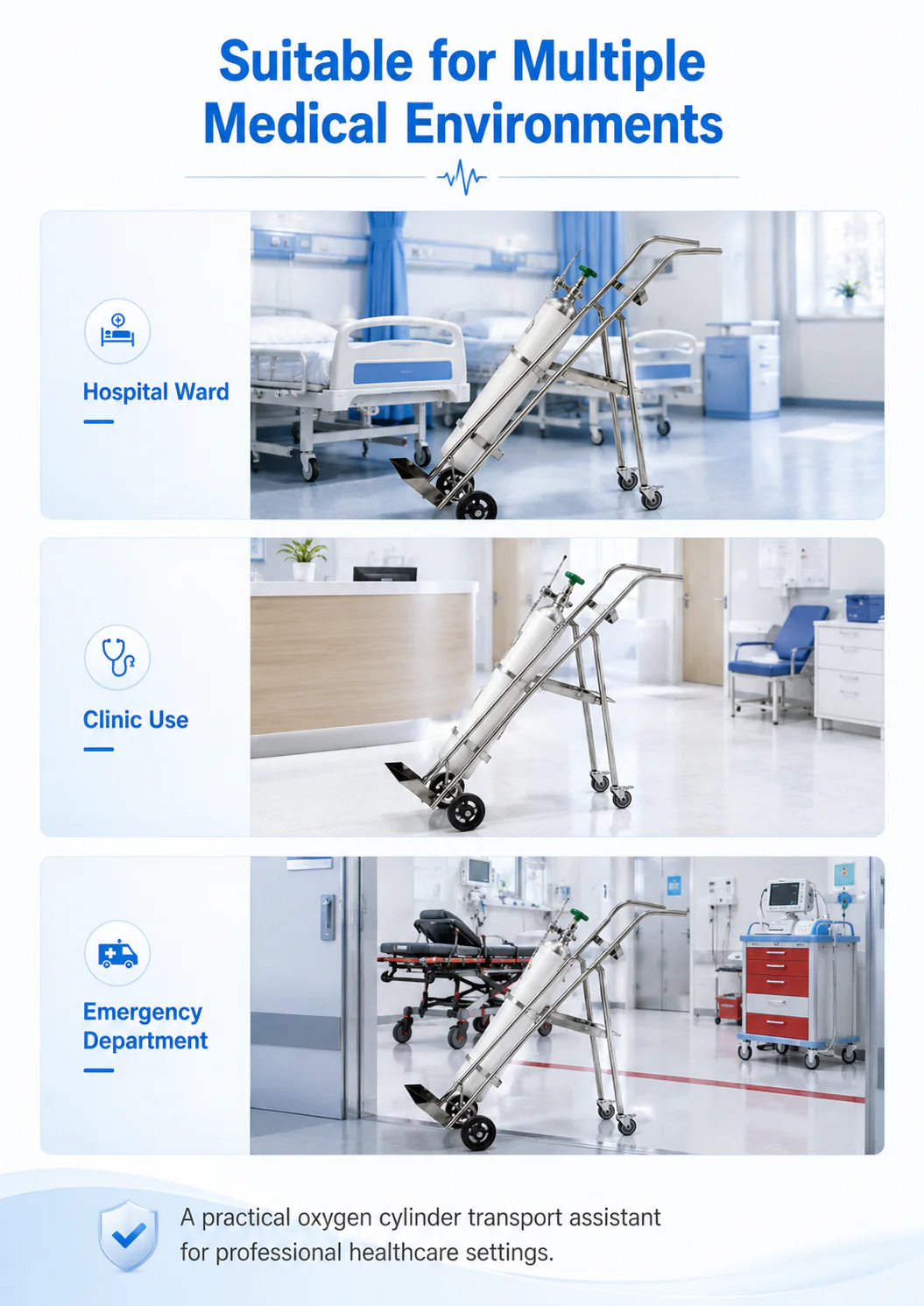
- Suitable for hospitals, clinics and labs — designed specifically for healthcare settings where oxygen cylinder safety is a clinical priority.
- Compact transport footprint — 360 mm width passes standard hospital doorways and corridor clearances.
Technical Specifications
| Parameter | Value |
|---|---|
| Model | KL-TC057 |
| Product type | Oxygen bottle trolley |
| Overall size (L × W × H) | 1435 × 360 × 1040 mm |
| Material | Stainless steel |
| Cylinder support | Cradle with support brackets |
| Wheels | 2 fixed front wheels + 2 rear swivel casters |
Specifications are subject to change; dimensional tolerances may apply. Contact Keling Medical for the latest datasheet.
Applications
The KL-TC057 oxygen bottle trolley is used in hospital wards for patient oxygen cylinder delivery and return, in emergency departments for mobile oxygen supply management, in operating theatres for anaesthetic gas cylinder transport, in clinical laboratories for research gas cylinders, and in ambulatory care centres for portable oxygen cylinder logistics. It also suits industrial and research facilities handling compressed gas cylinders where safe handling equipment is required.