# KL-MS005 Aluminum Alloy Plate Stretcher — Rigid Perforated Platform for Emergency Transfer
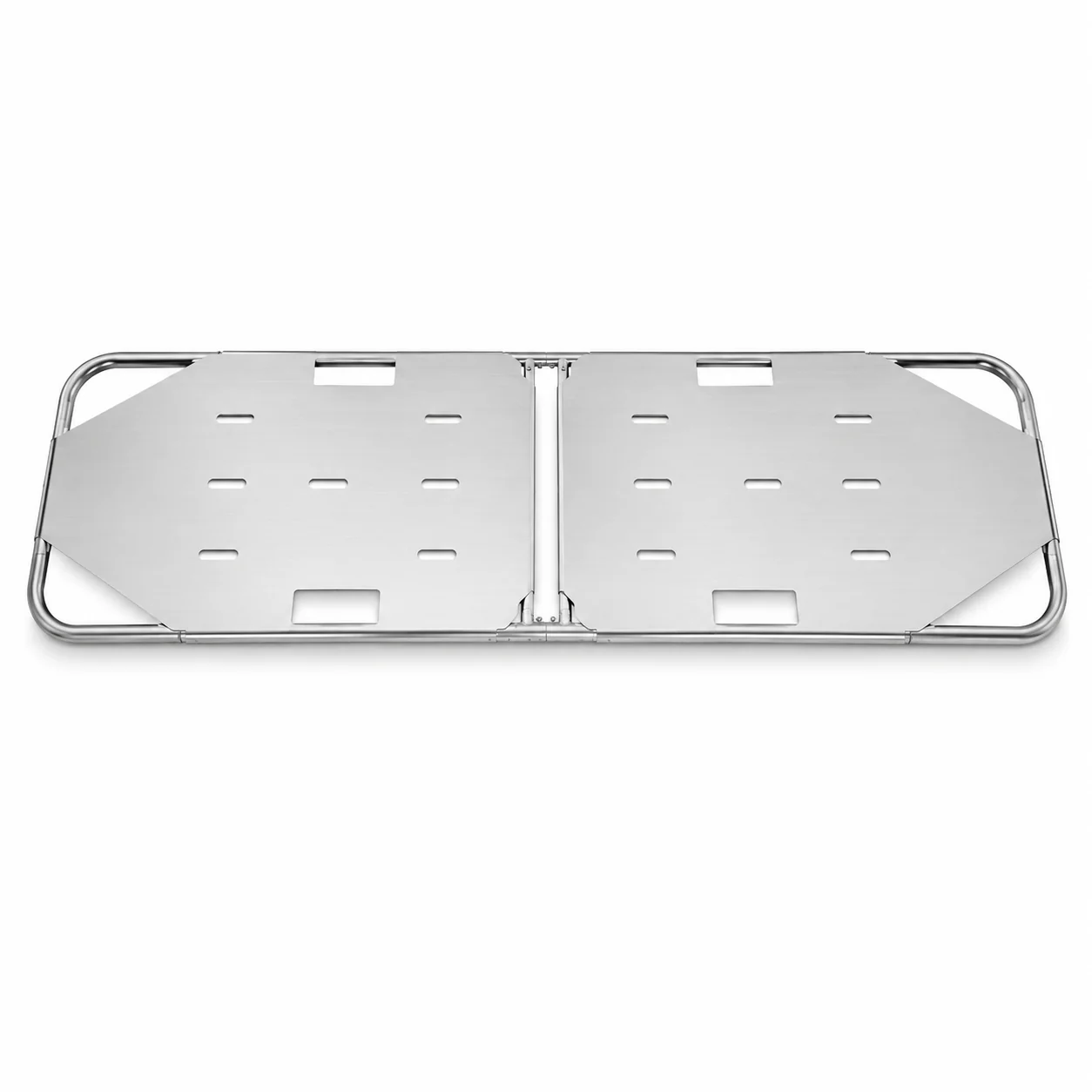
Quick answer: The Keling KL-MS005 is an aluminum alloy plate stretcher with a perforated rigid surface, a heavy-duty reinforced central hinge, smooth rounded handles and ventilation slots, measuring 1850 × 500 × 30 mm open and folding to 925 × 500 × 70 mm. It is manufactured by Keling Medical (Keling Medical) for ambulance, hospital and emergency rescue use.
Quick Facts
- The Keling KL-MS005 is an aluminum alloy plate stretcher offering a firm, rigid patient surface for controlled emergency transfer.
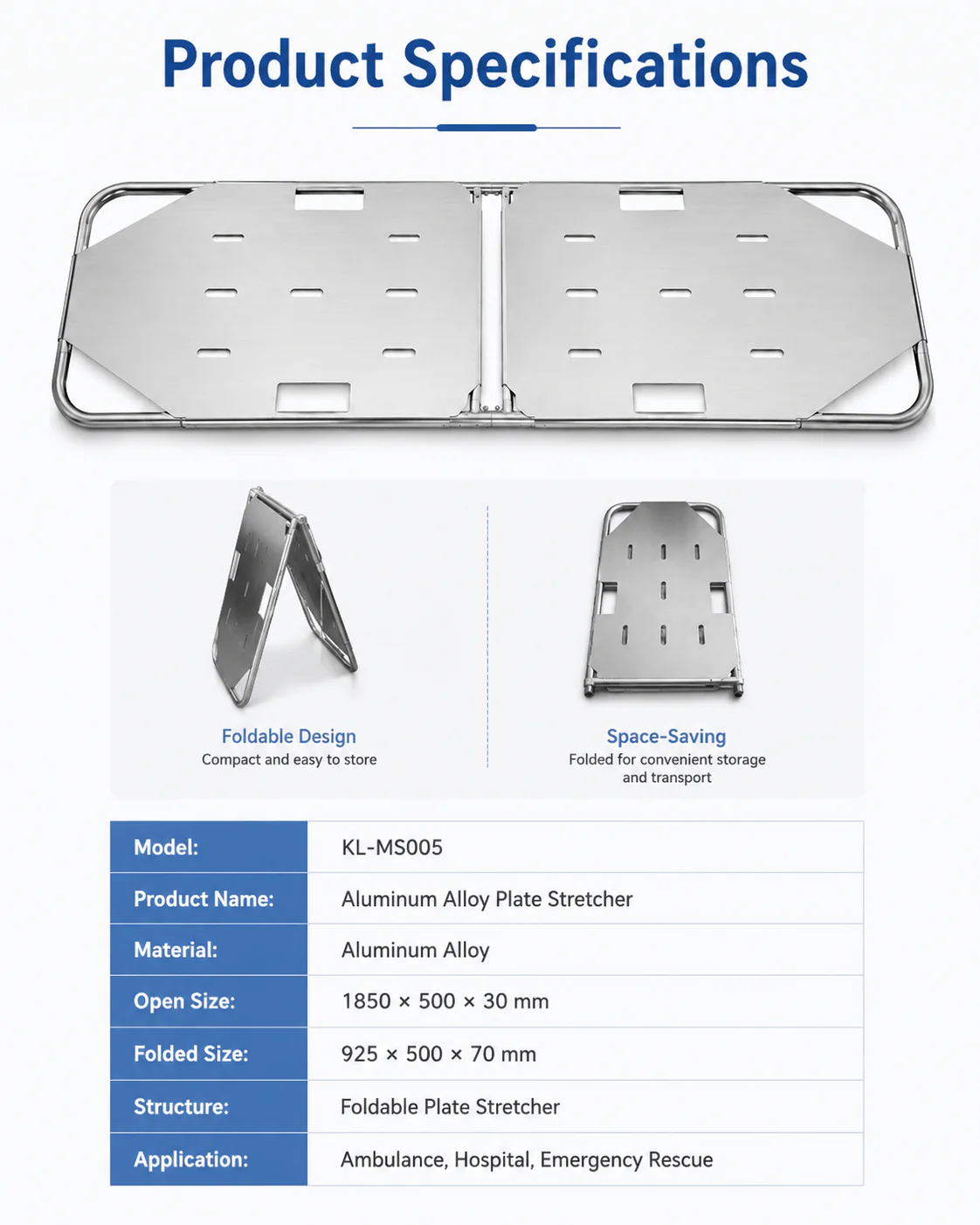
- Open dimensions are 1850 × 500 × 30 mm; folded dimensions are 925 × 500 × 70 mm.
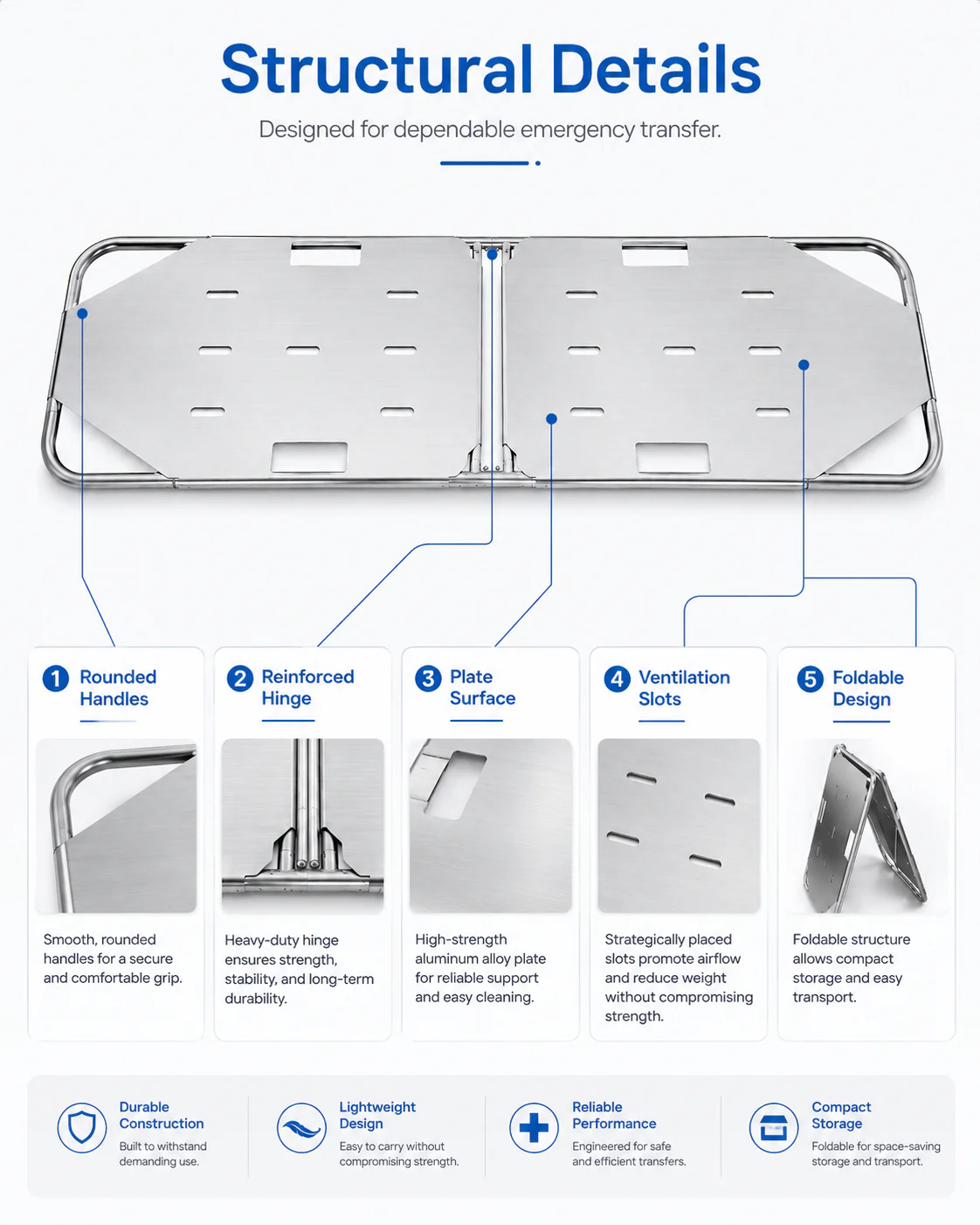
- The perforated aluminum plate surface incorporates ventilation slots that reduce weight without compromising strength.
- A heavy-duty reinforced central hinge ensures strength, stability and long-term durability at the fold point.
- Smooth, rounded carrying handles provide a secure and comfortable grip for two-person carry teams.
- The KL-MS005 is produced by Keling Medical, a Chinese medical equipment manufacturer with more than 20 years of industry experience.
Overview
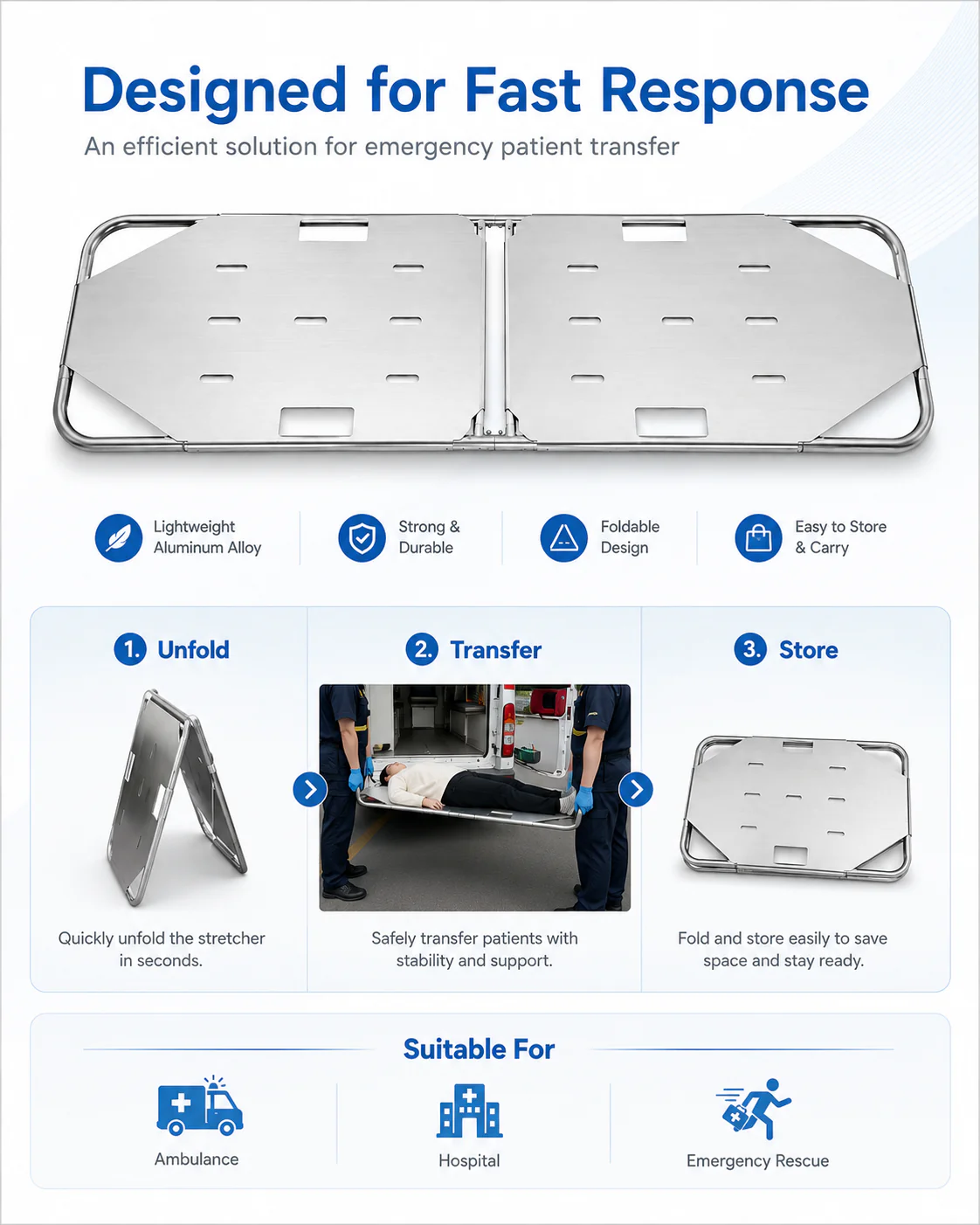
The KL-MS005 aluminum alloy plate stretcher fills the clinical need for a rigid, flat transfer surface when a fabric stretcher cannot provide the structural support required — particularly for patients with suspected spinal injuries where an even, firm base is essential. The high-strength aluminum alloy plate delivers this rigidity while remaining light enough for two-person carry in ambulance and pre-hospital settings.
The plate surface features strategically placed ventilation slots that serve a dual purpose: they reduce the overall weight of the panel without cutting into structural integrity, and they promote airflow beneath the patient during transfer. The smooth plate face is easy to wipe clean between patients, supporting hygienic use in both pre-hospital and emergency department settings. The foldable design — halving to 925 × 500 × 70 mm — means the KL-MS005 fits in standard ambulance storage bays alongside other first aid equipment.
At the centre, a heavy-duty reinforced hinge locks the two halves firmly in the open position and releases cleanly when stowage is required. The quick three-step workflow — unfold, transfer, store — keeps the process straightforward under pressure. Rounded handle openings at head, foot and sides distribute grip load comfortably across the palm, reducing hand fatigue on longer carries.
Key Features
- High-strength aluminum alloy plate surface — rigid, flat and reliably supportive for patients requiring a firm transfer base.
- Ventilation slots — strategically placed perforations reduce plate weight and promote airflow without compromising structural strength.
- Reinforced central hinge — heavy-duty hinge ensures the two halves lock securely open and fold reliably for storage.
- Smooth rounded carrying handles — ergonomic handle cutouts at head, foot and sides for a comfortable, balanced two-person carry.
- Easy-clean surface — smooth aluminum plate resists fluid absorption and is straightforward to wipe down after each use.
- Compact fold — halves to 925 × 500 × 70 mm for space-efficient ambulance and storeroom storage.
Technical Specifications
| Parameter | Value |
|---|---|
| Model | KL-MS005 |
| Product type | Aluminum alloy plate stretcher |
| Open size (L × W × H) | 1850 × 500 × 30 mm |
| Folded size (L × W × H) | 925 × 500 × 70 mm |
| Material | Aluminum alloy plate |
| Surface features | Ventilation slots, perforated panels |
| Hinge type | Reinforced heavy-duty central hinge |
Specifications are subject to change; dimensional tolerances may apply. Contact Keling Medical for the latest datasheet.
Applications
The KL-MS005 is used in ambulance services where a rigid flat surface is clinically preferred, hospital emergency departments requiring a firm patient transfer board, rescue teams extracting patients from confined spaces or vehicles, and any setting where a portable rigid stretcher platform is more appropriate than a fabric-surface design. It is particularly relevant for spinal injury protocols that require a stable, unyielding surface beneath the patient.