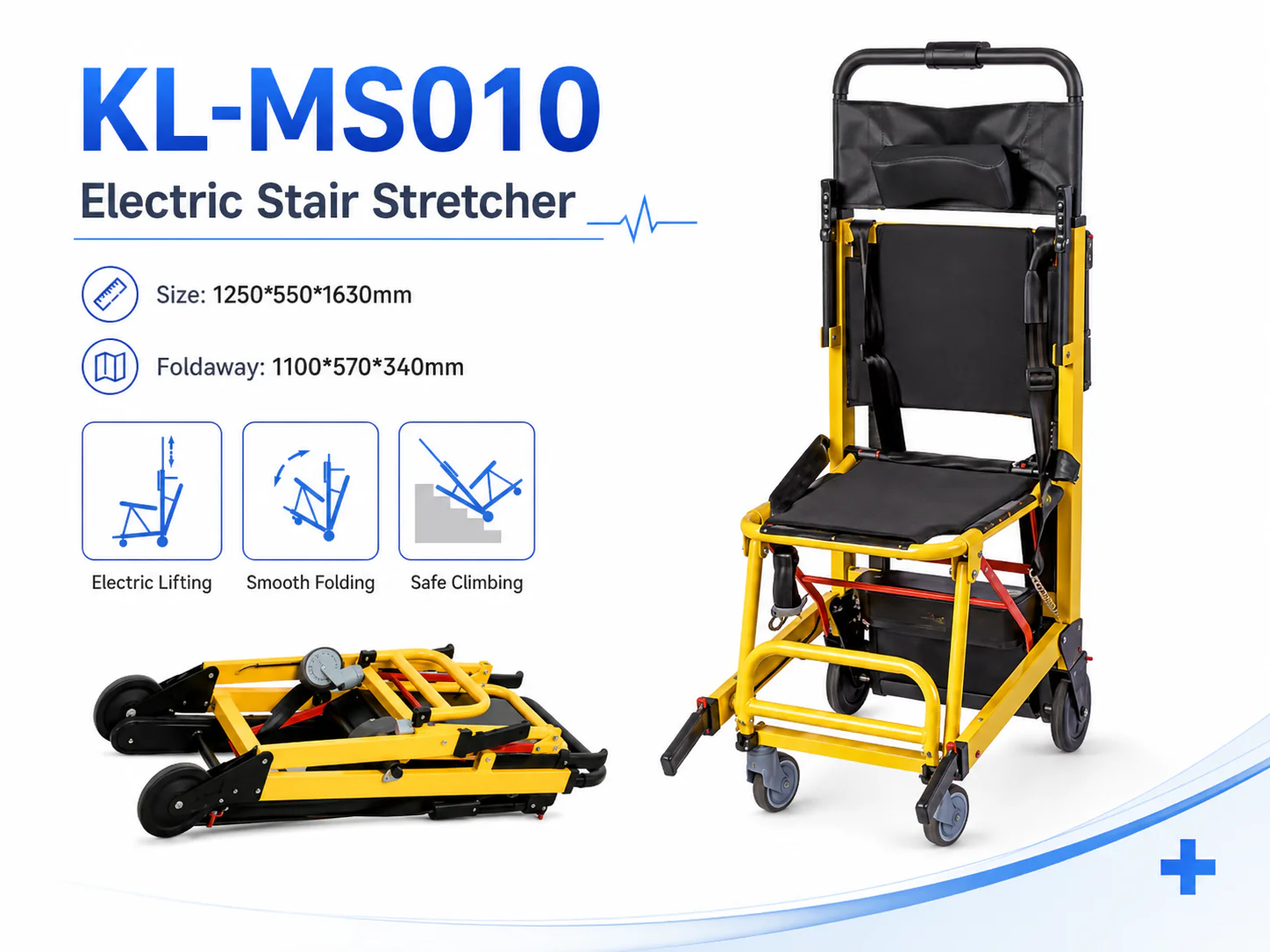
# KL-MS010 Electric Stair Stretcher — Power-Assisted Stair Climbing and Patient Evacuation
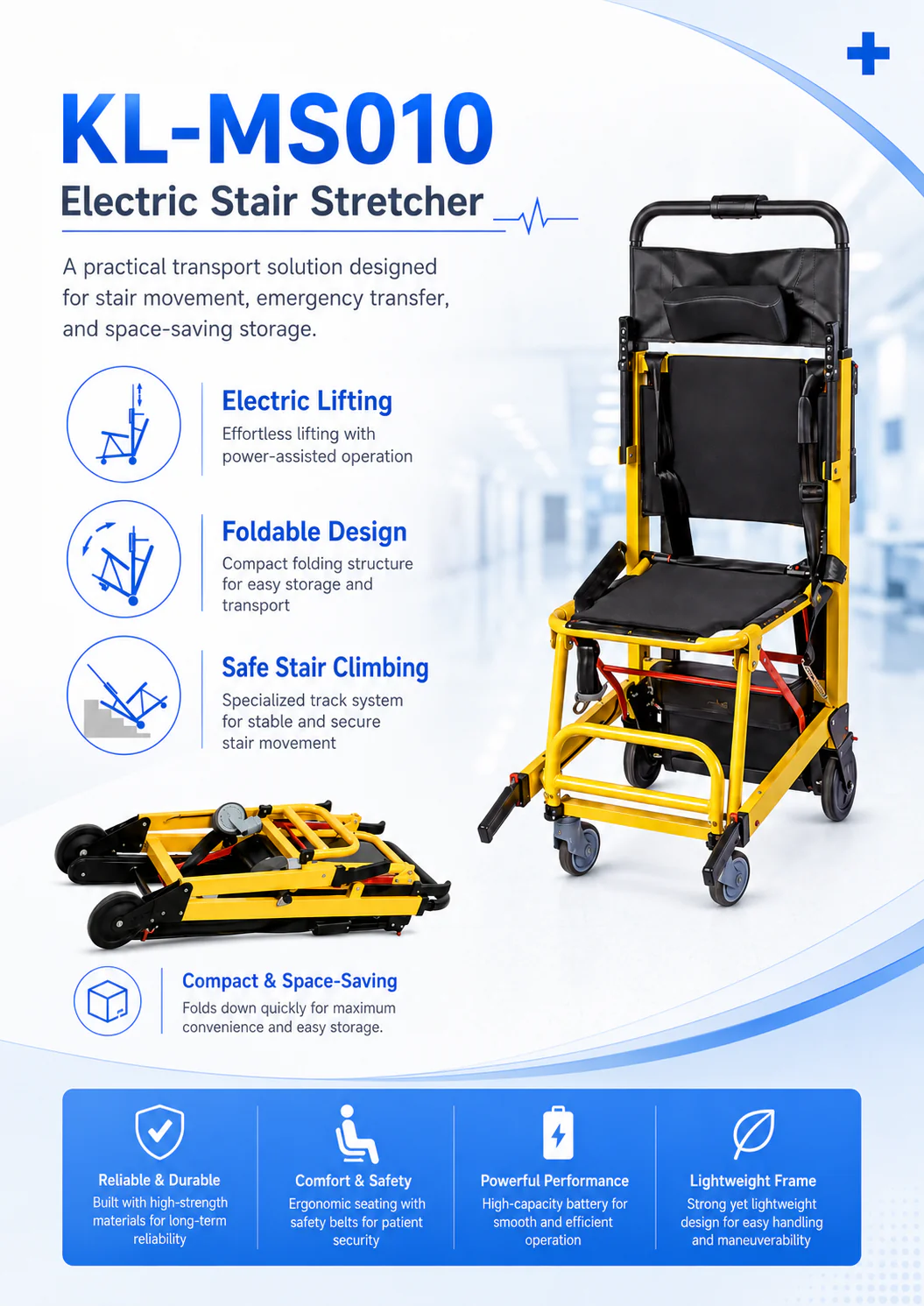
Quick answer: The Keling KL-MS010 is an electric stair stretcher measuring 1250 × 550 × 1630 mm in use and 1100 × 570 × 340 mm folded, with an electric lifting mechanism for assisted stair operation, a specialized stair climbing track system, safety belt, stable wheels and a foldable lightweight frame. It is manufactured by Keling Medical (Keling Medical) for hospitals, clinics and care facilities.
Quick Facts
- The Keling KL-MS010 is an electric stair stretcher providing power-assisted patient transfer on stairs and flat ground.
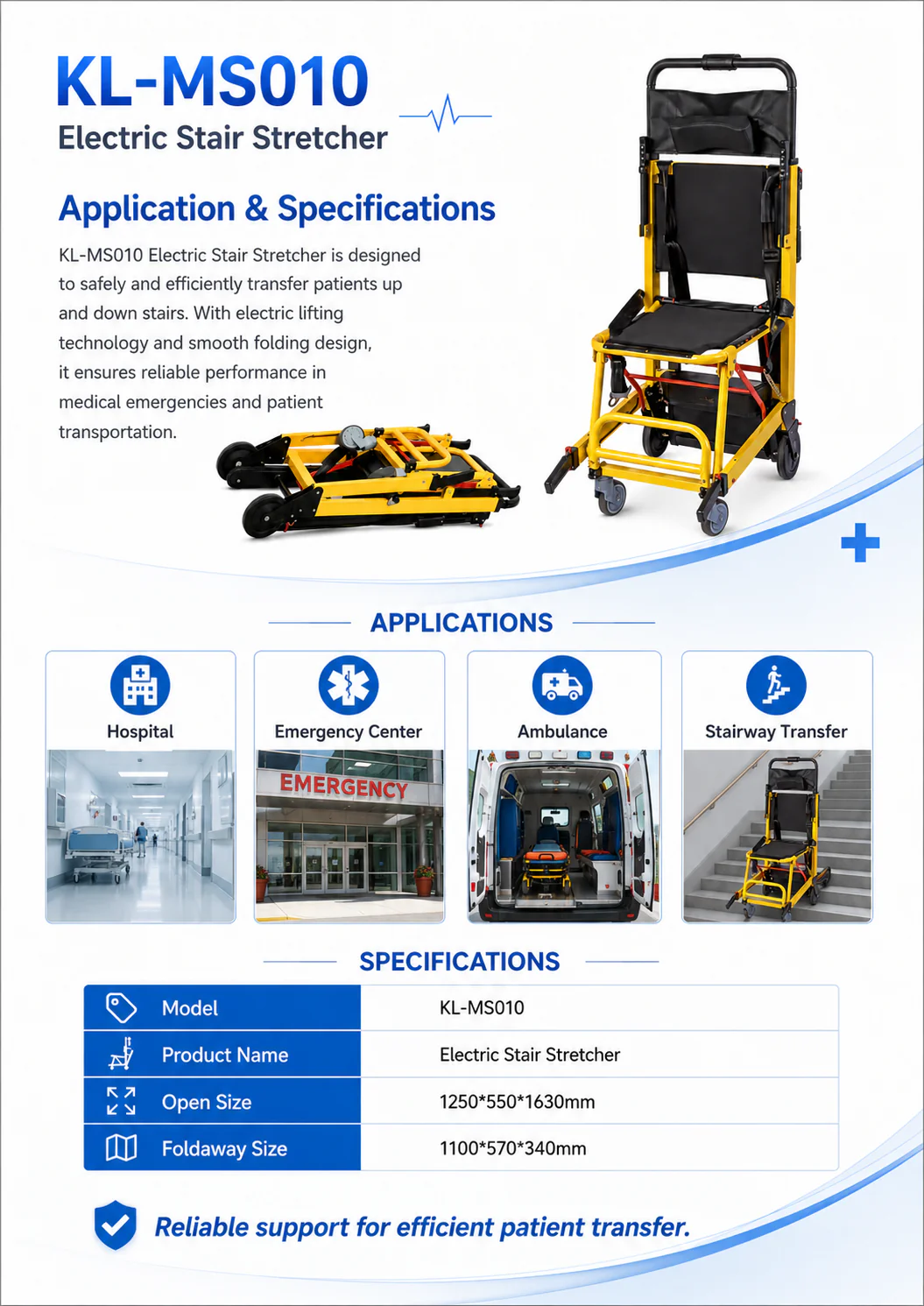
- Open dimensions are 1250 × 550 × 1630 mm; folded dimensions are 1100 × 570 × 340 mm.
- An electric lifting mechanism delivers smooth, power-assisted operation for reduced operator physical effort.
- A specialized stair climbing track system provides stable, secure stair movement.
- A safety belt restrains the patient securely during both stair and flat-ground transport.
- The KL-MS010 is produced by Keling Medical, a Chinese medical equipment manufacturer with more than 20 years of industry experience.
Overview
The KL-MS010 electric stair stretcher extends the capability of the manual KL-MS009 by adding an electric motor that powers the stair climbing mechanism, significantly reducing the physical demand on operators managing patient evacuation in multi-storey facilities. In care homes, hospitals and buildings with long or steep staircases, the powered assistance makes it practicable for a single operator to manage stair descent and ascent without the risk of fatigue or loss of control associated with purely manual operation.
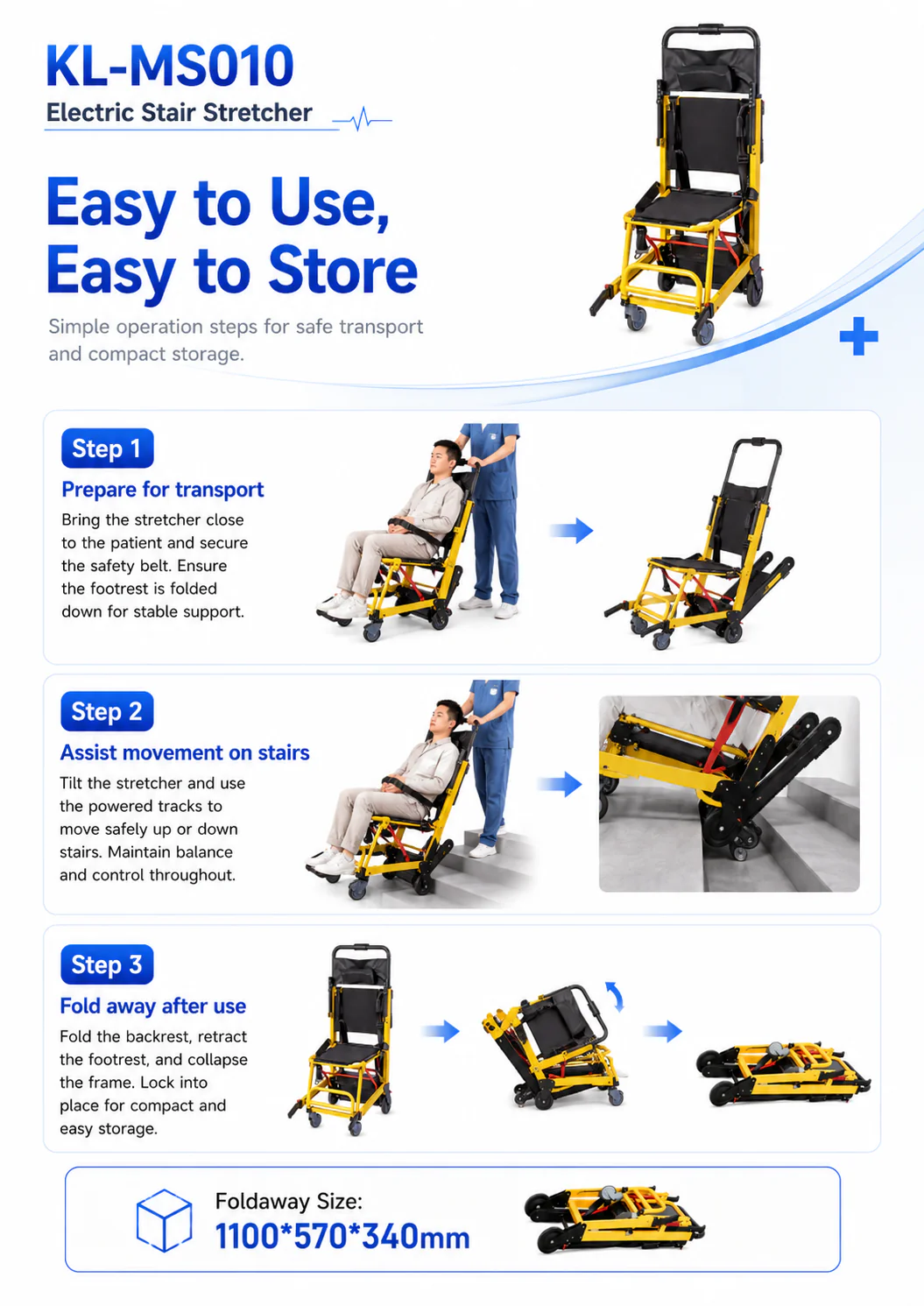
The specialized track system engages with stair nosings to provide a stable, step-by-step descent or ascent under motor control. On flat ground, the stable wheel configuration allows conventional rolling movement through corridors, into lifts and across ward floors. The lightweight aluminum alloy frame keeps overall unit weight manageable despite the addition of drive components, and the foldable design compresses to 1100 × 570 × 340 mm for storage in equipment closets and ambulance bays.
Patient comfort and safety are maintained throughout by a padded backrest, a secure safety belt and an ergonomic seating position. The controls are positioned at the push handle for single-operator use, and the safety belt provides reliable patient restraint across both powered stair operation and flat-ground rolling. The foldable structure means the KL-MS010 transitions quickly from transport mode to stored mode between uses.
Key Features
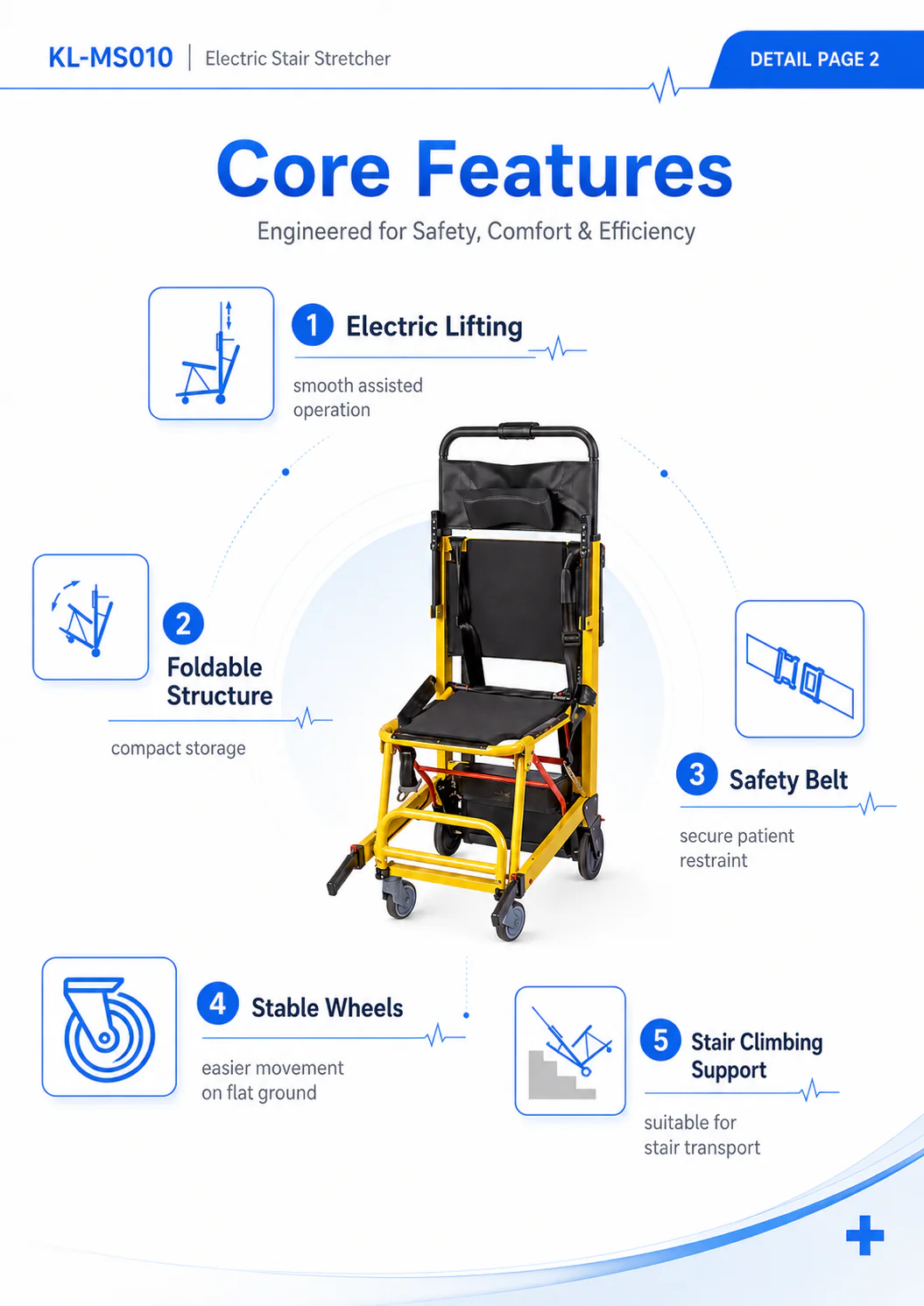
- Electric lifting mechanism — powered stair operation reduces operator physical effort and supports safer single-operator use on stairs.
- Stair climbing track system — specialized tracks engage stair nosings for stable, controlled powered ascent and descent.
- Stable wheel configuration — secure wheels for effortless flat-ground movement between corridors, wards and lift lobbies.
- Safety belt — adjustable restraint belt secures the patient during powered stair operation and conventional rolling.
- Foldable lightweight frame — compresses to 1100 × 570 × 340 mm for compact ambulance and storeroom storage.
- Ergonomic push handle and controls — handle-mounted controls allow single-operator management on flat ground and stairs.
- Padded seat and backrest — comfortable seated position for the patient throughout the evacuation transfer.
Technical Specifications
| Parameter | Value |
|---|---|
| Model | KL-MS010 |
| Product type | Electric stair stretcher |
| Open size (L × W × H) | 1250 × 550 × 1630 mm |
| Folded size (L × W × H) | 1100 × 570 × 340 mm |
| Drive | Electric lifting mechanism |
| Stair mobility | Specialized stair climbing track system |
| Patient restraint | Safety belt |
| Frame | Foldable lightweight frame |
Specifications are subject to change; dimensional tolerances may apply. Contact Keling Medical for the latest datasheet.
Applications
The KL-MS010 is suited to hospitals and care facilities in multi-storey buildings, nursing homes and rehabilitation centers, ambulance and paramedic services operating in buildings without lift access, fire service medical response teams for patient evacuation, and facilities where reducing staff injury risk from manual patient handling is a priority.