Clinical guides
Crash cart checklist: code cart medications, contents and daily checks
A practical crash cart checklist: code cart medications and their uses, drawer-by-drawer contents, pediatric cart differences, locks and how often to check.

A crash cart checklist lists the code cart medications, airway, breathing and circulation supplies, and the defibrillator checks a resuscitation cart must pass before it can be trusted in an arrest. In practice it has two parts: a short daily or per-shift check (seal intact, defibrillator ready, oxygen full) and a full monthly inventory against the hospital-approved contents list.
This guide gives a drawer-by-drawer template, the common crash cart drugs and what they are used for, pediatric differences, and the cart features that make checking faster. It is educational and written for trained staff and the people who buy and set up the carts. Always follow your own resuscitation committee, pharmacy formulary, local protocols and the device manufacturers' instructions for use.
For choosing the trolley itself (ABS vs stainless steel, drawer count, accessories), see our crash cart configuration guide.
What is a crash cart?
A crash cart (also called a code cart, crash trolley, emergency cart or resuscitation trolley) is a mobile cabinet on wheels with drawers that holds everything a team needs in the first minutes of a cardiac or respiratory arrest. It is kept sealed, stocked to a fixed list and parked in a known location on each unit.
What makes it different from an ordinary medical cart on wheels with drawers is standardization: the same items in the same drawer in the same order, so any nurse or physician from any ward can find them under pressure.
Code cart medications and their uses
The table below lists the crash cart drugs most hospitals stock, grouped by purpose. It is a reference for building a checklist, not a dosing guide: quantities, concentrations and the final list are decided by your pharmacy and resuscitation committee in line with current resuscitation guidelines.
| Medication (generic) | Typical use in a code | Notes for the checklist |
|---|---|---|
| Epinephrine (adrenaline) | Cardiac arrest, severe anaphylaxis, bradycardia | Usually several prefilled syringes; check concentration on the label |
| Amiodarone | Shock-refractory VF/pulseless VT, some tachyarrhythmias | Some carts stock lidocaine as the alternative |
| Lidocaine | Alternative antiarrhythmic in VF/pVT | Prefilled syringe format is common |
| Atropine | Symptomatic bradycardia | Check expiry; often low turnover |
| Adenosine | Stable narrow-complex tachycardia (SVT) | Often stored with flush syringes |
| Sodium bicarbonate | Selected cases such as hyperkalemia or certain overdoses | Not routine in every arrest |
| Calcium chloride or gluconate | Hyperkalemia, hypocalcemia, calcium-channel-blocker toxicity | Two salts are not interchangeable mg for mg |
| Dextrose (concentration per policy) | Hypoglycemia | Pediatric carts use lower concentrations |
| Naloxone | Opioid overdose | High-use item; check stock after each use |
| Magnesium sulfate | Torsades de pointes, some other indications | Often in vials, not syringes |
| IV fluids (normal saline, balanced crystalloid) | Volume, line patency | Check bag integrity and expiry |
| Flush syringes | Line flush after each drug | Count, not just presence |
Many hospitals add drugs for rapid sequence intubation, vasopressor infusions or antiemetics, but these are often kept in a separate RSI kit or the unit's automated dispensing cabinet. Controlled substances are generally kept out of the code cart.
Why the top drawer is for drugs
Placing emergency cart medications in the top drawer, in a fixed order and preferably in a divided insert, means the medication nurse can work without bending and the recorder can read labels at a glance. Prefilled syringes reduce drawing-up errors and save time.
Crash cart contents: a drawer-by-drawer template
Most five-drawer carts follow an airway, breathing, circulation layout. The exact crash cart contents vary, but this template covers the categories most code cart checklists include.
- Top of cart: defibrillator/monitor with pads, cables and paper; suction unit if not wall-mounted; CPR backboard (side mount); sharps container; glove box.
- Drawer 1 – medications: the drug tray from the table above, plus flush syringes and alcohol swabs.
- Drawer 2 – airway: laryngoscope handles and blades in several sizes, spare batteries or bulbs, endotracheal tubes, stylets, oral and nasopharyngeal airways, supraglottic airways, lubricant, tube holder, end-tidal CO2 detector, Yankauer tips and suction catheters.
- Drawer 3 – breathing: bag-valve-mask devices with masks in several sizes, oxygen masks and nasal cannula, oxygen tubing, PEEP valve if used, nebulizer kit.
- Drawer 4 – circulation and IV access: IV cannulas in several gauges, intraosseous access device if stocked, giving sets, tourniquets, dressings, syringes and needles, blood sample tubes, pressure bag.
- Drawer 5 – procedures and bulk: IV fluid bags, central line or chest drain packs if policy requires, sterile gloves, gowns, spare defibrillator pads, documentation forms.
- Cart frame: oxygen cylinder in its holder with regulator, IV pole, waste bin.
If your hospital uses a separate airway or difficult-airway cart, keep the code cart airway drawer lean and reference the other cart on the checklist. For more on suction tips and tubing to stock, see Yankauer suction tips, canisters and tubing.
Crash cart checklist: daily and monthly checks
A good code cart checklist separates what must be checked often from what only needs checking when the seal is broken or a date is near. The table below is a template you can adapt into your own form.
| Check | Daily / each shift | Monthly (full) | After every use |
|---|---|---|---|
| Seal intact and number matches log | Yes | Yes | Replace with new numbered seal |
| Cart in its marked location, unobstructed | Yes | Yes | Yes |
| Defibrillator self-test or manual check passed, charged and plugged in | Yes | Yes | Yes |
| Defibrillator pads (adult/pediatric) present and in date | Visual | Yes | Yes |
| Oxygen cylinder pressure above minimum | Yes | Yes | Yes |
| Suction working, canister and tubing present | Yes | Yes | Yes |
| Drug tray complete, earliest expiry recorded | – | Yes | Yes |
| All drawers checked against master list | – | Yes | Yes |
| Laryngoscope lights working | – | Yes | Yes |
| Cart clean, castors and brakes working | – | Yes | Yes |
| Check signed and dated | Yes | Yes | Yes |
How often should a crash cart be checked?
The common pattern is a quick check every day (or every shift in high-acuity areas), a full inventory and expiry review at least monthly, and a full restock after every opening. Recording the earliest expiry date on the seal tag or log lets staff schedule the next full check without opening the cart. The required frequency is set by your facility policy, accreditation body and the defibrillator manufacturer.
Pediatric crash cart: what changes
A pediatric crash cart (peds crash cart or pediatric code cart) carries the same categories as an adult cart, but in a range of sizes from neonate to adolescent. The main differences:
- Organization by size band. Equipment is grouped by weight or length range into color-coded drawers or pouches, matched to a length-based resuscitation tape, so staff pick a color instead of calculating sizes.
- Drug concentrations and dosing aids. Pediatric carts use lower-concentration products where appropriate and a weight-based dosing reference approved by pharmacy.
- Airway range. Smaller blades, cuffed and uncuffed tubes per policy, and infant masks.
- Defibrillation. Pediatric pads or an energy attenuator compatible with the defibrillator in use.
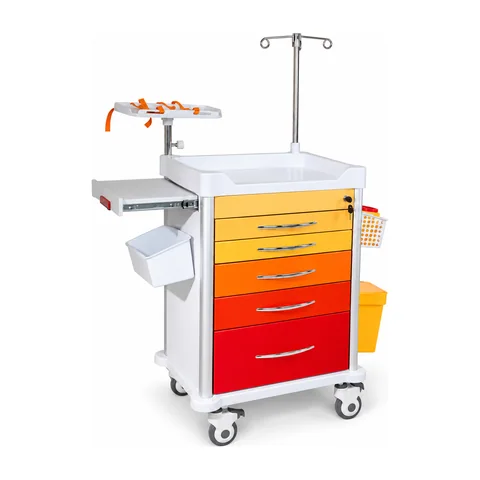
Because a pediatric cart needs more, smaller compartments, a cart with six or more drawers and dividers suits it well. Keling's KL-TC001 Emergency Trolley is a six-drawer crash cart with color-coded drawers and a centralized locking system, a layout that maps naturally to color-zone systems. Emergency departments that see both age groups often keep separate adult and pediatric carts rather than one mixed cart.
Crash cart locks, seals and drawers
Most hospitals secure the code cart with a numbered breakaway seal: it opens instantly in an arrest, and a broken or wrong-numbered seal tells the next person the cart needs checking. A central lock that secures all drawers at once is common in public or low-supervision areas. If you use a key, keep it attached to the cart or on a breakaway clip so it never delays a code.
Hardware that helps the checklist:
- Seal points on the drawer bank, positioned so one seal covers every drawer
- Clear drawer labels (front and inside), matching the checklist order
- Drawer dividers or removable trays so every item has a fixed slot and gaps are obvious
- A defibrillator shelf with a rim or strap, at a height where the screen is readable
- An oxygen cylinder holder, IV pole and CPR board bracket
- 360-degree castors with at least two brakes, and a bumper
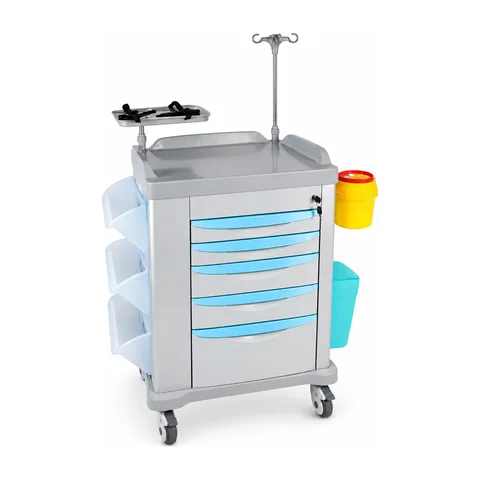
Keling's KL-TC020 Emergency Trolley is a five-drawer crash cart with central lock, stainless steel top working tray, IV pole and integrated sharps holder, while the KL-TC023 Emergency Trolley adds three transparent side storage bins for quick visual checks.
Setting up a crash cart for consistent checks
Crash cart setup decides how hard the checklist is to follow. A few rules hospitals use:
- One master list, one layout, every unit. Specialist areas add a supplementary drawer, not a different layout.
- Photograph each drawer and attach the photo to the master list so checkers compare against an image.
- Stock by count, not by "some". "4 × size 7.0 ET tubes" is checkable; "ET tubes" is not.
- Use a restock pack from pharmacy or central supply for the drug tray, sealed and with its own expiry label.
- Record the seal number and earliest expiry date on a tag visible without opening the cart.
If you are equipping a new unit, our ICU equipment list and hospital equipment list show where the code cart fits among the other room equipment.
What to specify when buying crash carts
Procurement teams can make checks easier by writing them into the tender. Include:
- Cart material (ABS or stainless steel) and color
- Number of drawers, drawer heights and the internal dimensions of each drawer
- Removable dividers or trays for the medication drawer
- Seal provision and/or central lock; number of keys supplied
- Defibrillator shelf size and load, with restraint
- Accessories: IV pole, oxygen cylinder holder, CPR board bracket, sharps holder, waste bin, side shelf
- Castor diameter, brakes and bumper
- Overall dimensions to fit lifts, door frames and the parking bay
- Spare parts list and cleaning instructions compatible with your disinfectants
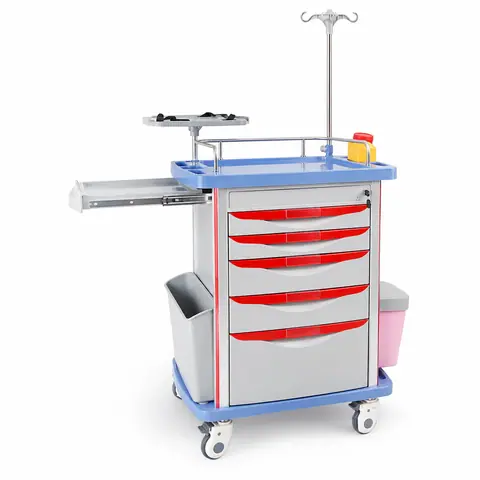
Ask the manufacturer for its ISO 13485 certificate and the registration or conformity documents that apply to the model and the destination country. Keling Medical is ISO 13485:2016 certified (SGS) and supplies emergency trolleys with five or six drawers, such as the KL-TC003 Emergency Trolley with its side pull-out shelf and integrated waste bins, as part of a 97-model medical trolley range.
Next steps
A crash cart checklist only works if the cart, the drawer layout and the contents list match on every unit. Agree the master list with pharmacy and the resuscitation committee, choose one cart model that fits it, and print the check log to match. To compare medication storage options for the rest of the ward, read our medication cart guide, or send your drawer layout and quantities and the export team will confirm the matching trolley configuration.
Frequently asked questions
What medications are in a crash cart?
Most adult crash carts hold epinephrine, amiodarone, lidocaine, atropine, adenosine, sodium bicarbonate, calcium chloride, dextrose, naloxone and magnesium sulfate, often as prefilled syringes. The exact list, concentrations and quantities come from the hospital's pharmacy and resuscitation committee, so two hospitals in the same city can stock slightly different carts.
How often should a crash cart be checked?
Common practice is a quick check every day or every shift, a full inventory and expiry review at least monthly, and a complete restock after every use. The quick check covers the seal number, defibrillator self-test, oxygen level and suction. Your facility policy and accreditation body set the binding frequency.
What is the difference between a crash cart and a code cart?
There is no practical difference. Crash cart, code cart, crash trolley, resuscitation trolley and emergency cart all describe the same mobile cabinet that holds the drugs and equipment for a cardiac or respiratory arrest. Usage varies by region: crash trolley and resuscitation trolley are more common in the UK and Commonwealth countries.
What is different about a pediatric code cart?
A pediatric code cart stocks equipment in several sizes, from neonate to adolescent, usually organized into color-coded drawers or pouches by weight or length band. It holds pediatric drug concentrations and a length-based resuscitation tape, and the defibrillator needs pediatric pads or an energy attenuator.
Should crash cart drugs be locked?
Most hospitals secure the cart with a numbered breakaway seal rather than a key, so it opens instantly in a code yet shows any tampering. Some use a central lock in public areas. Controlled substances are usually kept out of the code cart entirely and stored in the unit's locked medication system.
Can I use a crash cart checklist PDF from another hospital?
A published checklist is a useful starting template, but it must be matched to your own cart layout, formulary, defibrillator model and local protocols. Have pharmacy and the resuscitation committee approve the final version, then print it as a laminated card and a dated check log.