Buying guides
Geri chairs and medical recliners: a buyer's guide for care facilities
What a geri chair is, how it differs from a hospital recliner, bariatric chair or sleeper chair, and what to specify: recline, casters, upholstery and capacity.

A geri chair is a padded reclining chair on castors that lets frail, elderly or immobile patients sit out of bed safely, with the back and leg rest adjustable and often a removable tray. Facilities choose between geri chairs, hospital recliners, bariatric chairs and sleeper chairs by user, load and use: positioning a resident for hours, treating a patient in a chair, or giving a visitor a bed.
This guide explains each type and what to put in a specification, for long-term care operators, hospital procurement teams and distributors.
What is a geri chair?
A geri chair (short for geriatric chair) is a positioning chair. It supports a person who cannot sit unaided in an ordinary chair, keeps them upright or semi-reclined for meals and activities, and lets caregivers move them without a transfer.
Typical features:
- Padded seat, back and arms, often with lateral support "wings" at the head.
- Recline from upright to a semi-reclined or near-flat position, manual or electric.
- Elevating leg rest linked to or independent from the back.
- Four large castors, usually 100–125 mm (4–5 in), with brakes on two or all four.
- Optional lap tray for meals and activities.
- Push handle at the back for the caregiver.
Some models add tilt-in-space, which rotates the whole seat backward, which redistributes pressure from the sacrum and helps residents who slide forward.
Geri chair vs hospital recliner vs other medical chairs
Medical recliners all look broadly similar, but they are built for different jobs. Specifying the wrong one is a common and expensive mistake.
| Chair type | Primary user | Key features | Typical setting |
|---|---|---|---|
| Geri chair (geriatric chair) | Frail or immobile resident | Recline, leg rest, tray, large castors | Long-term care, geriatric wards |
| Hospital recliner chair | Inpatient sitting out of bed | Recline, leg rest, sometimes mobile | General wards, post-op, maternity |
| Infusion / transfusion chair | Patient receiving treatment | Recline, arm boards, IV pole | Day units, oncology, blood draw |
| Dialysis chair | Dialysis patient for several hours | Electric multi-position, Trendelenburg | Dialysis centers |
| Bariatric chair | Patient with higher body weight | Wider seat, reinforced frame, high rated load | All of the above |
| Sleeper chair / chair bed | Family member or visitor | Opens into a bed surface | Patient rooms, pediatric wards |
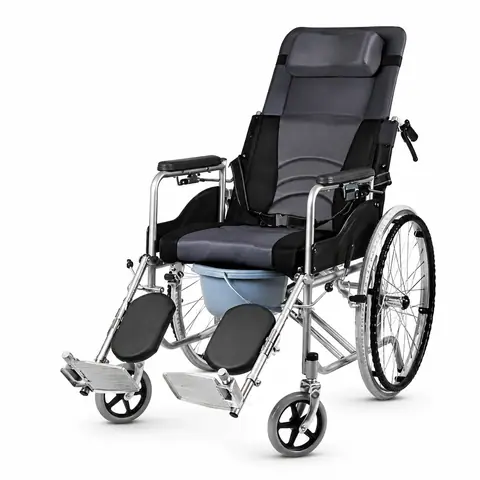
| Reclining wheelchair | Patient who must recline and travel | Large wheels, reclining back | Transport, rehabilitation |
For treatment-chair specifics, see our guide to infusion, dialysis and blood-draw chairs. Keling's KL-ZY005 Transfusion Chair transfusion chair, with an adjustable backrest, foldable footrest and integrated IV pole, and the KL-ZY007 Electric Dialysis Chair electric dialysis chair, which reclines from 1000 × 600 × 1300 mm seated to 1880 mm long, belong in that treatment-chair group.
Geri chair recliner mechanisms: manual or electric?
Manual geri chairs recline with a lever and gas spring or a ratchet. They are simpler, cheaper and work without power, but the caregiver does the work and positions are less precise.
Electric medical recliner chairs use one or two motors controlled by a handset, so the back, leg rest and sometimes seat tilt move independently. They suit residents who are repositioned often and reduce caregiver strain. They need charging or a socket, and the electrical part falls under medical electrical safety requirements; ask the supplier which standard the chair has been tested to and request the test report.
A medical recliner lift chair, which tilts forward to help a user stand, is mainly a home-care product. In clinical settings, staff usually prefer a stable chair plus a separate transfer aid or patient lift for residents who cannot stand safely.
Bariatric chairs and bariatric geri chairs
A bariatric chair is reinforced and wider so it can safely support a heavier patient. Bariatric chairs are commonly rated for around 225–450 kg (500–1,000 lb), with seat widths from about 610 mm (24 in) to 760 mm (30 in) or more.
What to check:
- Rated load for the whole chair, in every position, including fully reclined with the leg rest up.
- Seat width and depth measured between the armrests, not the overall width.
- Seat height that lets the user's feet rest flat on the floor for safe standing.
- Sturdy arms for pushing up; bariatric chairs with arms are standard for that reason.
- Overall width against doors and lifts. An extra wide bariatric chair may not pass a 900 mm door.
Bariatric seating is also needed in waiting areas and offices; our guide to hospital waiting room chairs covers that side.
Safety: falls, pressure injuries and restraint
Prolonged sitting carries real clinical risks. Procurement cannot solve them, but the right chair makes good practice easier.
- Pressure injuries. A resident who sits for hours needs pressure-redistributing cushioning and regular repositioning. Tilt-in-space and recline help offload the sacrum and ischial areas. Follow the care plan and local pressure-injury protocols.
- Sliding and falls. A seat that is too deep or too high causes residents to slide forward. Measure the users: seat depth should leave a few fingers' gap behind the knee.
- Brakes. Lock the castors whenever the chair is stationary, especially during transfers.
- Restraint. A geri chair with a tray, or a recline the resident cannot release, can count as a physical restraint under many regulations and care standards. Use trays within the facility's restraint policy and document the clinical reason.
Upholstery, cleaning and fire performance
Medical recliners are sat in for hours, often by incontinent or unwell patients, so the upholstery decides how long the chair lasts.
- Fluid-proof vinyl or PU with sealed or welded seams; avoid stitched seams on the seat deck where fluid can enter.
- Removable cushions with zip-off covers for laundering or replacement.
- Crevice-free design: a gap between seat and back for cleaning access, or a sealed junction.
- Disinfectant compatibility: ask which chlorine, alcohol and quaternary products the cover tolerates.
- Fire performance: upholstered furniture in public buildings must meet local flammability rules, for example California TB 133 for contract seating in some US occupancies, BS 7176 with BS 5852 tests in the UK, or EN 1021-1 and EN 1021-2 cigarette and match tests in Europe. Ask for the test report that applies to your market.
Hospital sleeper chairs, chair beds and sofa beds
Patient rooms increasingly include a chair that opens into a bed for a family member. These hospital chair beds (also sold as hospital sleeper chairs or, in larger rooms, hospital sofa beds) are built for visitors, so they emphasize compact footprint, quick conversion and wipe-clean surfaces.
Keling's KL-ZY004 Attendant Chair attendant chair converts from 640 × 720 × 940 mm as a chair to a 640 × 1900 × 420 mm rest bed. The KL-ZY009 Companion Chair companion chair extends to an 830 × 2000 mm rest surface and uses waterproof, easy-clean PU upholstery. For private rooms there is also the KL-ZY006 Luxury Attendant Chair luxury attendant chair with wood-finish armrests.
When specifying, check the folded footprint against the room plan, the length of the bed surface, the locking of the conversion mechanism and whether the castors lock.
Geri chairs for home use
Families looking for the best sleeping recliner for an elderly person often need something between a living-room recliner and a hospital chair. A geri chair or medical recliner for home is worth considering when the person cannot sit safely in a standard armchair, needs regular repositioning or must be moved from room to room.
Before buying, measure door widths, turning space and floor surfaces, and ask the person's clinician or occupational therapist about recline angle, seat size and cushion type. Where the person also needs to go outdoors or to appointments, a reclining wheelchair such as the KL-LY006 Reclining Wheelchair, with a backrest adjustable from 90° to 180°, may cover both needs; see our overview of types of wheelchairs.
What to specify when buying medical recliners
For a tender or project order, write down the use first, then measurable requirements:
- Chair type and users: geri chair, hospital recliner, treatment chair, bariatric chair or sleeper chair.
- Rated load for the complete chair in all positions, in kg and lb.
- Seat dimensions: width between arms, depth, height from floor.
- Recline: manual or electric, back angle range, leg rest, tilt-in-space, Trendelenburg.
- Mobility: castor diameter, number with brakes, central locking, push handle.
- Accessories: tray, IV pole, side table, head pillow, side wings.
- Upholstery: material, color, seam type, removable covers, disinfectant list, fire test report.
- Overall dimensions upright and fully reclined, against doors and room layouts.
- Documents: factory quality certificate, instructions for use, electrical safety report for powered chairs, spare-parts list and warranty terms.
Keling Medical manufactures its chairs at an ISO 13485:2016-certified factory and supplies hospitals, contractors and distributors with project and OEM orders. Ask for the documents that apply to the model and your destination country.
Next steps
Define who sits in the chair, for how long and for what, and the right category follows: geri chair, recliner, treatment chair, bariatric chair or sleeper chair. Browse the hospital furniture range for attendant, transfusion and dialysis chairs, then request a quotation with your quantities, upholstery colors and destination, and the export team will confirm configuration and lead time.
Frequently asked questions
What is a geri chair used for?
A geri chair, or geriatric chair, lets an older or immobile person sit out of bed comfortably and safely for long periods. It reclines, often has an elevating leg rest and sometimes a removable tray, and rolls on large castors so staff can move the resident between room, lounge and dining area. It supports positioning and social contact rather than independent mobility.
What is the difference between a geri chair and a wheelchair?
A wheelchair is designed for mobility: it has large rear wheels the user can push, or a motor, and it folds or packs for transport. A geri chair is designed for prolonged seating and positioning: it is heavier, more padded, reclines further and rolls on four castors pushed by a caregiver. A reclining wheelchair sits between the two.
How much weight can a bariatric chair hold?
Bariatric chairs are commonly rated for about 225 kg (500 lb) at the lower end and up to roughly 450 kg (1,000 lb) for heavy-duty models. Always check the stated safe working load for the complete chair in every position, including reclined and with the leg rest raised, because the recline mechanism can be the weakest point.
Can a geri chair be used at home?
Yes. Geri chairs for home use help families care for someone who cannot sit safely in an ordinary armchair. Measure door widths and turning space first, since many geri chairs are 650–750 mm (26–30 in) wide, and ask the person's clinician or occupational therapist which recline and cushion type suit their posture and skin condition.
Is a geri chair with a tray considered a restraint?
It can be. If a lap tray or a reclined position prevents a resident from getting up and they cannot remove or release it themselves, many regulators and care standards treat it as a physical restraint. Facilities should use trays only within their restraint policy, document the reason in the care plan, and review it regularly.
What is a hospital sleeper chair?
A hospital sleeper chair, sometimes called a hospital chair bed, is a chair that opens into a flat or nearly flat surface so a family member can stay overnight beside the patient. It is built for visitors rather than patients, so it emphasizes compact storage, wipe-clean upholstery and easy conversion rather than clinical positioning.
How much does a hospital recliner chair cost?
Prices vary widely with mechanism, size and upholstery. Manual geri chairs and basic recliners sit at the lower end, while electric multi-position recliners and bariatric models cost several times more. For project orders, ask for a quotation per configuration and include freight, spare parts and upholstery color, since these change the total more than the list price.