Buying guides
Types of wheelchairs: manual, lightweight, reclining and more explained
Types of wheelchairs compared: standard, lightweight, ultralight, transport, reclining, bariatric, pediatric and electric, with sizes and a buyer's checklist.

A wheelchair is a wheeled seat that provides mobility for someone who cannot walk, or cannot walk safely or far. The main types of wheelchairs are standard manual, lightweight and ultralight, transport chairs, reclining and tilt-in-space, bariatric, pediatric, sport and electric models. The right type depends on who propels it, how long the user sits and where it will be used.
This guide explains each category, gives typical sizes and weights, and ends with a checklist that hospital buyers and distributors can drop into a specification.
What are the main types of wheelchairs?
Most catalogs group wheelchairs by how they are propelled and how much postural support they give. The table below is a quick map of the categories of wheelchairs you will see in hospital, home-care and distributor ranges.
| Type | Propelled by | Typical frame | Typical weight | Main use |
|---|---|---|---|---|
| Standard manual wheelchair | User or attendant | Chrome-plated steel, folding | 16–20 kg (35–45 lb) | Hospital wards, short-term use, general stock |
| Lightweight wheelchair | User or attendant | Aluminum or light steel, folding | about 13–16 kg (28–36 lb) | Daily self-propelling, home care, travel |
| Ultra lightweight wheelchair | User | Aluminum or titanium, often rigid | under about 13.6 kg (30 lb) | Active full-time users |
| Transport chair | Attendant only | Aluminum or steel, small rear wheels | about 9–14 kg (20–30 lb) | Escort duty, outings, airports |
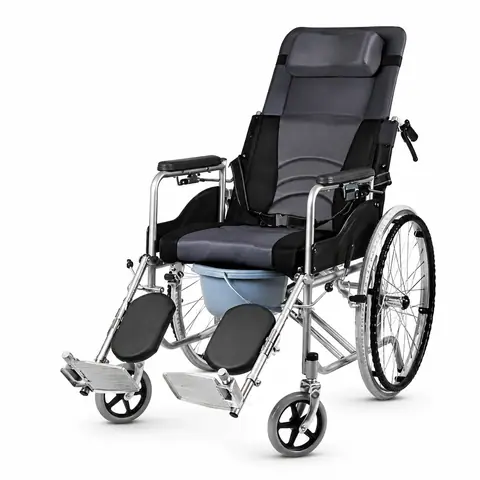
| Reclining / high back wheelchair | Attendant mostly | Steel, reinforced back | heavier than standard | Long sitting, poor trunk control |
| Tilt-in-space / positioning | Attendant | Steel or aluminum | heavier than standard | Pressure management, complex postures |
| Bariatric / heavy duty wheelchair | User or attendant | Reinforced steel, wide seat | 20 kg+ (45 lb+) | Users above standard load ratings |
| Pediatric wheelchair | User or attendant | Scaled frame, adjustable | varies | Children, including cerebral palsy |
| Electric wheelchair | Motor, joystick | Steel or aluminum with batteries | 25 kg+ (55 lb+) | Users without arm strength or range |
Weights are indicative ranges seen across the market, not standard values; always compare the manufacturer's measured mass, which ISO 7176-5 defines how to measure.
Standard manual wheelchair
The standard wheelchair is the workhorse of hospitals and the most common regular wheelchair in general stock. It has a folding cross-brace frame, large 24 in (about 610 mm) rear wheels with push rims for self-propulsion, smaller front casters, fixed or removable armrests and swing-away footrests.
Typical adult seat sizes are about 460 mm (18 in) wide and 400–460 mm (16–18 in) deep. Narrow (16 in) and wide (20 in) seats are usually offered as options. Keling's KL-LY001 Manual Wheelchair is a standard manual wheelchair of this kind, with a chrome-plated frame and a 460 × 400 mm seat, while the KL-LY003 Manual Wheelchair uses a strong steel frame rated for 100 kg.
The trade-off is weight. A steel standard chair is robust and economical, which suits high-turnover hospital fleets, but it is tiring to push all day and heavy to lift into a car boot.
Lightweight, ultralight and foldable wheelchairs
A lightweight wheelchair reduces frame mass, usually with aluminum tubing. In the US market, "lightweight" generally means under about 16 kg (36 lb) and "ultralightweight" under about 13.6 kg (30 lb), although the exact definitions vary by payer and region.
Foldable wheelchairs use a cross-brace that collapses sideways so the chair narrows to roughly 250–350 mm for storage. Many lightweight folding wheelchairs for travelling also have quick-release rear wheels. The KL-LY002 Manual Wheelchair is a foldable manual wheelchair with elevating footrests and PP side guards, a practical choice for wards and home use where the chair is stored or transported often.
Ultra lightweight wheelchairs for active users are often rigid (non-folding) frames with adjustable axle position, camber and seat angle. They are configured to the individual, so they are less common in hospital fleets and more common through rehabilitation dealers.
Choose lightweight or portable wheelchairs when:
- the user self-propels over long distances
- a carer has to lift the chair into a vehicle repeatedly
- the chair is used for travel or outpatient visits
Transport chairs and hospital wheelchairs
A transport chair has small rear wheels (often around 300 mm / 12 in) and no push rims, so it must be pushed by an attendant. It is lighter and narrower than a self propelled wheelchair, which helps in tight corridors and lifts.
Hospitals use transport chairs for escort duty from admission, radiology and discharge. For a detailed comparison, see our guide on transport chair vs wheelchair.
High back and reclining wheelchairs
A high back wheelchair extends the backrest to shoulder or head height and normally adds a headrest. Reclining versions let the backrest drop back, often with elevating leg rests to keep the legs in line, so the user can rest or be repositioned without a transfer.
The KL-LY006 Reclining Wheelchair reclining wheelchair has a cushioned high back adjustable from 90° to 180°, 24 in rear wheels and an integrated commode opening, which is useful in long-term care where toileting transfers are difficult.
Tilt-in-space chairs rotate the whole seat and back together, keeping hip angle constant. Clinicians often prefer tilt for pressure redistribution and for users who slide forward in a reclined chair. Recline and tilt are not interchangeable; the prescriber should choose.
Heavy duty and bariatric wheelchairs
A heavy duty wheelchair has a reinforced frame and cross-brace, and bariatric wheelchairs add wider seats, commonly 560–760 mm (22–30 in). Load ratings typically start around 160 kg (350 lb) and can go considerably higher on purpose-built models.
Key checks for bariatric wheelchairs:
- rated load verified by strength and fatigue testing (ISO 7176-8)
- overall width against your door openings and lifts
- rear axle position for stability, since heavier users shift the center of gravity
- upholstery that will not sag or tear at the seat rails
Never "upgrade" a standard chair by adding a wider cushion; the frame rating is what matters.
Pediatric and cerebral palsy wheelchairs
Children need scaled seats, growth adjustment and, often, postural support. Pediatric positioning wheelchairs add tilt, recline, lateral supports, head supports and harnesses.
The KL-LY007 Pediatric Cerebral Palsy Wheelchair is a pediatric cerebral palsy wheelchair with tilt and recline functions and a 370 × 370 mm seat cushion. Pediatric seating should always be set up with a therapist, because poor positioning in a growing child can contribute to long-term postural problems.
Electric, sport and off-road wheelchairs
Powered chairs replace push rims with motors, batteries and a joystick. They suit users without the arm strength or endurance to self-propel. Our electric wheelchair guide covers folding, lightweight and all-terrain powered models in detail, including Keling's KL-LY004 Electric Wheelchair.
Sports chairs, including racing wheelchairs with long wheelbases and three wheels, are highly specialized and built to the athlete. Off-road wheelchairs use wide tires, suspension or even tracks for trails and beaches. These are niche categories that most hospitals and general distributors do not stock in volume.
How to choose the right wheelchair
Start from the user and the environment, then pick the type, then the size.
- Who propels it? User (self-propelled, larger rear wheels) or attendant (transport chair or attendant brakes).
- How long is the user seated? Short trips suit standard chairs; all-day sitting needs a proper cushion, back support and possibly tilt or recline.
- Body size and weight. Measure hip width and thigh length; add about 25 mm (1 in) to hip width for seat width. Confirm the rated load.
- Transfers. Removable or flip-up armrests and swing-away footrests make side transfers and hoist use easier.
- Environment. Door widths, lift sizes, ramps, outdoor terrain and car transport.
- Cleaning and infection control. Hospital wheelchairs should tolerate your disinfectants, with removable, wipe-clean upholstery.
For measurements such as seat height, overall width and turning space, see wheelchair dimensions and standard sizes.
What to put in a wheelchair specification
For hospital tenders and distributor orders, state the requirements rather than a model name. A typical spec sheet includes:
| Item | What to specify |
|---|---|
| Seat | Width, depth, seat-to-floor height, upholstery material |
| Rated load | kg and lb, with test evidence |
| Frame | Material, finish (chrome, powder coat), folding or rigid |
| Wheels | Rear wheel size, tire type (solid or pneumatic), caster size |
| Brakes | User brakes, attendant brakes if needed |
| Armrests | Fixed, removable or flip-up; full or desk length |
| Footrests | Fixed, swing-away, elevating; heel loops |
| Back | Standard, high back, reclining range, headrest |
| Packaging | Folded carton size, units per carton, assembly required |
| Documents | ISO 7176 test reports, ISO 13485 certificate, IFU, labeling, registration for the destination country |
ISO 7176 is the international series for wheelchair testing, covering static stability (Part 1), braking (Part 3), dimensions and mass (Part 5), and static, impact and fatigue strength (Part 8). Ask the manufacturer which parts were tested for the exact model you are buying.
For pricing ranges by category, see how much a wheelchair costs.
Next steps
Most facilities buy a core fleet of standard and transport chairs, then add reclining, bariatric and pediatric chairs for specific wards. Keling Medical manufactures manual, reclining, pediatric and electric wheelchairs alongside walkers, crutches and patient lifts, so one order can cover a ward's mobility needs. Browse the rehabilitation range or send a request for quotation with your quantities, seat sizes and destination country.
Frequently asked questions
What are the main types of wheelchairs?
The main types are standard manual wheelchairs, lightweight and ultralight self-propelled chairs, transport (attendant) chairs, reclining and tilt-in-space positioning chairs, bariatric heavy duty wheelchairs, pediatric chairs, sports chairs and electric wheelchairs. Each trades weight, adjustability and cost differently, so the right type depends on who propels the chair and for how long.
What is the difference between a standard and a lightweight wheelchair?
A standard wheelchair usually has a chrome-plated steel frame and weighs around 16–20 kg (35–45 lb). A lightweight wheelchair uses aluminum or a lighter steel frame and typically weighs under about 16 kg (36 lb). The lighter chair is easier to push and lift, but usually costs more per unit.
What type of wheelchair is best for elderly users?
For an older person who cannot self-propel far, a lightweight foldable wheelchair or a transport chair is often easiest for carers to push and load. If the person sits for many hours or has poor trunk control, a high back reclining wheelchair with head support is more appropriate. A therapist should assess seat size and posture.
How much weight can a standard wheelchair hold?
Standard adult manual wheelchairs are commonly rated around 100–136 kg (220–300 lb), depending on the model. Heavy duty and bariatric wheelchairs are reinforced and wider, with ratings that often start around 160 kg (350 lb) and go higher. Always check the rated load on the label and test report, not the brochure alone.
What is a high back wheelchair used for?
A high back wheelchair extends the backrest to support the upper back and head, usually with a headrest and often a reclining backrest. It is used for patients who tire quickly, have limited trunk or head control, or need to rest or be repositioned during long sitting periods in wards and long-term care.
Can a manual wheelchair be used in the shower?
A regular wheelchair should not be rolled into a shower, because upholstery, bearings and plated steel are not designed for repeated wetting. Use a dedicated shower wheelchair or rolling shower commode chair with a water-resistant frame, drain-friendly seat and locking casters instead.
What should a hospital put in a wheelchair tender?
A wheelchair tender should state seat width and depth, rated load, frame material and finish, folding mechanism, wheel and caster sizes, brake type, armrest and footrest options, upholstery cleanability, and required documents such as ISO 7176 test reports, ISO 13485 certification and destination-country registration.