Why the trolley type matters
Trolleys are often bought as a single line item, but a treatment trolley, an instrument trolley and a medicine trolley do very different jobs. Choosing the wrong type leads to supplies stored where staff cannot reach them, carts that cannot be disinfected as required, or equipment that will not fit through the doors of the area where it is used.
Keling’s catalogue lists 97 items in the Medical & Emergency Trolleys category. Grouping them by function is the fastest way to build a specification.
Emergency and anaesthesia trolleys
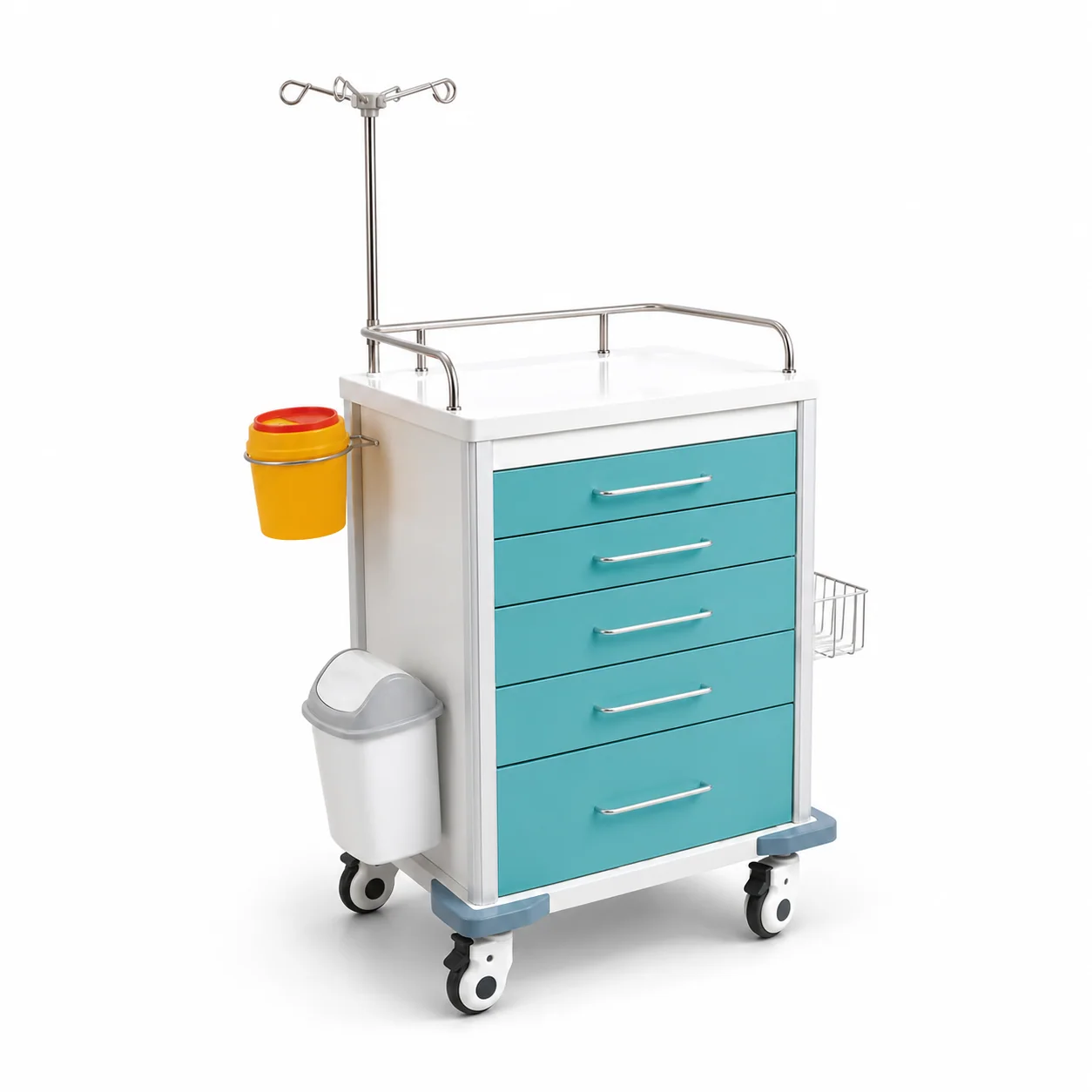
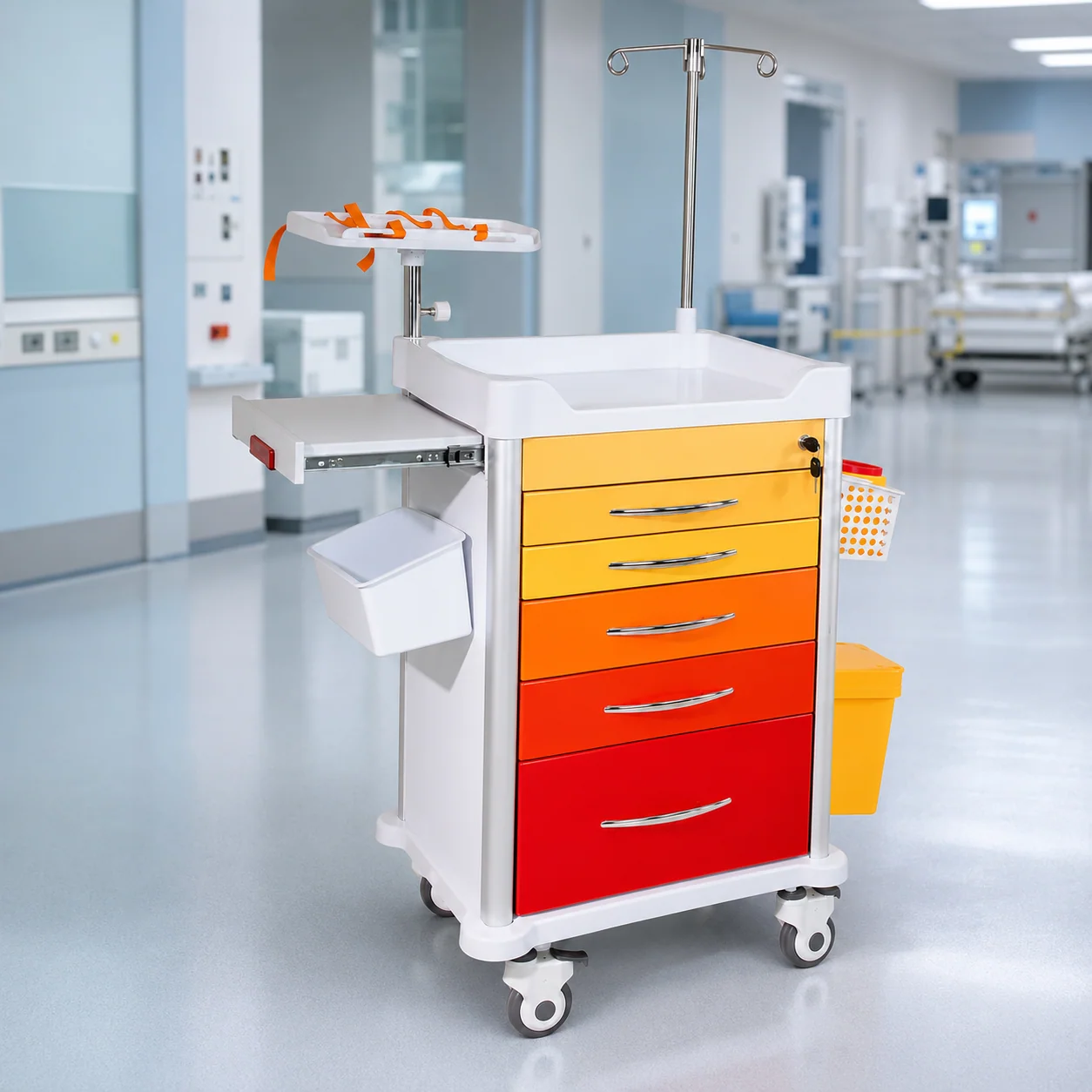
Emergency trolleys (crash carts) carry resuscitation supplies in a fixed drawer order and are usually locked or sealed between uses. Keling lists eight models, including the KL-TC001 with six colour-coded drawers and a centralised lock, and the KL-TC023 with five drawers, a stainless IV pole and three side bins. The crash cart buying guide compares them in detail.
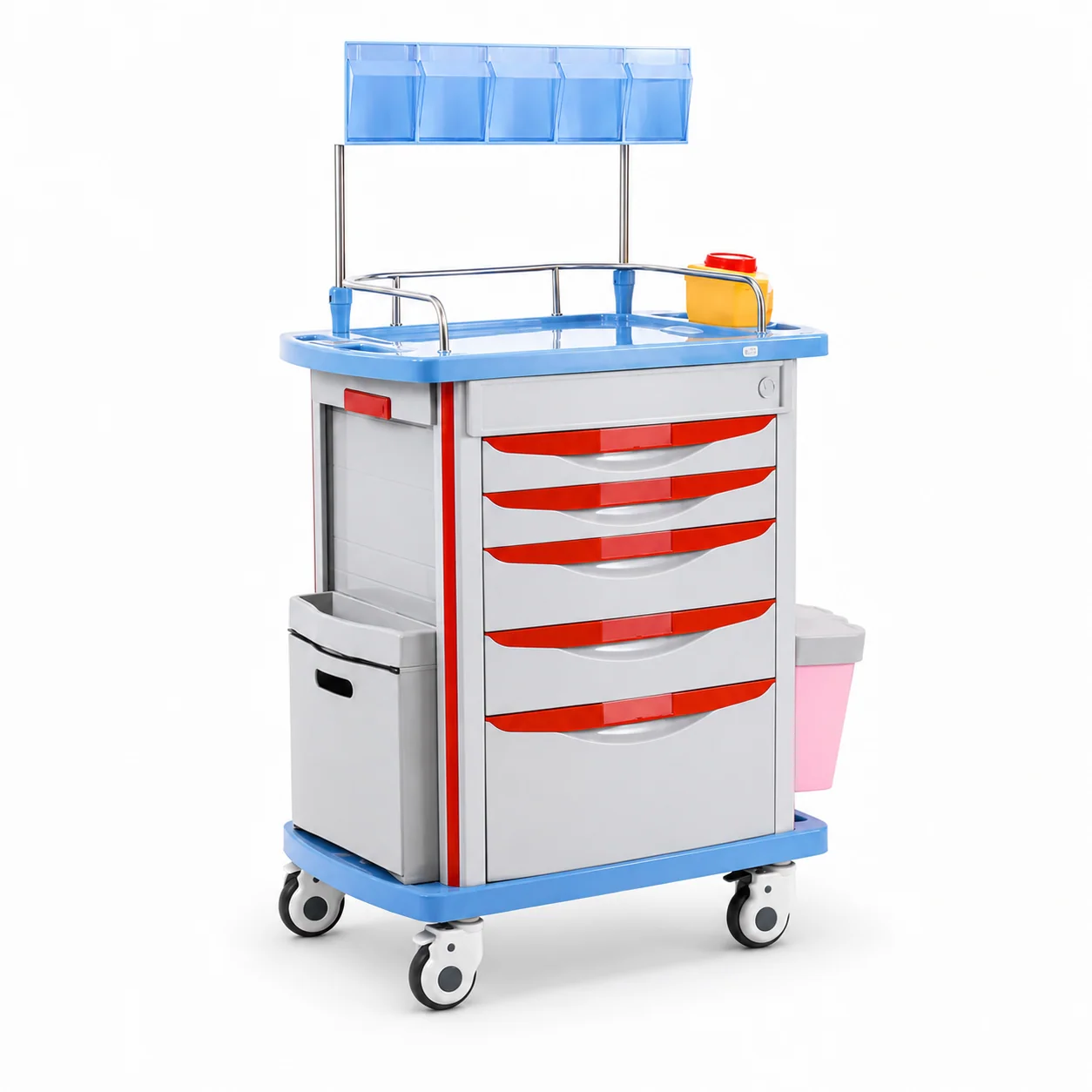
Anaesthesia trolleys hold drugs, airway items and consumables for theatres and induction rooms, with more small compartments than a crash cart. Examples include the KL-TC005 (classified drawers with upper organiser bins, two size options), the KL-TC009 (transparent top bins, lockable drawers and a double-door lower cabinet), the KL-TC021 (5 drawers, centralised lock) and the stainless steel KL-TC044 with a locking drawer and double-door cabinet.
Treatment, dressing and clinical trolleys
Treatment and clinical trolleys support routine ward and clinic procedures. They are chosen by drawer count, work surface and accessories. The seven clinical trolleys from KL-TC025 to KL-TC031 cover a range of drawer arrangements; the KL-TC025, for example, lists five drawers, a stainless steel guard rail top, an IV pole and a sharps container in a 660 × 470 × 980 mm footprint. Treatment trolleys include the KL-TC022 (2-drawer ABS ward cart) and the compact stainless KL-TC041 (460 × 460 × 860 mm).
Dressing trolleys are usually stainless steel and carry a basin and bucket for wound care. The KL-TC040 lists a drawer, a removable stainless basin and a hanging bucket; the KL-TC043 is a second dressing trolley option.
Instrument and Mayo trolleys for theatres
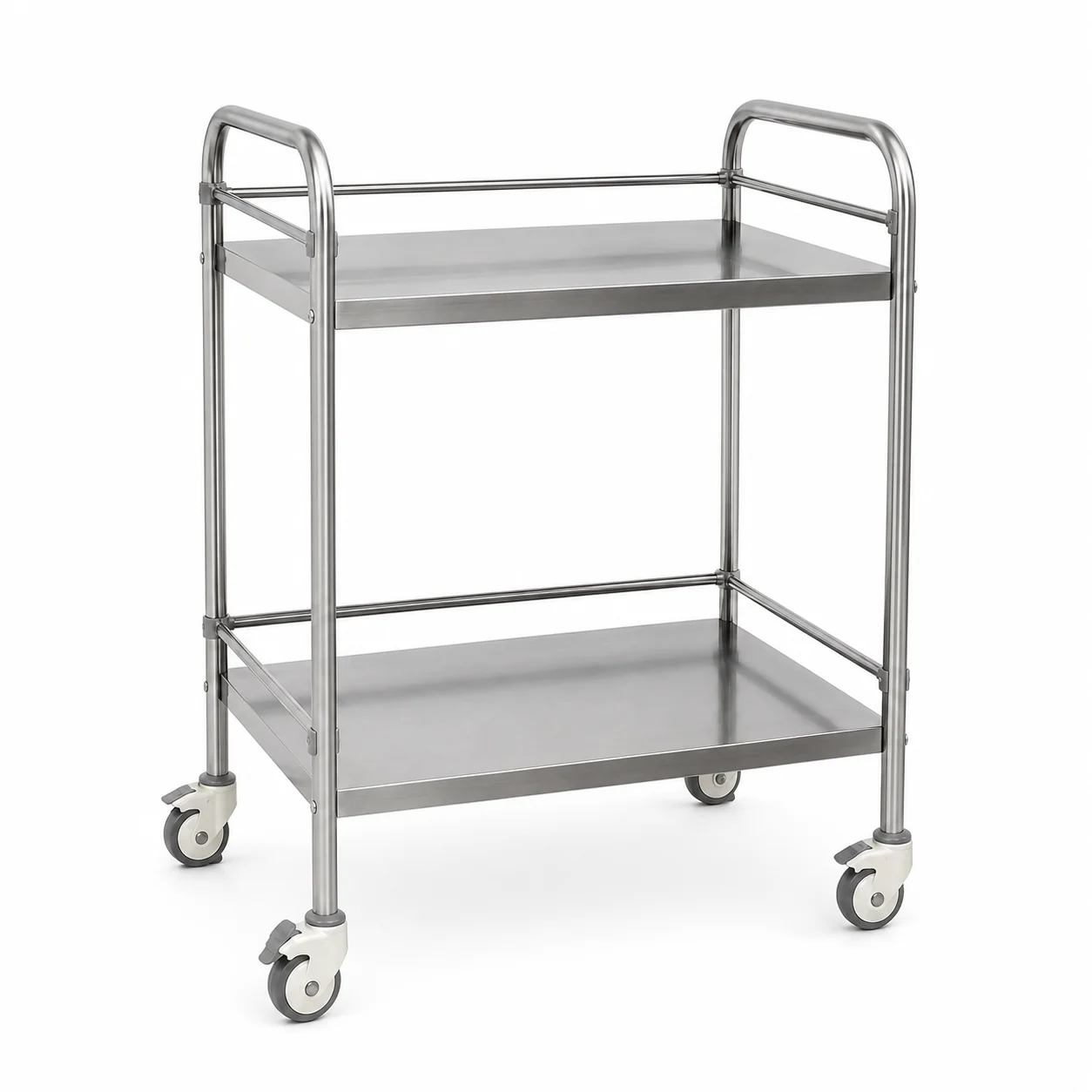
In operating rooms and CSSD areas, open stainless steel trolleys are preferred because they can be cleaned and disinfected thoroughly. Instrument trolleys such as the KL-TC036 (SUS304 stainless steel, two tiers, disassembly structure) and KL-TC037 carry instrument sets and supplies. Mayo trolleys are narrower and sit over the patient or beside the scrub nurse: the KL-TC048 lists two stainless instrument basins in a 340 × 400 mm footprint, and the KL-TC051 is an alternative.
Specify the steel grade if your tender requires it, and ask whether the trolley ships assembled or flat-packed, which affects freight volume.
Medicine, case history and nursing IT carts
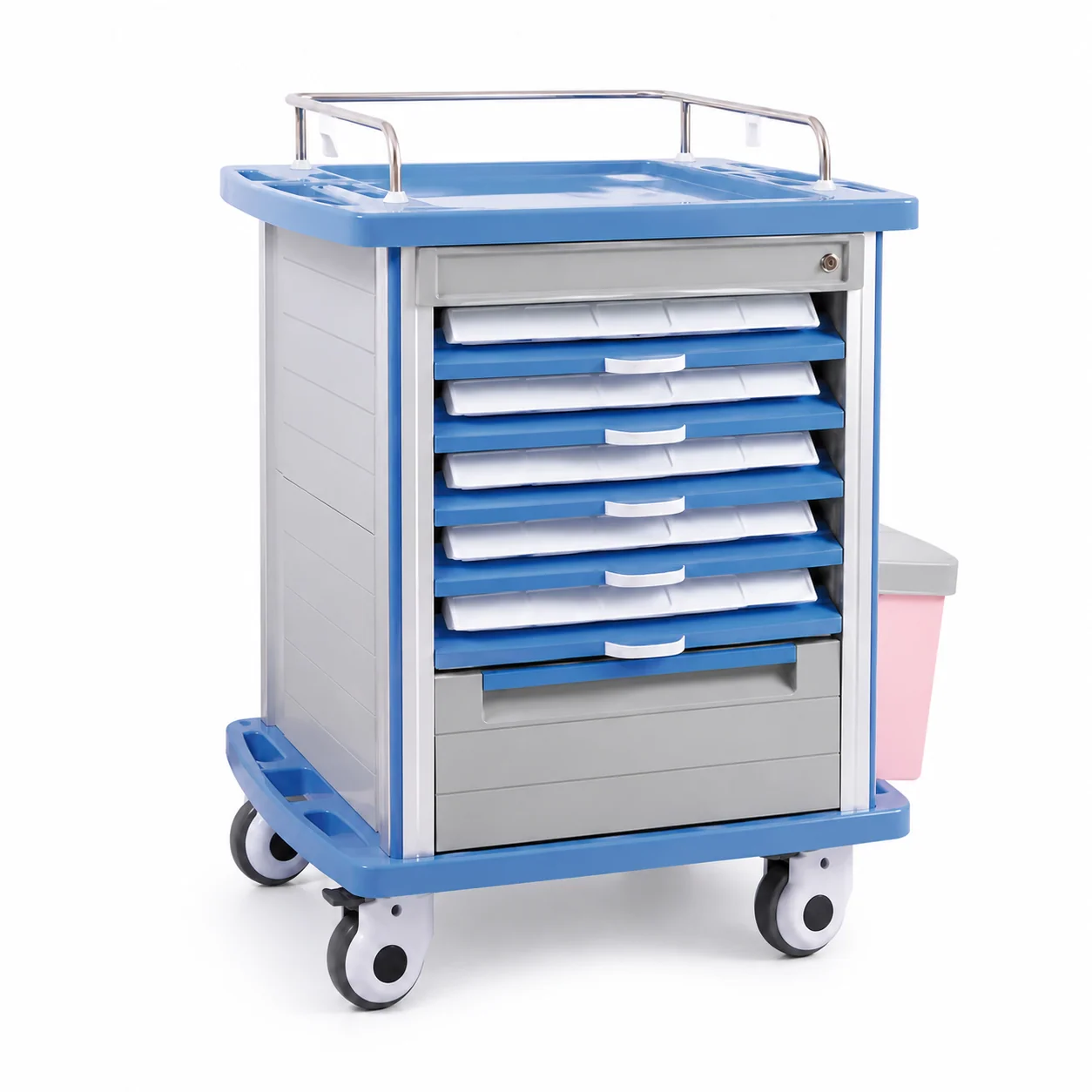
Medicine trolleys are used for ward medication rounds. The KL-TC006 is an 8-drawer ABS medication cart; the KL-TC011 combines three open shelves with a drawer and a stainless guardrail. If your ward uses unit-dose or patient-specific drawers, send the drawer plan so the supplier can confirm the layout.
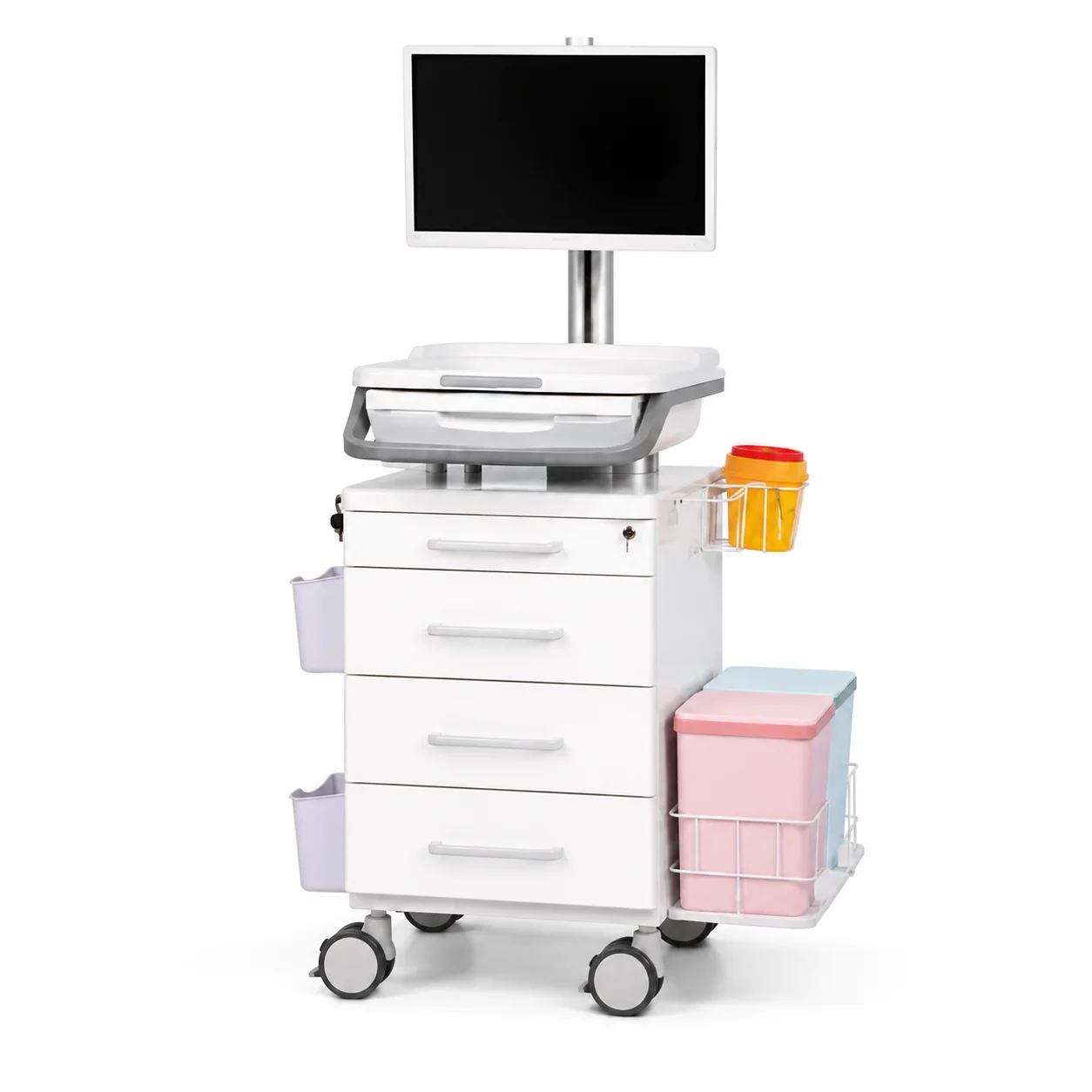
Case history trolleys carry patient files on ward rounds: the catalogue lists the KL-TC012, KL-TC013, KL-TC014 and KL-TC050, plus the KL-TC015 case clip. Hospitals moving to electronic records use computer and nursing IT carts instead, such as the KL-TC201 laptop cart, KL-TC202 all-in-one computer cart, KL-TC206 information nursing cart and KL-TC207 ward rounds cart.
Device carts carry a specific instrument: the KL-TC208 patient monitor cart, KL-TC209 ultrasonic cart, KL-TC210 ECG cart and KL-TC205 endoscopic system cart. For these, send the make and model of the device so mounting and shelf size can be confirmed.
Laundry, food, cylinder and storage
Support services need carts too. The catalogue lists four laundry trolleys (KL-TC032 to KL-TC035), an KL-TC045 insulated food cart, an KL-TC057 oxygen bottle trolley and storage items such as steel cabinets (KL-TC061 to KL-TC070), work tables (KL-TC058, KL-TC059) and a stainless washing sink (KL-TC060). Stainless steel small items, including kidney dishes, sterilisation trays, gauze cans and sharps containers, are listed from KL-TC071 to KL-TC086.
How to build a trolley schedule
A trolley schedule turns the room list into quantities that suppliers can quote consistently:
- List every room or area (ward bays, treatment rooms, theatres, CSSD, ED, support areas).
- For each area, list the trolley types needed and the quantity.
- For each type, record the required material, drawer count, overall size limit and accessories.
- Mark items that must match a colour scheme or be lockable.
- Group identical lines across departments to reach realistic quantities per model.
Send the schedule as a spreadsheet with model references where known. You can use the models in this guide as references and ask for equivalents where your specification differs. Submit it through the request-a-quote page.