Buying guides
Shower chairs and tub transfer benches: types, sizes and how to choose
Shower chairs and bath transfer benches compared: stools, chairs with backs, rolling shower chairs, swivel and bariatric models, plus sizing and buying tips.

Shower chairs let people who cannot stand safely for a full shower sit while they wash, reducing fall risk on wet floors. The main types are shower stools, shower chairs with back and arms, rolling shower commode chairs, and tub transfer benches that straddle the bathtub wall. Choose by how the user enters the shower or tub, how much support they need, and whether a carer assists.
Bathrooms are one of the highest-risk rooms for falls in hospitals, care homes and private homes alike. This guide compares the options and gives procurement teams a specification checklist.
Types of shower chairs and benches
Each type solves a different problem: sitting balance, entry over a tub wall, or moving a dependent user into a roll-in shower.
| Type | Where it sits | Key features | Best for |
|---|---|---|---|
| Shower stool | Inside shower | No back or arms, compact, often with a hand-hold cutout | Users with good sitting balance, small shower trays |
| Shower chair with back and arms | Inside shower or tub | Backrest, armrests for push-up, adjustable legs | Older users, weaker trunk control |
| Rolling shower chair (shower commode chair) | Rolls into roll-in shower, over toilet | Casters with brakes, hygiene opening, footrests | Carer-assisted bathing and toileting |
| Tub transfer bench | Straddles tub wall | Long seat, two legs in and two out, backrest | Users who cannot step over a bathtub rim |
| Sliding or swivel transfer bench | Straddles tub wall | Seat slides or rotates on a frame | Users who struggle to slide or twist |
| Tilt or reclining shower chair | Roll-in shower | Tilt-in-space seat, head support | Highly dependent users, long-term care |
| Bariatric shower chair | Inside shower | Wide seat, reinforced frame, high rated load | Users above standard weight ratings |
Shower stools and basic shower chairs
A basic shower chair is a molded plastic seat on four aluminum legs with rubber feet. Drainage holes keep water from pooling, and push-button legs set the height in steps.
Adding a backrest and armrests turns it into a more supportive elderly shower chair. Armrests matter more than many buyers expect: they give the user something to push up from when standing. The KL-FS790 Bath Chair bath chair, for example, combines a seat height adjustable from 370 to 520 mm with padded armrests, a backrest with built-in handle and a 150 kg rating.
Practical points:
- Rubber feet must be in good condition; worn or missing tips cause sliding.
- All four legs should be set to the same height unless the floor slopes to a drain.
- Folding or tool-free assembly helps if the chair is a portable shower chair for travel.
What is a tub transfer bench?
A tub transfer bench is a long seat, typically about 650–850 mm (26–33 in), with two legs that stand in the bathtub and two on the bathroom floor. The user sits down outside the tub, slides across the seat and lifts the legs over the rim, so they never have to step over the wall standing up.
That single change removes one of the most common bathing fall scenarios. A bath transfer bench is usually the first recommendation for people with hip or knee replacements who still use a bathtub.
Sliding and swivel transfer benches
A sliding tub transfer bench has a seat that travels on rails across the frame, so the carer moves the seat rather than the user shuffling across. A swivel shower chair or swivel bench rotates the seat, locking at set angles, to swing the legs in without twisting the spine. Both are useful for users with limited hip flexion or for carers who want to reduce handling effort.
Check that the bench is adjustable independently on the inside and outside legs, because the tub floor and bathroom floor are often at different levels.
Rolling shower chairs with wheels
A shower chair with wheels, also called a rolling shower chair or shower commode chair, lets a carer move the user from the bedside to the toilet and into a roll-in shower without an extra transfer. It typically has four casters, brakes on at least two, a seat with a hygiene opening, removable armrests and flip-up footrests.
They work only with suitable bathrooms. Roll-in showers need a level or near-level entry; US accessibility guidance sets roll-in shower compartments at least 760 × 1525 mm (30 × 60 in). Raised shower trays and tub walls stop wheeled chairs.
Look for:
- total-lock casters or brakes on all four wheels for wet floors
- a corrosion-resistant frame (aluminum, stainless steel or coated steel)
- a seat opening sized for hygiene care, with a removable pan for commode use
- push handles at a comfortable carer height
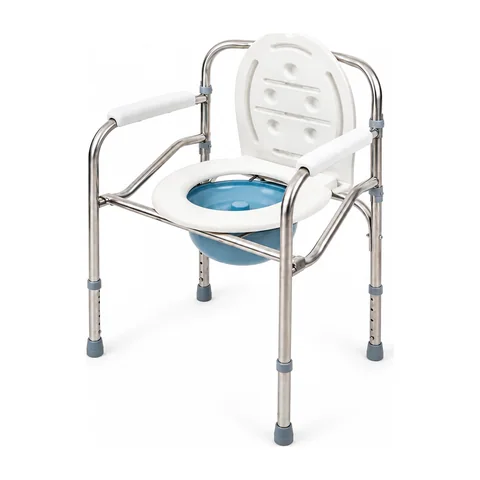
For dual use as a toilet chair, see our guide to bedside commodes and 3-in-1 commode chairs. Keling's KL-FS792 Commode Chair commode chair has an adjustable seat height of 400–500 mm and a detachable bucket with lid.
Tilt, reclining and bariatric shower chairs
For dependent users who cannot sit upright, a tilt or reclining shower chair supports the head and trunk and keeps them from sliding forward. These are typical in long-term care and spinal units, and they are heavier and larger, so plan storage and turning space.
Heavy duty shower chairs and bariatric rolling shower chairs widen the seat, commonly to around 560–660 mm (22–26 in), and use reinforced legs and cross-braces. Never assume a chair is heavy duty because it looks sturdy; confirm the rated load in kg and lb on the label.
How to choose the right shower chair
Start with how the user enters the bathing area.
- Bathtub with a wall to step over? Choose a tub transfer bench, sliding or swivel if needed.
- Walk-in shower with a low tray? A shower chair with back and arms, or a stool for users with good balance.
- Roll-in shower and carer assistance? A rolling shower chair with brakes and footrests.
- Cannot sit upright? A tilt or reclining shower chair, with a hoist for transfers.
Then measure:
- the user's seated knee height to set seat height (feet flat, knees about 90°)
- hip width, adding about 50 mm (2 in) for a comfortable seat width
- the shower tray or tub interior, and door or curtain clearance
- the user's weight against the rated load
A height adjustable shower chair covers most adults, but tall and short users may need extended or low-range legs. Occupational therapists can assess bathing transfers and recommend grab bar positions.
If the user transfers from a bed or wheelchair with help, patient transfer boards and aids or a patient lift may be part of the same plan.
Cleaning and infection control
Shower chairs in hospitals and care homes are shared equipment, and wet surfaces encourage biofilm. Choose designs that can be cleaned completely:
- smooth, sealed seat surfaces without fabric padding, or padding that is fully waterproof and wipeable
- few hidden crevices, with drainage holes large enough to rinse
- frames that tolerate your chlorine or quaternary ammonium disinfectants without corroding
- removable components that can go through a washer-disinfector if your facility uses one
Plated mild steel corrodes quickly in showers; aluminum and stainless steel last longer.
What to specify when buying shower chairs
For tenders and distributor orders, state performance requirements:
| Item | What to specify |
|---|---|
| Type | Stool, chair with back, rolling, transfer bench, swivel or sliding |
| Seat height | Min–max in mm and inches; adjustment steps |
| Seat | Width, depth, cutout or solid, drainage, padding |
| Rated load | kg and lb, with test evidence |
| Frame | Aluminum, stainless steel or coated steel; corrosion resistance |
| Feet or casters | Rubber tips; caster size, brake type and count |
| Arms and back | Fixed, removable or flip-up; backrest height |
| Assembly | Tool-free, flat-packed carton size |
| Documents | ISO 17966 test report, ISO 13485 certificate, IFU, labeling and registration for the destination market |
ISO 17966 sets requirements and test methods for assistive products for personal hygiene, including shower chairs and commode chairs. Ask which tests the specific model has passed.
Next steps
Most wards and care homes need a mix: stools and chairs with arms for ambulant patients, transfer benches for bathtub rooms, and rolling shower commode chairs for dependent residents. Keling Medical supplies bath chairs, commode chairs, walkers, wheelchairs and patient lifts for hospital, care-home and distributor orders. Browse the rehabilitation range or request a quote with the models and quantities you need.
Frequently asked questions
What is the difference between a shower chair and a transfer bench?
A shower chair sits entirely inside the shower or tub, so the user must already be inside before sitting. A transfer bench is longer and straddles the tub wall, with two legs inside and two outside. The user sits outside the bath and slides across, which avoids stepping over the rim and lowers fall risk.
How do you use a tub transfer bench in a tub?
Place the bench with its long side across the tub wall, outside legs on the bathroom floor and inside legs in the tub, all at a level seat height. The user backs up, sits, then slides across while lifting the legs over the rim. A carer or therapist should demonstrate the transfer first, and grab bars help.
Are shower chairs with wheels safe?
A rolling shower chair is safe when it is used on a level floor, with all casters locked during transfers and bathing, and with a carer pushing it. Wheels are not suitable for users who will move unaided on a wet floor or for showers with a raised threshold. Check the brake design and caster count.
What height should a shower chair be?
The seat should let the user sit with feet flat on the floor and knees at about a right angle, which for many adults means roughly 400–500 mm (16–20 in). That is why height adjustable shower chairs with push-button legs are standard. For transfer benches, match the seat to the user's wheelchair or bed height.
What is a swivel shower chair?
A swivel shower chair or transfer bench has a seat that rotates and locks in set positions, often every 90 degrees. The user sits facing outward, then the carer turns the seat so the legs swing into the tub or shower. It reduces twisting for users with hip, knee or back limitations.
What shower chair is best for heavy people?
Look for a bariatric or heavy duty shower chair with a rated load clearly above the user's weight, a wider seat of around 560 mm (22 in) or more, a wider leg stance and reinforced cross-bracing. Confirm the frame rating on the label and test report, and check the chair still fits inside the shower footprint.
Do shower chairs need a hole in the seat?
Not always. A seat with a cutout or hygiene opening makes perineal washing easier for users who cannot stand, and is standard on shower commode chairs. Users who can stand briefly often prefer a solid seat with drainage holes, which is more comfortable and easier to clean.