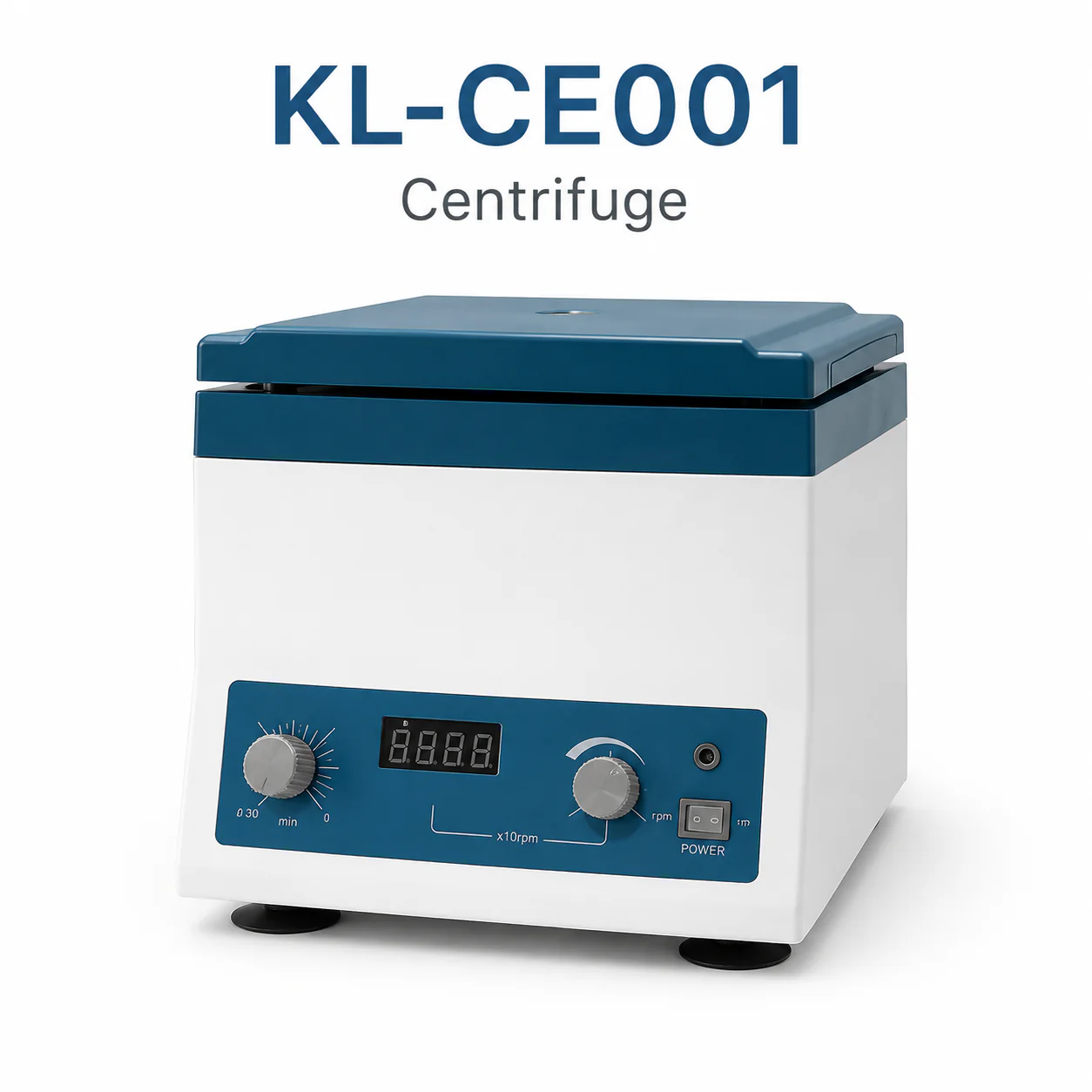
# KL-CE001 Bench Centrifuge — Compact, Efficient Lab Centrifuge for Daily Routine Applications
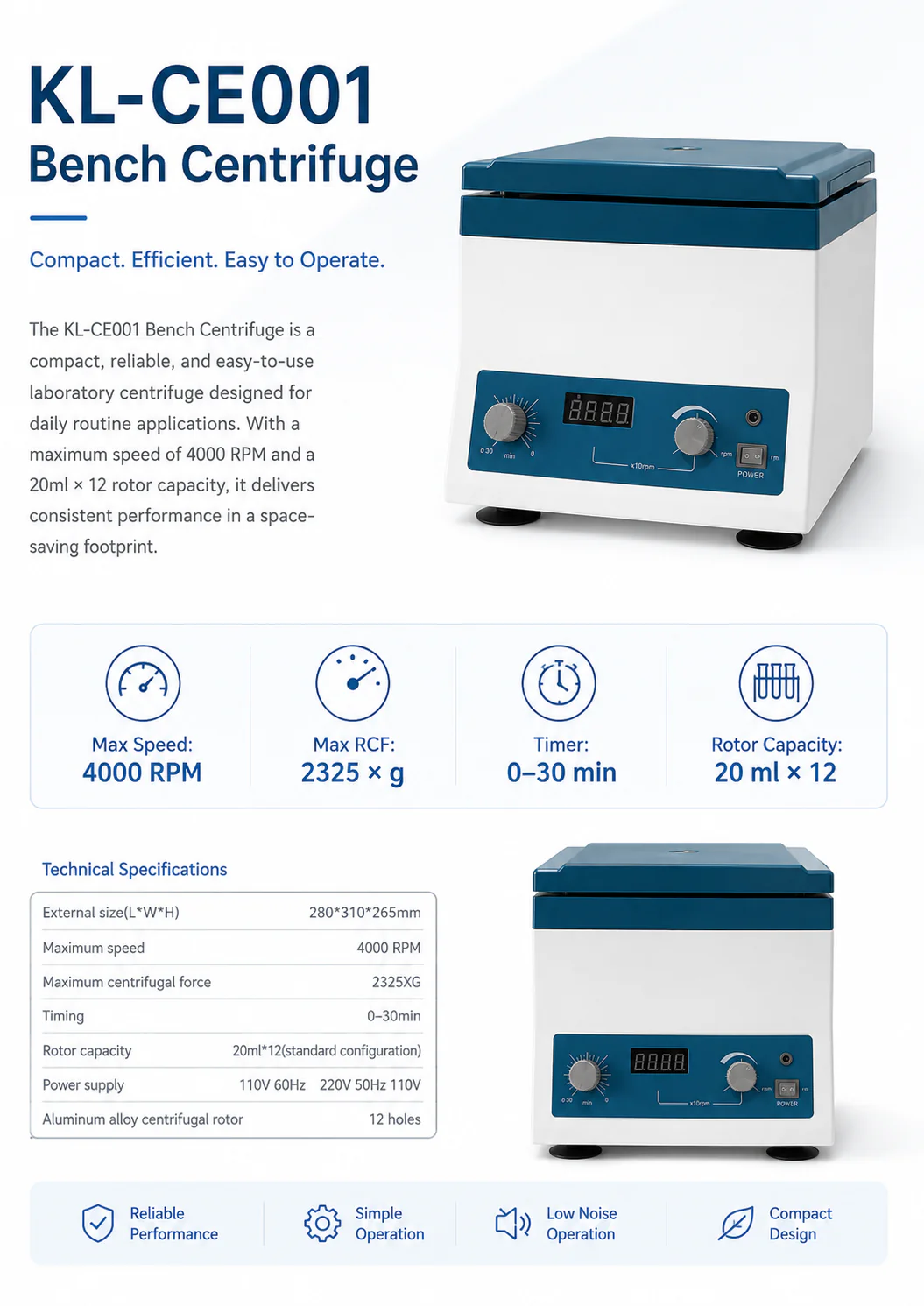
Quick answer: The Keling KL-CE001 is a bench centrifuge with a maximum speed of 4000 RPM, a maximum centrifugal force of 2325 × g, and a 20 ml × 12 rotor capacity, housed in a compact 280 × 310 × 265 mm footprint. It is manufactured by Keling Medical (Keling Medical) for clinical laboratories, hospitals and research facilities worldwide.
Quick Facts
- The Keling KL-CE001 is a tabletop bench centrifuge designed for daily routine laboratory applications.
- Maximum rotor speed of the KL-CE001 is 4000 RPM, producing a maximum centrifugal force of 2325 × g.
- The standard rotor accommodates 12 tubes of 20 ml capacity, with an aluminum alloy centrifugal rotor featuring 12 holes.
- Built-in timer covers 0–30 min, allowing precise control of centrifugation cycles.
- External dimensions are 280 × 310 × 265 mm (L × W × H), keeping the instrument within a small benchtop footprint.
- The KL-CE001 is produced by Keling Medical, a Chinese medical equipment manufacturer with more than 20 years of industry experience, with dual-voltage power supply (110 V 60 Hz / 220 V 50 Hz).
Overview
The KL-CE001 bench centrifuge delivers consistent, reliable centrifugation for clinical and research laboratories that need a compact, straightforward instrument for daily routine tasks. Capable of reaching 4000 RPM and generating up to 2325 × g of centrifugal force, it handles blood serum separation, urine analysis and general sample preparation without occupying excessive bench space. The small 280 × 310 × 265 mm footprint makes it equally at home in busy hospital labs, point-of-care settings and compact research workstations.
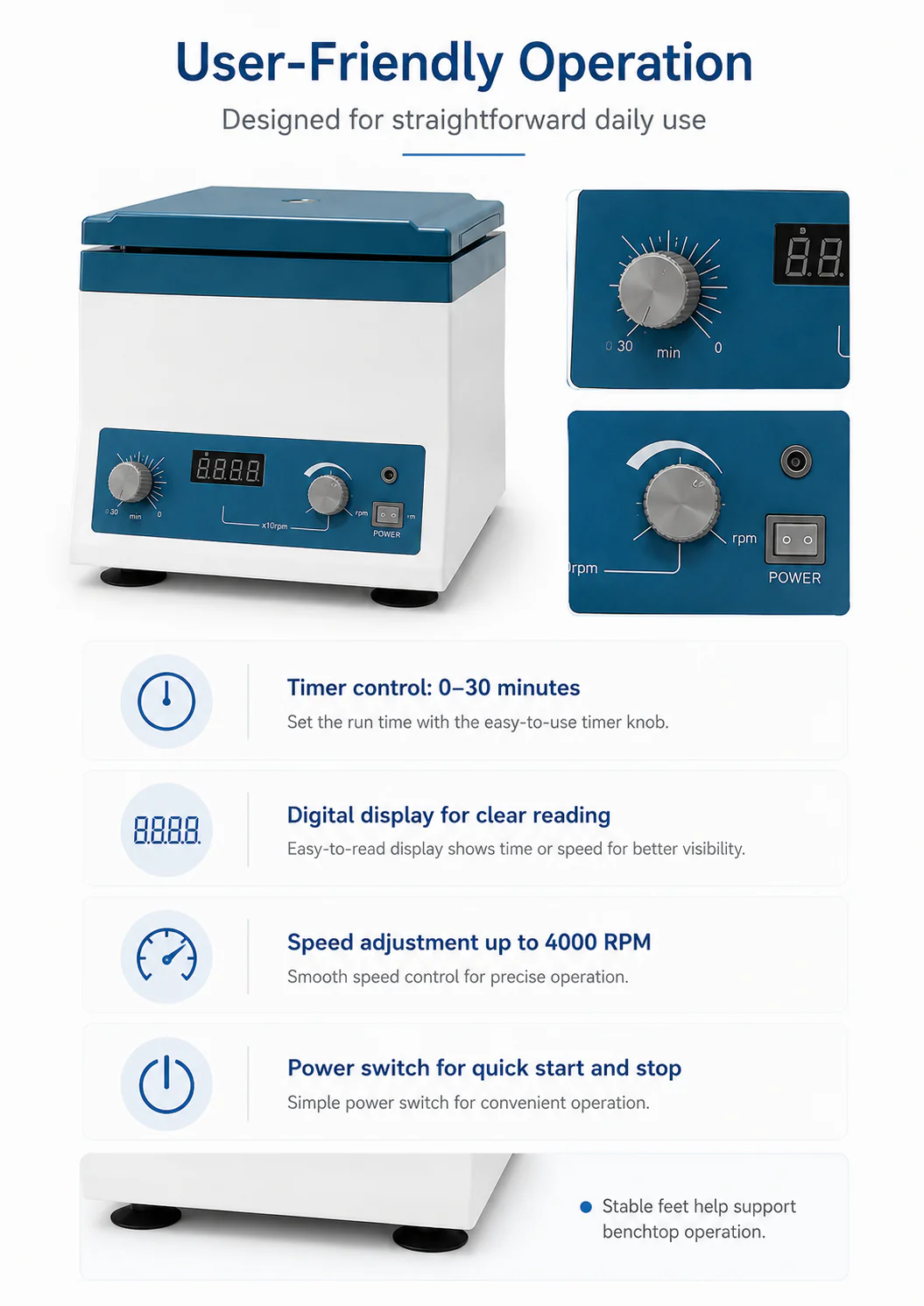
The instrument features an aluminum alloy centrifugal rotor with 12 holes, accepting 20 ml tubes in the standard configuration. A digital display and easy-to-set rotary controls allow operators to dial in speed and timing in seconds. The 0–30 min timer enables straightforward cycle management without constant monitoring, and the low-noise operating design keeps the work environment productive.
Built for simplicity and reliability, the KL-CE001 requires no complex setup or specialized training. Its dual-voltage compatibility (110 V 60 Hz and 220 V 50 Hz) makes it suitable for deployment in hospitals and export markets across multiple regions. Keling Medical's manufacturing background ensures consistent build quality to laboratory instrument standards.
Key Features
- 4000 RPM maximum speed — delivers up to 2325 × g centrifugal force, sufficient for serum separation and standard clinical assays.
- 12-hole aluminum alloy rotor — accepts 20 ml × 12 tubes in the standard configuration for efficient multi-sample processing.
- 0–30 min programmable timer — allows precise cycle control; instrument stops automatically at the set time.
- Digital display and rotary controls — simple, intuitive interface keeps operation fast and error-free.
- Low-noise operation — compact motor design minimizes acoustic disturbance in shared laboratory spaces.
- Dual-voltage power supply — compatible with 110 V 60 Hz and 220 V 50 Hz mains, supporting use across different countries and facilities.
- Compact benchtop footprint — 280 × 310 × 265 mm keeps the unit space-efficient on crowded lab benches.
Technical Specifications
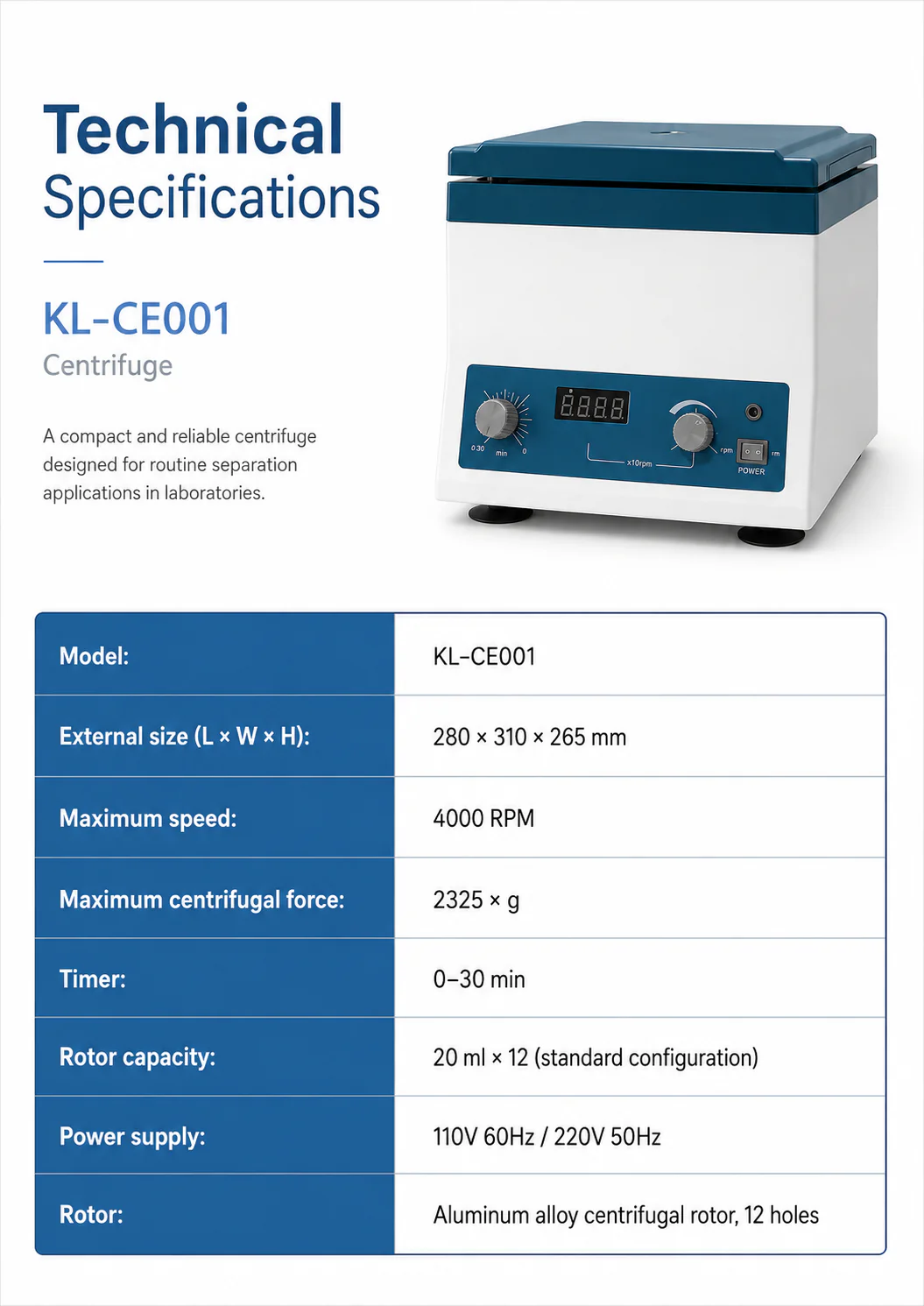
| Parameter | Value |
|---|---|
| Model | KL-CE001 |
| Product type | Bench centrifuge |
| External size (L × W × H) | 280 × 310 × 265 mm |
| Maximum speed | 4000 RPM |
| Maximum centrifugal force | 2325 × g |
| Timer range | 0–30 min |
| Rotor capacity | 20 ml × 12 (standard configuration) |
| Rotor material | Aluminum alloy |
| Rotor holes | 12 |
| Power supply | 110 V 60 Hz / 220 V 50 Hz / 110 V |
Specifications are subject to change; dimensional tolerances may apply. Contact Keling Medical for the latest datasheet.
Applications
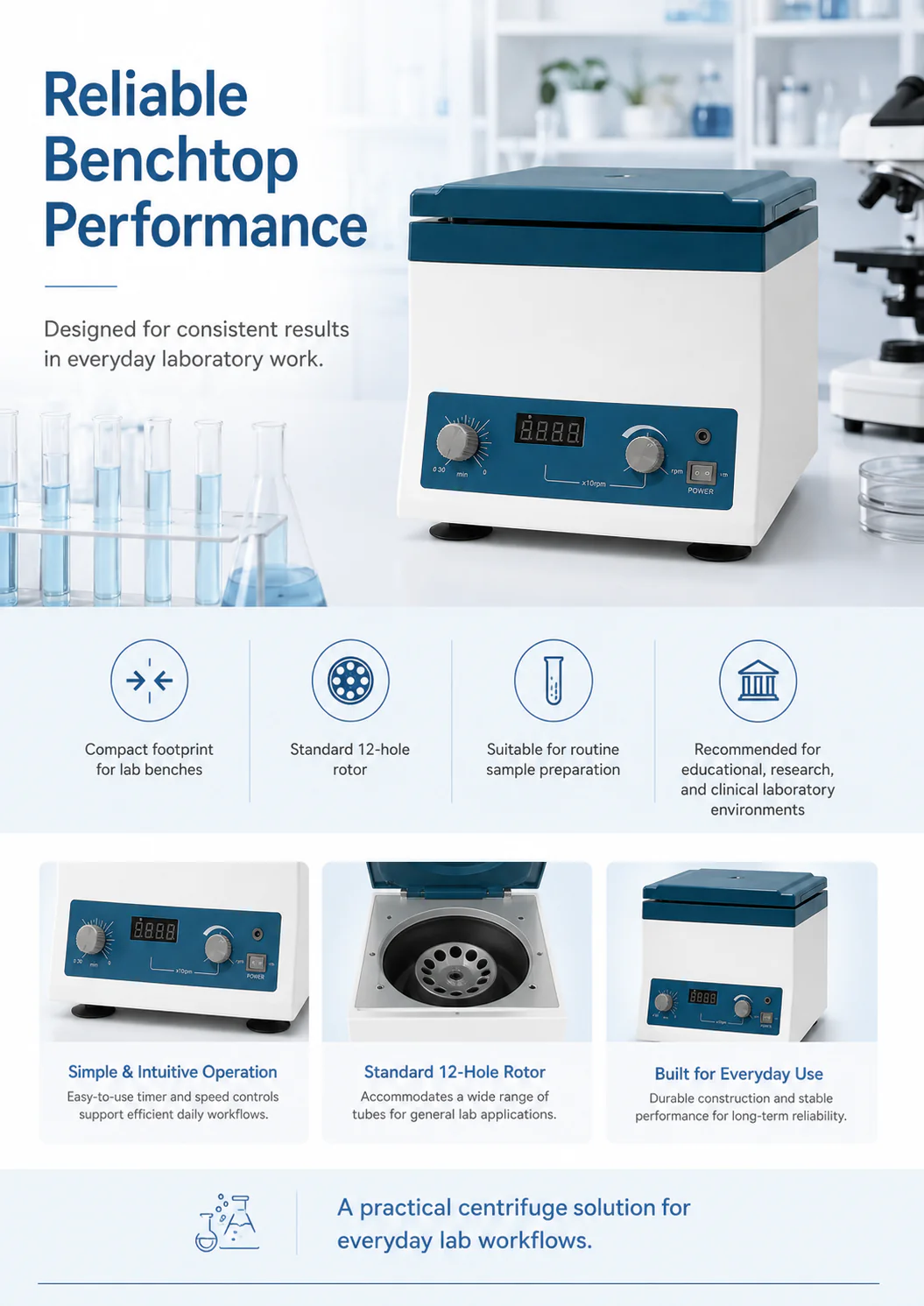
The KL-CE001 bench centrifuge suits clinical and research environments requiring routine sample separation: hospital clinical laboratories, point-of-care testing stations, outpatient clinics, university and pharmaceutical research labs, and blood collection centers. Common tasks include blood serum and plasma separation, urine sedimentation, cell washing, and general sample preparation for analysis.