Sourcing guides
Mobility aids and rehabilitation equipment: a buyer's sourcing guide
Mobility aids sourcing guide for hospitals and distributors: product categories, physical therapy equipment list, standards, documents and supplier checks.

Mobility aids are assistive devices that help people walk, stand, transfer or move about safely: canes, crutches, walking frames, rollators, wheelchairs, patient lifts, bed mobility aids and bathroom safety equipment. For hospitals, care homes and distributors, sourcing them well means choosing the right product mix, checking each family against its test standard, and working with a supplier who can document every model.
This guide is written for procurement teams, rehabilitation managers and importers building or refreshing a mobility equipment range.
What counts as mobility aids and rehabilitation equipment?
Mobility equipment is usually grouped by the function it supports. The international classification of assistive products, ISO 9999, uses similar groupings. The table maps the main families to their typical test standards.
| Product family | Examples | Typical standard | Main buyers |
|---|---|---|---|
| Single-arm walking aids | Canes, quad canes, elbow and underarm crutches | ISO 11334 series | Pharmacies, orthopedics, home care |
| Two-arm walking aids | Walking frames, 2-wheel walkers, rollators, forearm walkers | ISO 11199 series | Hospitals, rehab, home care |
| Wheelchairs | Manual, transport, reclining, pediatric, electric | ISO 7176 series | Hospitals, rehab, distributors |
| Transfer and lifting | Patient lifts, sit to stand lifts, transfer chairs, boards | ISO 10535 (hoists) | Hospitals, nursing homes |
| Personal hygiene | Shower chairs, transfer benches, commodes | ISO 17966 | Care homes, home care |
| Bed and bed mobility aids | Medical beds, bed rails, bed canes, trapezes | IEC 60601-2-52 (medical beds) | Hospitals, home care |
| Physical therapy equipment | Treatment tables, parallel bars, exercise equipment | Depends on product | Rehab centers, clinics |
Standards define tests for strength, stability and durability; they are not product approvals in themselves. Ask suppliers which standard and which parts were applied to each model.
Walking aids: canes, crutches and walkers
Walking aids are the highest-volume mobility devices in most markets and the first line of fall prevention. They are inexpensive per unit, but buyers handle many sizes and variants.
- Underarm crutches are typically supplied in several height ranges. Keling's KL-FS901 Armpit Crutch comes in three sizes covering users 1300–1950 mm tall, in aluminum alloy or stainless steel.
- Elbow (forearm) crutches suit longer-term users and give better control on stairs.
- Folding canes and crutches matter for travel and retail; the KL-FS903 Tri-fold Crutch tri-fold crutch folds to 300 mm.
- Seat canes combine a walking aid with a perch; the KL-FS904 Stainless Steel Crutch with Chair is a stainless steel crutch with a folding tripod seat.
- Walkers and rollators cover users who need two-handed support; see rollator vs walker for the differences between frames, 2-wheel walkers and rollators with seats.
Order walking aids in a size spread that matches your population's height distribution, and include replacement rubber tips, which wear out long before frames.
Wheelchairs and transport chairs
Wheelchairs are higher-value, bulkier items and drive much of a mobility range's freight cost. A typical hospital or distributor assortment includes standard steel chairs, lightweight foldable chairs, transport chairs, a reclining or high back model, bariatric chairs, pediatric positioning chairs and electric wheelchairs.
Our guide to the types of wheelchairs explains each category and what to put in a wheelchair specification. When comparing quotes, normalize for seat size, rated load, wheel type and included accessories, because these vary widely between apparently similar models.
Transfer, lifting and bed mobility aids
Transfers between bed, chair, toilet and car cause many falls and many carer injuries. Equipment in this group includes:
- Patient lifts: full-body mobile lifts, sit to stand lifts and ceiling lifts. The KL-FS909 Electric Patient Transfer Lift is an electric patient transfer lift rated to 120 kg. Our patient lift guide compares the types.
- Transfer boards and slide sheets for lateral transfers.
- Bed mobility aids: bed rails, bed canes or assist handles, overhead trapezes and bed ladders that help users sit up and reposition.
A bed cane or bed rail for seniors must be compatible with the bed and mattress; gaps between rail, mattress and headboard can create entrapment risks. See our guide to bed rails for hospital and home-care beds.
Physical therapy equipment list
Rehabilitation centers and clinics need equipment for assessment, treatment and exercise, alongside the mobility aids patients will take home. A starting physical therapy equipment list:
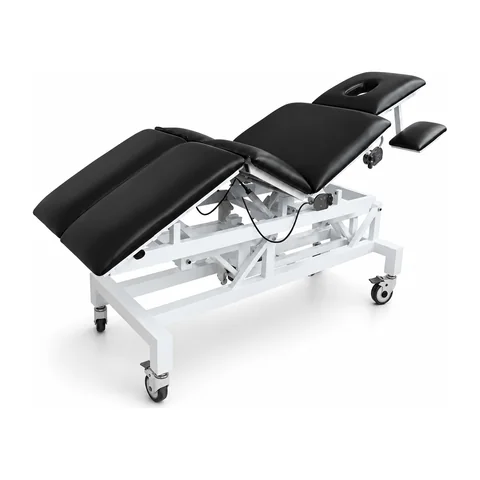
- Treatment tables: height-adjustable hi-lo plinths, for example the electric KL-BC127 Physiotherapy Table physiotherapy table with a 490–890 mm height range.
- Gait training: parallel bars, a training staircase, walkers and forearm walkers in several sizes.
- Exercise equipment: free weights, resistance bands, exercise bikes, balance boards and mats.
- Electrotherapy and thermal devices: according to the clinic's scope and local regulations.
- Transfer and seating: wheelchairs, transfer boards and a lift for dependent patients.
- Storage and support: treatment trolleys, screens and waiting room seating.
Physical therapy equipment for home is a smaller set, usually focused on walking aids, simple exercise equipment and bathroom safety. For knee or hip replacement recovery, clinicians typically prescribe a walker or crutches, a raised toilet seat or commode, and a shower chair or transfer bench. Detailed table options are covered in our guide to physical therapy treatment tables.
Regulatory documents to request
Mobility aids are medical devices in most markets. In the EU, most non-powered aids are Class I under the MDR; in the US, many manual aids are Class I, while powered wheelchairs are Class II. Classification and registration requirements differ by country, so check each product for each destination.
Request for every model you plan to sell or tender:
- ISO 13485 certificate of the manufacturing site, with scope covering the product
- Declaration of Conformity and labeling for the EU, or the registration required in your country
- Test reports against the relevant standard (ISO 7176, ISO 11199, ISO 11334, ISO 10535, ISO 17966), plus electrical safety and EMC reports for powered products
- Instructions for use in the required languages, with rated load and maintenance guidance
- Label artwork with model, rated load, batch or serial number and, where required, UDI
Our guide to importing medical equipment from China explains how these documents fit into customs and registration.
How to evaluate a mobility equipment supplier
Unit price is only one line in the comparison. Evaluate suppliers of mobility aids on:
| Criterion | What to check |
|---|---|
| Manufacturing | Own factory or trading company; which processes are in-house (tube bending, welding, plating, powder coating, sewing) |
| Quality system | ISO 13485 certificate, scope and certification body; incoming and final inspection records |
| Range | Breadth across walking aids, wheelchairs, lifts and hygiene products, so one supplier can fill a container |
| Documentation | Model-specific test reports and IFUs available before the order |
| Samples | Willingness to send samples for clinical and engineering evaluation |
| OEM capability | Private labeling, custom colors and packaging, minimum order quantities |
| Logistics | Folded carton sizes, units per container, mixed-container loading |
| After-sales | Spare parts list (tips, casters, brakes, batteries), warranty terms, response time |
Visit or audit the factory where possible. For a broader checklist, see how to choose a medical equipment supplier.
Planning a range and controlling landed cost
Mobility equipment is light but bulky, so freight can be a large share of landed cost. Practical ways to control it:
- Choose foldable and knock-down designs where clinically acceptable, and confirm folded carton dimensions before quoting customers.
- Fill containers with a mix of high-cube items (wheelchairs, rollators) and dense items (crutches, canes, spare parts).
- Standardize a core range with few variants and keep specialist models (bariatric, pediatric, tilt) on longer lead times.
- Hold spare parts stock locally; a missing brake or caster can take a chair out of service for weeks.
About Keling Medical as a supplier
Keling Medical has manufactured hospital equipment since 1996 at a production base of about 120,000 m² in Yangzhou, China, with sales and export handled from Shanghai. The company is ISO 13485:2016 certified by SGS, exports more than 40% of its output to Europe, Africa, the Middle East, Southeast Asia and South America, and supplies distributors, hospitals, contractors and tender agents with wholesale, project and OEM orders.
Its rehabilitation line includes manual, reclining, pediatric and electric wheelchairs, walking frames, rollators, crutches, patient transfer lifts, and bath and commode chairs, which can be combined with hospital beds, trolleys and furniture in one shipment. Ask for the documents that apply to each model and destination country.
Next steps
Start with a product list grouped by family, the standard each item must meet and the documents you need, then request samples for the models you will stock in volume. Browse the rehabilitation products or send a request for quotation with your range, quantities and target markets.
Frequently asked questions
What are mobility aids?
Mobility aids are assistive devices that help people move safely when walking, standing or transferring is difficult. They include canes, crutches, walking frames, rollators, wheelchairs, transfer boards, patient lifts, bed rails and bed canes, and bathroom aids such as shower chairs and commodes. The right aid depends on balance, strength and the environment.
What are the most common mobility aids for the elderly?
The most common elderly mobility aids are walking sticks, standard walkers and rollators with seats, followed by wheelchairs or transport chairs for longer distances. In the home, bed mobility aids, grab bars, shower chairs and raised or commode seats are often more important for preventing falls than walking aids alone.
What equipment does a physical therapy clinic need?
A basic physical therapy equipment list includes height-adjustable treatment tables, parallel bars and a training staircase, walking aids for gait training, exercise equipment such as weights, bands and balance boards, electrotherapy and thermal devices, and wheelchairs for patient movement. The exact list depends on the clinic's caseload, such as orthopedics, neurology or pediatrics.
How do I choose a supplier of mobility aids?
Choose a supplier that manufactures or controls the products it sells, holds ISO 13485 certification, can provide model-specific test reports and the registrations your market requires, and supports spare parts and warranty. Evaluate samples, compare landed cost per unit including freight, and check references from buyers in similar markets.
Are mobility aids classified as medical devices?
In most markets, yes. In the EU, wheelchairs, walkers, crutches and patient lifts are medical devices under the MDR, most non-powered ones in Class I. In the US, many manual mobility aids are Class I devices, while powered wheelchairs are Class II. Confirm the classification for each product in each destination country.
What is a bed mobility aid?
A bed mobility aid helps a person reposition, sit up or get in and out of bed. Examples include bed canes and assist handles, bed rails, overhead trapeze bars, bed ladders, transfer boards and slide sheets. Assist handles and rails must fit the bed correctly to avoid entrapment gaps, so follow the bed and rail manufacturers' guidance.