Buying guides
Bed rails for seniors: hospital bed side rails, half rails and trapezes
Bed rails for seniors and hospital beds explained: full vs half rails, entrapment gaps under IEC 60601-2-52, trapeze bars, fitting tips and what to specify.

Bed rails for seniors are side barriers fitted to a hospital or home-care bed to reduce the risk of rolling out and to give a hand-hold for repositioning. On medical beds they must meet IEC 60601-2-52 gap and height limits, because a poorly fitting rail can trap a head, neck or chest. Rails reduce roll-out risk; they do not prevent falls on their own.
This guide covers rail types, the dimensional rules, mattress compatibility, trapeze bars, fitting and what to put in a specification. It is written for buyers, biomedical engineers and nurses, with notes for families choosing bed rails for elderly relatives at home.
What are hospital bed rails for?
Hospital bed side rails do three jobs: they reduce the risk of a patient rolling out of bed, give a handrail for turning and sitting up, and on some beds hold the patient controls. They are also used during transport so limbs stay on the mattress.
They are not a restraint device. Using rails to stop someone who wants to get out of bed is a restraint decision with ethical and legal implications in most countries, and it should follow local policy.
Types of bed rails: full, half and split
Hospital beds with rails come in a few common configurations. The table compares them.
| Rail type | Coverage | Strengths | Watch-outs |
|---|---|---|---|
| Full-length rail | Most of the bed length | Maximum containment; good during transport | Harder for a patient to exit alone; climbing risk |
| Half rail (head or foot) | About half the length | Exit gap, hand-hold for sitting up | Less containment at the open end |
| Split rails (head + foot) | Two sections per side | Raise one or both; controls in head rail | Gap between sections must meet limits |
| Assist handle / bed handrail | Short grip near the head | Helps getting in and out | Not a containment rail |
| Folding drop rail (tubular) | Full or partial length | Simple, low cost, robust | Check bar spacing and latch quality |
Keling's KL-HL001 Bed Rail is a tubular rail made in aluminum (6-bar, 1740 × 130 mm, or 5-bar, 1490 × 120 mm) and stainless steel (6-bar, 1750 × 135 mm, or 4-bar) versions. The KL-HL002 ABS Side Rail is an ABS side rail in big and small sizes, the kind used on modern ward beds as split rails.
Half rails and patient independence
A hospital bed with half rails is often the best compromise for a mobile senior. The head-end rail gives a grip for sitting up and swinging the legs out, and the open foot end means they never have to climb anything to stand.
Folding and adjustable bed rails for adults
Folding bed rails for adults drop down or swing away for transfers and care. Adjustable bed rails for seniors change height or length to suit different mattresses. On a medical bed, any adjustment must still keep every gap within the limits below.
Entrapment gaps and the IEC 60601-2-52 limits
Entrapment happens when part of the body slips into a gap between the rail, mattress, headboard or bed frame and cannot be withdrawn. People at highest risk include those who are frail, confused, have dementia, involuntary movements or unusual body size.
IEC 60601-2-52, the safety standard for medical beds, sets dimensional limits. UK guidance based on the standard summarizes them for adult beds:
| Measurement | Limit |
|---|---|
| Rail top above the uncompressed mattress | At least 220 mm |
| Gaps within the rail and between rail and platform | Less than 120 mm |
| Gap between headboard and rail end | Less than 60 mm |
| Gap between footboard and rail end | Less than 60 mm or more than 318 mm |
| Gap between split rails | Less than 60 mm or more than 318 mm |
| Rail-to-mattress gap | Must pass a 120 mm cone test |
The US FDA's 2006 guidance on reducing bed entrapment describes seven zones, from within the rail (zone 1) to between the headboard and mattress end (zone 7), with a 120 mm (4¾ inch) limit for zones 1–3 based on head breadth and 60 mm (2⅜ inch) for zone 4 based on neck size.
The figures only apply to a complete bed system. Ask the manufacturer for the test report covering the bed, its rails and the mattress it was tested with.
Mattresses change rail safety
A rail that passes with a 120 mm foam mattress may fail with a 200 mm air mattress. A thicker or softer surface lowers the effective height of the rail and can open a vertical gap at the rail edge when the mattress compresses.
When you change mattress type:
- Re-measure rail height above the mattress in the worst case, for example with an air mattress fully inflated.
- Check the mattress covers the full platform width so there is no side gap.
- Consider extra-height rails if the effective height falls below the required figure.
- Update the risk assessment.
See the pressure-relief mattress guide for how surface thickness varies.
Bed rails for seniors to prevent falls: what works
Bed rails for seniors to prevent falls are only one tool, and in some cases the wrong one. A person who is determined to get up may climb over a raised rail and fall from a greater height.
Alternatives and additions, each of which needs its own assessment:
- Ultra-low or low beds that reduce the height of any fall
- Fall mats beside the bed
- Bed-exit alarms or sensor pads
- Positioning wedges and bolsters
- Mesh or padded rail covers that reduce limb entrapment
- Toileting routines, lighting and non-slip footwear
Families buying safety bed rails for seniors at home should involve the person's clinician or occupational therapist. In the US, adult portable bed rails sold for consumer beds are subject to a federal safety standard (16 CFR part 1270); they are a different product from the rails supplied with a medical bed.
Hospital bed trapeze and overhead frames
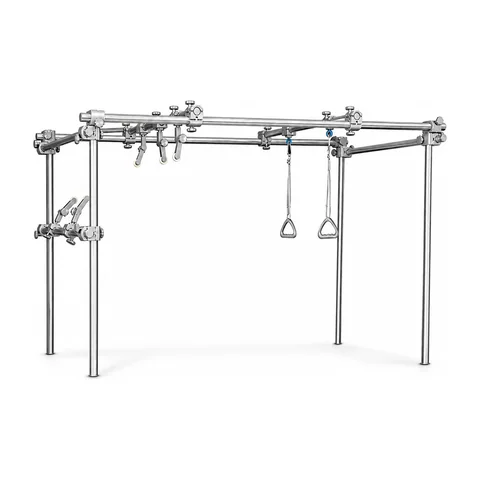
A hospital bed trapeze is a triangular grab bar hung from an overhead frame. A patient with good arm strength can use it to lift the upper body, move up the bed or help with a bedpan or sheet change.
Trapeze bars work best for orthopedic and long-stay patients who are alert and can follow instructions. They are not appropriate for everyone, and their use should be agreed by the care team. Check the safe working load of the frame and that it mounts to sockets designed for it.
Keling's KL-LJ045 Orthopedics Traction is a stainless steel overhead frame with traction pulleys and a trapeze bar, and the KL-BC111 Manual Orthopedics Traction Bed is a 5-function manual orthopedic traction bed with an integrated overhead frame.
How to install hospital bed rails
Fit only rails that the bed manufacturer specifies for that model. Third-party rails attached to a medical bed change the tested system and can introduce gaps.
General points, always subject to the manufacturer's instructions for use:
- Identify the mounting points. Rails attach to fixed brackets on the frame or to the moving backrest section.
- Fit and lock. Insert the rail, tighten fixings to the specified torque, and confirm it latches up and down.
- Test for movement. Push and pull the rail; it should not flex outward or wobble.
- Check gaps. Confirm gaps to the mattress, headboard and other rail section, ideally with the correct test tools.
- Cycle the bed. Run the backrest, knee and height through their range to make sure the rail does not pinch or collide.
- Record it. Note the rail, mattress and date in the bed's maintenance record.
Biomedical teams should include rails in planned preventive maintenance, since worn latches and loose brackets are common findings.
Pediatric and specialist beds
Children need tighter limits than adults because their heads and limbs are smaller. Pediatric cots use full-length rails and narrower openings. Keling's KL-BC114 Child's Cot child's cot has full-length protective side rails. The guide to hospital bassinets, cribs and pediatric beds covers infant and child beds in more detail.
What to specify when buying hospital beds with rails
A clear specification avoids rails that do not suit the ward or that fail entrapment checks. Ask suppliers for:
- Rail type and length: full, half or split; number per bed
- Material: ABS, aluminum or stainless steel, and how it is cleaned
- Operation: one-hand release, quiet lowering, lock indicators
- Rail height above the platform and above your chosen mattress
- IEC 60601-2-52 test report that includes the rails and named mattress
- Integrated controls in the rail, and lockout for patient controls
- Spare rail parts: latches, brackets and fixings
- Compatibility with trapeze frames, IV poles and transport
Ask for the documents that apply to the bed model and destination country.
Next steps
Choose rails as part of the bed system, check the combination with the mattress you will actually use, and base every decision on an individual risk assessment. Browse Keling's hospital beds and accessories, compare bed types in types of hospital beds, or send your requirements through the quote form.
Frequently asked questions
Are bed rails safe for seniors?
They can be when the rail is designed for that bed, the gaps meet the bed standard and an individual risk assessment supports their use. Rails are unsuitable for some people, especially those who are confused and may try to climb over them. Alternatives such as ultra-low beds, fall mats and bed-exit alarms may be safer.
What are the best bed rails for elderly people?
The best bed rails for elderly users are the ones made or approved by the bed manufacturer for that specific bed and mattress, with gaps that meet IEC 60601-2-52. On home beds, a short assist handle often helps more than a full rail. The right choice depends on the person's mobility and cognition, so ask their clinician or therapist.
What is the difference between full and half rails on a hospital bed?
Full-length rails run most of the bed length and contain the patient on both sides. Half rails cover only the head or foot half, leaving an opening so the patient can get out of bed and use the rail as a grab handle. Split rails combine head and foot sections that can be raised separately.
How do you install bed rails on a hospital bed?
Use only rails specified by the bed manufacturer and follow its instructions for use. Generally the rail mounts to fixed brackets on the bed frame or platform and locks in place. After fitting, check that it latches, does not wobble, and that gaps to the mattress and headboard are within limits. Re-check after any mattress change.
What is a hospital bed trapeze used for?
A trapeze bar hangs from an overhead frame so a patient can grip it to lift or reposition their upper body. It helps people with good arm strength move up the bed or turn with less help. It is not suitable for everyone, for example after some shoulder or cardiac procedures, so its use should be agreed with the clinical team.
Do bed rails prevent falls?
Not reliably on their own. Rails reduce the chance of rolling out of bed, but a determined or confused person may climb over them and fall from a greater height. Fall prevention in care settings relies on a combination of low bed height, footwear, lighting, toileting routines, alarms and supervision.
What height should hospital bed rails be?
IEC 60601-2-52 and UK guidance based on it call for the top of the rail to be at least 220 mm above the uncompressed mattress on adult medical beds. A thicker mattress or overlay lowers that effective height, so extra-height rails may be needed with air mattresses.