Buying guides
Scoop stretcher vs spine board: which one does your EMS team need?
Scoop stretcher vs spine board compared: how each works, when EMS teams use them, sizes, materials, short backboards and what to specify when buying.

A scoop stretcher splits lengthwise into two halves that slide under a patient from each side and lock together, so the patient can be lifted off the floor with minimal rolling. A spine board (long backboard) is a rigid one-piece board used mainly for extrication, water rescue and carries over rough ground. Most EMS fleets carry both, because they solve different handling problems.
This guide compares the two devices, explains where short spine boards and vacuum mattresses fit, and lists what to put in a tender specification.
What is a scoop stretcher?
A scoop stretcher (also called an orthopedic stretcher or split stretcher) is a frame that separates into left and right halves. Each half is slid under the patient from one side, then the halves are latched together at the head and foot ends.
Because the blades go under the patient instead of the patient being rolled onto a board, the device is popular for lifting people found lying on the floor, in narrow spaces, or with suspected hip and pelvic injuries. Most models are length-adjustable so the frame can be shortened for smaller patients and for storage.
There are two main constructions:
- Aluminum alloy scoops: light, stiff, with a telescopic frame. Keling's KL-MS006 Scoop Stretcher is an aluminum scoop stretcher measuring 2100 × 440 × 80 mm open and 1200 × 440 × 90 mm folded.
- Plastic scoops: molded halves with smoother contact surfaces, easier to wipe down and often designed for imaging. The KL-MS007 Plastic Shovel Stretcher plastic shovel (scoop) stretcher has three quick-release straps, metal locking parts and a load rating of ≤159 kg (350 lb).
A scoop is a lifting device first. Many services lift with the scoop, place the patient onto the ambulance stretcher or a vacuum mattress, and then remove the scoop by separating the halves again.
What is a spine board?
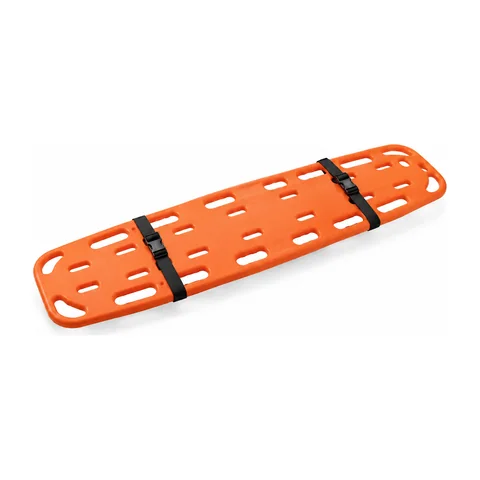
A spine board, also called a long backboard, spinal backboard or rescue backboard, is a flat rigid board with handholds around its perimeter and slots or pins for straps. The patient is log-rolled or slid onto it and secured with straps and a head immobilizer.
Modern boards are usually molded from high-density polyethylene with a hollow core. That makes them buoyant for water rescue, tolerant of mud and fuel, easy to disinfect and, on most models, radiolucent. Older wooden boards are still in service in some regions but are harder to clean.
A typical adult board is about 1.8 m (72 in) long and 400–460 mm (16–18 in) wide. Keling's KL-MS017 Spine Board spine board comes in six sizes, from 1380 × 350 × 50 mm to 2210 × 630 × 170 mm, with adjustable straps and handhold openings, and pairs with the KL-MS014 Head Immobilizer head immobilizer, which is designed to attach to most spine boards.
Scoop stretcher vs spine board: side-by-side comparison
The core difference is how the patient gets onto the device: a scoop goes under the patient in two halves, a spine board needs the patient to be rolled or slid onto it.
| Feature | Scoop stretcher | Spine board (long backboard) |
|---|---|---|
| Construction | Two halves that split lengthwise and latch together | One-piece rigid board |
| How the patient is loaded | Halves slid under from each side, minimal rolling | Log-roll or slide onto the board |
| Typical length | Adjustable, roughly 1.6–2.1 m (63–83 in) | Fixed, about 1.8 m (72 in) for adults |
| Main uses | Lifting from floor or ground, short carries, transfer to stretcher | Vehicle extrication, water rescue, dragging over rough terrain, high-angle carries in a basket |
| Rigidity under load | Good, but center seam can flex on long carries | Very stiff along the full length |
| Water rescue | Not designed for it | Most plastic boards float |
| Imaging | Plastic models often radiolucent; aluminum is not | Most plastic boards are radiolucent |
| Comfort for longer times | Hard frame; not intended for long periods | Hard flat surface; pressure and discomfort increase with time |
| Cleaning | Hinges and latches need attention | Smooth sealed surface, easy to wipe |
When do EMS teams use each one?
The short answer: scoop stretchers for lifting, spine boards for extrication and rescue. Local protocols and the medical director make the final call.
Typical scoop stretcher uses:
- A patient found on the floor at home, in a bathroom or in a corridor where rolling is awkward.
- Suspected hip or pelvic fracture where log-rolling is undesirable.
- Lifting a patient onto a vacuum mattress or the ambulance stretcher.
- Lifting from the ground in a sports or event setting.
Typical spine board uses:
- Extrication from a vehicle, often combined with a correctly sized cervical collar where protocols call for one.
- Water rescue, where the buoyant board is floated under the patient.
- Carrying or dragging a patient across debris, snow or uneven ground.
- Placing inside a basket stretcher for rope or helicopter rescue.
These scenarios are educational examples for trained staff. Follow your local spinal-care protocol, the device instructions for use (IFU) and your clinical leads.
Spinal motion restriction: why backboards are used less
EMS practice has shifted from routine "full immobilization" to spinal motion restriction. A joint position statement published in 2018 by U.S. surgeon, emergency physician and EMS physician organizations supported this approach and described the long backboard mainly as an extrication tool, with the patient moved off it when practical.
The practical reasons are well known to crews: rigid boards are uncomfortable, they create pressure points over time, and tight torso straps can restrict breathing. A flat board also does not follow the natural curves of the spine.
What this means for buyers:
- You still need spine boards, but possibly fewer per vehicle than in the past.
- Scoop stretchers and vacuum mattresses become more central to the kit. Keling's KL-MS019 Vacuum Stretcher vacuum stretcher molds to the patient when air is extracted through its valve.
- The ambulance stretcher itself, with a good mattress and straps, does more of the work. See our overview of types of stretchers used in hospitals and EMS for how the devices fit together.
Short spine board vs extrication vest
A short spine board (short backboard) is a rigid board roughly the length of an adult torso, used to stabilize a seated patient before moving them to a full-length device. It is strapped behind the back with the head secured to its upper section.
Many services have replaced short boards with vest-type extrication devices: semi-rigid vests that wrap around the torso with color-coded straps and lifting handles. They fit more body shapes, conform to car seats and are easier to apply in tight vehicle interiors.
Keling's KL-MS013 Extrication Device extrication device is a vest of this type, measuring 860 × 260 × 350 mm with color-coded straps and reinforced handles. If your tender still lists "short spine board," ask clinical leads whether a vest is the intended item.
What is the best spine stretcher for your service?
There is no single best spine stretcher. The right mix depends on call types, terrain, crew size and how your protocols handle spinal care.
A practical starting point for a front-line ambulance:
- One scoop stretcher, aluminum or plastic depending on cleaning and imaging needs.
- One long spine board with a full strap set.
- One head immobilizer and a range of cervical collars (adult and pediatric).
- One extrication vest for seated patients.
- One vacuum mattress where protocols use it.
Rescue units, water rescue teams and mountain services usually add more boards and a basket stretcher. Event medical teams often prioritize scoops and lightweight folding stretchers.
What to put in a tender or specification sheet
Spinal boards and scoops look simple, but small differences matter in the field. Specify these points so bids are comparable:
- Dimensions: open length (and length range for scoops), width, thickness and folded or stored length in mm.
- Load rating: maximum patient load in kg and lb, and the test method or standard the manufacturer uses.
- Material: aluminum alloy or polymer; surface finish; corrosion resistance.
- Latch design (scoops): one-handed operation, locking indication, latch tolerance after repeated use.
- Radiolucency: requested in writing for the exact model if imaging on the device matters.
- Buoyancy (boards for water rescue).
- Straps and accessories: number, color coding, buckle type, head immobilizer compatibility, pin or slot spacing.
- Fit: compatibility with your ambulance stretcher, basket stretcher and vehicle storage brackets.
- Cleaning: approved disinfectants and whether the core is sealed against fluid ingress.
- Documents: IFU in the required language, quality system certificate, declaration of conformity or registration that applies to the model and destination country.
For ambulance-mounted devices in Europe, buyers often reference the EN 1865 series on patient handling equipment used in road ambulances. Ask the supplier which parts of which standards the specific model has been tested against.
If you are buying from an overseas factory for the first time, our guide on importing medical equipment from China covers inspection, documentation and shipping.
Care, inspection and service life
Both devices need routine checks. Damaged latches and cracked boards are common reasons for removing equipment from service.
- Scoop stretchers: check latches engage fully, length adjustment locks, blades have no cracks or burrs, and straps are intact.
- Spine boards: look for cracks, warping, fluid ingress into hollow cores and frayed straps.
- After every use: clean and disinfect per IFU, paying attention to handholds, hinges and strap slots.
- Records: log inspections per device so worn units are retired on evidence, not guesswork.
Next steps
For most services the question is not scoop stretcher or spine board, but how many of each, plus which vest, collars and vacuum mattress complete the set. Keling Medical manufactures scoop stretchers, spine boards, immobilizers, extrication devices and ambulance stretchers, and can quote them as one matched kit.
Browse the stretchers and first-aid range, read how a gurney differs from a stretcher, or send your quantities and specification for a quote.
Frequently asked questions
What is a scoop stretcher used for?
A scoop stretcher is used to lift a patient off the ground or floor with minimal movement. Its two halves separate lengthwise, slide under the patient from each side and lock together at the head and foot ends. It is mainly a lifting and short-carry device; the patient is usually transferred to an ambulance stretcher or vacuum mattress for transport.
Is a scoop stretcher better than a spine board?
Neither is better in every case. For lifting a supine patient from the floor, a scoop stretcher generally causes less body movement than log-rolling onto a spine board. A spine board is stronger for extrication from vehicles, water rescue and dragging over debris. Your medical director and local protocols decide which device is used for which patient.
What is a short spine board?
A short spine board, or short backboard, is a shorter rigid board used to stabilize the head and torso of a seated patient, typically during vehicle extrication, before the patient is moved to a full-length device. Many services now use a vest-type extrication device for this job because it wraps around the torso and has built-in straps and handles.
Do EMTs still use backboards?
Yes, but less routinely than before. Joint guidance published in 2018 by U.S. trauma, emergency medicine and EMS physician organizations supports spinal motion restriction rather than routine immobilization, and describes the long backboard mainly as an extrication tool. Many systems now move patients to the ambulance stretcher or a vacuum mattress as soon as practical.
Can a scoop stretcher be used for X-rays?
Some plastic scoop stretchers are designed to be radiolucent so imaging can be done without moving the patient, while aluminum scoops generally are not. If imaging on the device matters to your emergency department, ask the manufacturer to state radiolucency in writing for the exact model rather than assuming it from the material.
How long is a standard spine board?
Adult long spine boards are typically about 1.8 m (72 in) long and roughly 400–460 mm (16–18 in) wide, with handholds around the edge and pins or slots for straps. Pediatric and short boards are smaller. Always check the overall length against the stretcher, ambulance floor and storage space you have.