Buying guides
Gurney bed vs stretcher: what is the difference in a hospital?
Gurney bed vs stretcher explained: what a hospital gurney is, how it differs from stretchers and trolleys, main types, dimensions and what to specify.

A gurney bed is a wheeled stretcher: a padded patient platform on a frame with castors, used to move a lying patient around a hospital or into an ambulance. A stretcher, in the strict sense, is any device for carrying a patient lying down, wheeled or not. So every gurney is a stretcher, but a folding pole stretcher or spine board is not a gurney.
In American English the words often mean the same thing. In Britain and many export markets, the same equipment is called a patient trolley or transport stretcher. This guide explains the differences that matter when you specify and buy.
What is a gurney in medical terms?
A gurney is a medical transport stretcher with a wheeled undercarriage. Typical features are a padded mattress, side rails, a raisable backrest, an IV pole socket and castors with brakes.
The word is used mainly in North America. Hospital staff use "gurney," "stretcher" and "cart" loosely, while procurement documents, standards and catalogs more often use patient transport stretcher or patient trolley. Use the term your tender authority uses, and describe the function in the specification.
Gurneys are found in:
- Emergency departments, for triage, treatment and transport to imaging
- Pre-op and recovery areas, for moving patients to and from theater
- Day-surgery, endoscopy and outpatient procedure units
- Ambulances, where the gurney is called a cot or ambulance stretcher
Gurney vs stretcher: the key differences
The defining difference is wheels and a frame. A stretcher can be carried by hand; a gurney is rolled.
| Feature | Gurney (wheeled stretcher) | Hand-carried stretcher |
|---|---|---|
| Undercarriage | Fixed or height-adjustable frame on castors | None; carried by poles or handles |
| Typical setting | Hospital, ambulance | Field, rescue, disaster, military, sports |
| Examples | Hospital gurney, ambulance cot, stretcher chair | Pole stretcher, folding stretcher, scoop, spine board, basket |
| Height | Fixed or adjustable, roughly 500–950 mm (20–37 in) | At floor level |
| Weight | Heavier, often 40–100 kg (88–220 lb) | Light, often a few kg to 15 kg |
| Patient comfort | Mattress, backrest, rails | Fabric or rigid surface |
| Storage | Parked in bays or corridors | Folds into a bag or wall bracket |
| Operators | 1–2 to push | 2–4 to carry |
Weights and heights vary widely by model, so treat the table as typical ranges, not specification values.
Gurney vs hospital bed
A gurney bed is not a hospital bed. It is designed for minutes to hours, while a hospital bed is designed for days to weeks.
Gurneys are narrower and lighter so they pass through doors and fit in elevators. They usually have a thinner mattress and fewer sections. A hospital bed has a wider surface, a pressure-reducing mattress, multi-section profiling and often electric controls. If ED patients are boarded for long periods, plan to move them to beds or to provide pressure-redistributing mattresses.
For bed options, see our guide to types of hospital beds.
Types of hospital gurneys
Most hospital gurneys fall into a few families, each optimized for a different job.
Fixed-height transport gurneys
The simplest medical gurney has a fixed platform height, a backrest and side rails. It is light and economical for internal transport. Keling's KL-PT001 Patient Transportation Trolley patient transportation trolley has a stainless steel frame, a 1960 × 600 × 750 mm footprint, a 150 kg capacity, a 0–70° backrest and an under-frame storage rack.
Height-adjustable gurneys
Hydraulic or crank height adjustment lets staff raise the patient to working height and lower to a level transfer with a bed or table. The KL-PT002 Patient Transportation Trolley hydraulic patient transportation trolley adjusts from 530 to 900 mm, with a 0–85° backrest, foldable aluminum side rails, an IV pole and a 160 kg safe working load. Crank-operated models are a simple alternative where hydraulic service is hard to arrange locally.
Heavy-duty and bariatric gurneys
Higher-capacity models have stronger frames and larger castors. The KL-PT003 Patient Transportation Trolley is rated for 250 kg, with 6-inch castors and a 590–870 mm height range. For true bariatric needs, also check platform width and the width of doors on the route.
Operating room transfer trolleys
These gurneys are designed to dock with an operating table and to support patient positioning before and after surgery. The KL-PT006 Operation Connecting Trolley operation connecting trolley offers back plate, leg, Trendelenburg and height adjustment.
Stretcher chairs (gurney chairs)
A gurney chair converts between a reclining chair and a flat stretcher. It suits day-surgery and procedure units where patients sit for most of their stay but need to lie flat on demand.
The EMT gurney: ambulance stretchers
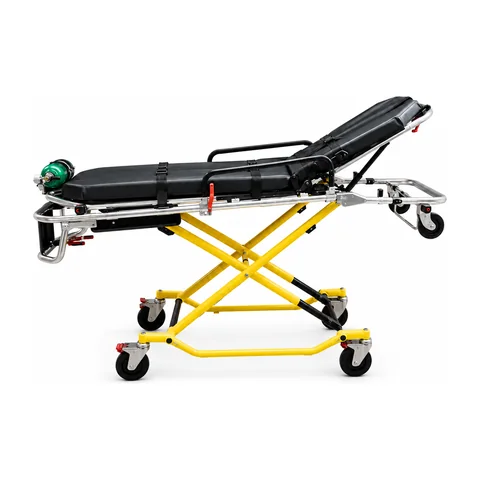
An EMT gurney, called an ambulance stretcher or cot, has a collapsible undercarriage. As crews push it into the vehicle, the legs fold, and the cot locks into a floor fastening system.
Ambulance stretchers come in manual, hydraulic-assist and powered versions. Keling's KL-MS021 Ambulance Stretcher heavy-duty ambulance stretcher has a hydraulic lifting frame, 380–1000 mm height range and a ≤250 kg load capacity. In Europe, ambulance stretchers are usually specified against the EN 1865 series; ask suppliers which parts apply to the model.
For a broader overview, read our guide to types of stretchers used in hospitals and EMS.
Hospital gurney dimensions
Size decides whether a gurney fits your doors, elevators and bays. These are typical ranges for adult hospital gurneys:
| Dimension | Typical range |
|---|---|
| Overall length | 1900–2100 mm (75–83 in) |
| Platform width | 600–700 mm (24–28 in) |
| Overall width, rails up | 650–800 mm (26–31 in) |
| Height (adjustable models) | about 500–950 mm (20–37 in) |
| Backrest angle | 0–70° to 0–85° |
| Castor diameter | 125–200 mm (5–8 in) |
| Safe working load | 150–250 kg (330–550 lb); bariatric higher |
A small gurney for pediatrics, imaging rooms or tight clinics may be shorter and narrower. Always measure the tightest point on the route, including elevator car depth with doors closed.
Gurney or hand-carried stretcher: which do you need?
Most facilities need both, because each solves a different handling problem. The choice depends on where the patient starts and the route to care.
Choose a wheeled gurney when:
- The route is on level floors, ramps and elevators.
- The patient will stay on the device for treatment, imaging or waiting.
- Staff need working height for care and level transfers to beds or tables.
- One or two staff must move the patient without carrying.
Choose a hand-carried stretcher when:
- The patient is on the ground, in a vehicle, on stairs or in a confined space.
- The route crosses rough terrain, debris or narrow corridors.
- Equipment must be stored compactly in a vehicle, cabinet or disaster stockpile.
- Multiple patients may need to be moved at once, as in a mass-casualty plan.
In practice, hand-carried stretchers often bring the patient to a gurney. A folding stretcher such as the KL-MS002 Foldable Stretcher, with an aluminum frame and rear wheels, bridges the two: it carries like a pole stretcher but rolls on flat ground.
Gurney mattresses, cleaning and patient comfort
The mattress is the part patients notice and the part that wears out first. A gurney mattress is typically thinner than a bed mattress so the platform stays light and the rails remain effective.
Check the foam density, the thickness, and the cover. Covers should be fluid-resistant, welded or sealed at the seams, and compatible with your disinfectants. Damaged covers let fluid into the foam and should be replaced, so ask for mattress spare prices in the quotation.
Frames also need to be cleanable. Smooth tubing, sealed joints and few crevices make wipe-down faster between patients. Stainless steel and powder-coated steel both work; confirm which chemicals the finish tolerates.
What to specify when buying a hospital gurney
A good specification describes the function and the critical numbers, not a single brochure. Include:
- Clinical use: ED, pre-op, recovery, imaging, OR transfer, ambulance.
- Dimensions: overall length and width, platform size, height range in mm.
- Adjustment: fixed, crank, hydraulic or electric; backrest range; Trendelenburg if needed.
- Safe working load in kg and lb.
- Side rails: height, folding mechanism, one-hand operation.
- Castors: diameter, central or individual brakes, fifth wheel or steering lock.
- Mattress: thickness, foam density, cover material and fluid resistance.
- Accessories: IV pole, oxygen cylinder holder, storage rack, X-ray cassette tray.
- Materials: stainless steel, powder-coated steel or aluminum; cleaning compatibility.
- Documents: IFU, quality system certificate, declaration of conformity or registration that applies to the model and destination country.
If you are comparing factories, our guide on how to choose a medical equipment supplier lists the questions to ask.
Next steps
Whether your tender says gurney, stretcher or patient trolley, define the job first: transport only, procedures, OR transfer or ambulance use. Then specify height range, load, rails, castors and mattress.
Keling Medical manufactures patient transportation trolleys and ambulance stretchers for hospitals, distributors and tender projects. Browse the stretchers and first-aid range or request a quote with your quantities and specification.
Frequently asked questions
What is a gurney in medical terms?
In medical terms, a gurney is a wheeled stretcher: a padded patient platform on a frame with castors, used to move a lying patient within a hospital or into and out of an ambulance. It usually has side rails, a raisable backrest and brakes. The word is mainly American; elsewhere the same item is called a patient trolley or transport stretcher.
Is a gurney the same as a stretcher?
Every gurney is a stretcher, but not every stretcher is a gurney. A stretcher is any device that carries a patient lying down, including folding pole stretchers, scoop stretchers and spine boards that must be carried by hand. A gurney specifically has a wheeled frame, so it can be rolled rather than carried.
What is the difference between a gurney and a hospital bed?
A gurney is built for short periods and transport: it is narrower, lighter, easier to push through doors and elevators, and has a thinner mattress. A hospital bed is built for stays of hours to weeks, with a wider sleep surface, a pressure-reducing mattress, multi-section profiling and often electric controls. Patients waiting long periods should be moved to a bed.
What is an EMT gurney called?
The gurney used by EMTs and paramedics is usually called an ambulance stretcher, ambulance cot or simply the cot. It has a collapsible undercarriage that folds as it is loaded into the vehicle, locks into a floor-mounted fastening system, and is often available in manual, hydraulic or powered versions.
How wide is a hospital gurney?
Most hospital gurneys have a patient platform around 600–700 mm (24–28 in) wide, with an overall width of roughly 650–800 mm (26–31 in) including side rails. Bariatric gurneys are wider. Check the overall width with rails up against door openings and elevator cars before buying.
What is a gurney chair?
A gurney chair, often called a stretcher chair, is a transport device that converts between a reclining chair and a flat stretcher. It lets patients sit upright for procedures, recovery or transport and then lie flat when needed. It is common in day-surgery, endoscopy and ophthalmology units where many patients are mobile but need a supported position.