Buying guides
Types of stretchers: a guide to medical stretchers for hospitals and EMS
Every main type of stretcher explained: hospital, ambulance, folding, scoop, basket, bariatric, stretcher chairs and more, with a comparison table and tips.

A stretcher is any device used to move a patient lying down, and the types range from wheeled hospital and ambulance stretchers to hand-carried folding stretchers, immobilization devices such as scoops and spine boards, and rescue stretchers for rope, water and air. Choosing the right type depends on where the patient is, how far they must travel and how they must be handled.
This guide lists the main types of stretchers, what each is for, and what to check when buying medical stretchers for a hospital, ambulance service or distribution business.
Types of stretchers at a glance
Most stretcher names describe either where the device is used or how the patient is loaded. This table groups them by function.
| Stretcher type | Wheels | Main setting | Main purpose |
|---|---|---|---|
| Hospital transport stretcher | Yes | ED, wards, imaging, recovery | In-hospital transport and short procedures |
| Ambulance stretcher (cot) | Yes, collapsible | Ambulance | Patient transport to and in the vehicle |
| OR transfer trolley | Yes | Operating theater | Transfer to and from the operating table |
| Stretcher chair | Yes | Day surgery, procedure units | Seated and lying transport in one device |
| Folding (pole) stretcher | Sometimes rear wheels | Field, events, disaster, military | Portable carry over short distances |
| Soft / flexible stretcher | No | Confined spaces, stairs, homes | Carry where rigid devices will not fit |
| Scoop stretcher | No | EMS, floor-level patients | Lifting with minimal movement |
| Spine board | No | Extrication, water rescue | Rigid carry and extrication |
| Vacuum mattress | No | EMS | Molded immobilization |
| Basket stretcher | No | Mountain, rope, helicopter rescue | Protected carry and hoisting |
| Stair chair | Yes, often tracked | EMS, building evacuation | Moving a seated patient on stairs |
| Bariatric stretcher | Yes | Hospitals, EMS | Higher-weight patients |
| Mortuary stretcher | Yes | Hospitals, funeral services | Moving the deceased |
Hospital stretchers
A hospital stretcher is a wheeled patient platform with side rails, a backrest and brakes, used for transport and short-term care inside the building. In many U.S. hospitals it is called a gurney; see gurney vs stretcher for the terminology.
Key variations are fixed height versus hydraulic, crank or electric height adjustment; backrest and Trendelenburg range; and castor size. Keling's KL-PT002 Patient Transportation Trolley hydraulic patient transportation trolley adjusts from 530 to 900 mm, has a 0–85° backrest, foldable aluminum side rails and a 160 kg safe working load.
Specialized hospital stretchers include:
- Emergency stretchers for ED bays, often with an X-ray cassette tray and oxygen holder
- OR transfer trolleys that dock with operating tables
- Imaging-compatible stretchers with radiolucent tops; MRI use requires a model labeled MR-safe or MR-conditional
- Pediatric stretchers with higher rails and smaller platforms
Ambulance stretchers
An ambulance stretcher, also called a cot, is the stretcher paramedic crews load into the vehicle. Its undercarriage collapses as it is pushed into the ambulance. It locks into a floor fastening so it stays secure in transit.
Manual, hydraulic-assist and powered versions exist. Keling's KL-MS020 Ambulance Stretcher ambulance stretcher has an aluminum alloy frame, a 260–920 mm height range, a 0–75° backrest, a ≤159 kg load capacity and four swivel casters with brakes. In Europe, ambulance stretchers are commonly specified against the EN 1865 series, which covers patient handling equipment in road ambulances.
Folding, portable and collapsible stretchers
A folding stretcher, sometimes called a pole stretcher, portable stretcher or collapsible stretcher, is a lightweight frame with a fabric or rigid bed that folds for storage. It is the classic first-aid and field stretcher.
Typical users are event medical teams, sports venues, factories, schools, disaster stockpiles and the military. The KL-MS001 Foldable Stretcher foldable stretcher measures 2080 × 550 × 130 mm open and folds to 1040 × 170 × 90 mm, supplied with a carry bag. Variants include models with rear wheels for rolling on flat ground and camouflage versions for military and civil-defense use.
Military stretchers
Military and army stretchers are usually folding litters with poles, a durable fabric bed and handles at each corner. They are designed to be carried by two to four people and to fit vehicle and aircraft mounting points. Purchasing forces often define dimensions in their own specifications, so ask for the specification first.
Soft and flexible stretchers
Soft stretchers are made of reinforced fabric or nylon with many handles. They roll up or fold into a bag and can be carried down narrow stairs or through tight doors, then placed on a wheeled stretcher outside. Some flexible plastic designs wrap around the patient for confined-space and high-angle rescue.
Immobilization and rescue stretchers
Scoop stretchers, spine boards and vacuum mattresses are lifting and immobilization devices rather than transport platforms. They get the patient off the ground and onto the main stretcher with controlled movement.
- Scoop stretcher: splits lengthwise and slides under the patient from both sides. The KL-MS006 Scoop Stretcher is an aluminum scoop stretcher, 2100 × 440 × 80 mm open.
- Spine board: a rigid board for extrication and water rescue, used with straps and a head immobilizer.
- Vacuum mattress: a bead-filled mattress that becomes rigid around the patient when air is removed. Keling's KL-MS019 Vacuum Stretcher vacuum stretcher has color-coded straps and an air valve for fast extraction.
How these compare, and how EMS guidance on spinal motion restriction affects them, is covered in scoop stretcher vs spine board.
Basket and rescue stretchers
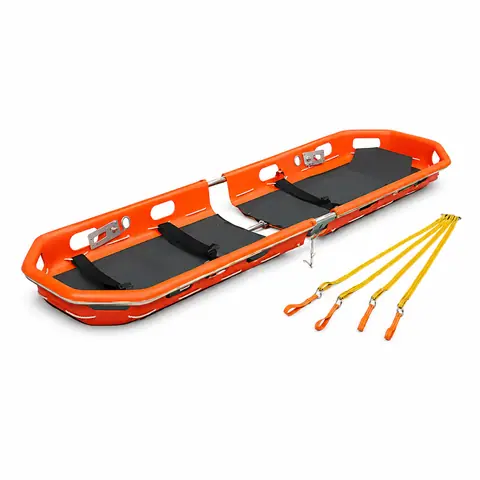
A basket stretcher is a rigid tub-shaped stretcher made of plastic, metal or composite, with a raised rim, restraint straps and many handholds. It protects the patient during carries over rocks, through rubble, on ropes or under a helicopter.
The KL-MS008 Hanging Basket Stretcher hanging basket stretcher measures 2190 × 640 × 180 mm and includes a 4-leg lifting sling set for hoisting and vertical extraction. Rescue teams often place a spine board or vacuum mattress inside the basket for added immobilization.
Stair chairs and stretcher chairs
Some patients are better moved sitting up. Two device types cover this need.
A stair chair is a folding, wheeled chair for moving a seated patient up or down stairs; many have tracks so the chair glides down the steps. Read our stair chair and evacuation chair guide for details.
A stretcher chair converts from a reclining chair into a flat stretcher. It is used in day surgery, endoscopy and dialysis units to reduce chair-to-stretcher transfers. A wheelchair stretcher, by contrast, usually means a wheelchair that reclines fully flat, which suits long-term care more than acute transport.
Specialty stretchers: bariatric and mortuary
Two groups of stretchers are defined by who they carry rather than where they are used.
Bariatric stretchers
A bariatric stretcher has a reinforced frame, wider platform and higher safe working load than a standard model. Many standard stretchers are rated around 150–160 kg (330–350 lb), so bariatric programs need a model with a clearly higher rating.
When planning a bariatric stretcher, check more than the load:
- Platform width and overall width with rails up
- Door, corridor and elevator dimensions on the route
- Castor size and push forces for staff
- Compatible bariatric mattress, lifts and wheelchairs
- Ambulance fastening rated for the load
In Europe, heavy-duty ambulance stretchers are addressed by EN 1865-3. Ask the manufacturer to confirm the standard and load rating for the exact model.
Mortuary stretchers
Mortuary and funeral home stretchers move deceased persons with dignity. They range from simple wheeled stretchers to cots with collapsible undercarriages for loading into removal vehicles.
Look for a fitted cover, a raised edge or tray to contain fluids, surfaces that tolerate strong disinfectants, and a load rating suited to the population served.
A note on terms: searches for "back stretcher," "leg stretcher" or "back cracker stretcher" usually refer to fitness and stretching products, not patient-handling equipment. This guide covers medical stretchers only.
How much is a stretcher?
There is no single price; it depends on type, materials and options. As a rough order from lowest to highest cost:
- Soft and folding pole stretchers
- Scoop stretchers, spine boards and vacuum mattresses
- Basket stretchers and stair chairs
- Fixed-height hospital transport stretchers
- Hydraulic or crank height-adjustable hospital stretchers
- Powered ambulance stretchers and powered stair chairs
Within each type, price is driven by frame material, mattress, accessories, quantity and the documentation needed for the destination country. For the cleanest comparison, request quotes against a written specification.
How to choose stretchers for your facility or fleet
Start with each care setting, then choose the simplest stretcher that does the job safely. A practical process:
- List each use: ED, wards, OR, imaging, ambulance, events, rescue, mortuary.
- Survey routes: doors, corridors, elevators, stairs, vehicle floors.
- Define the patient population, including bariatric and pediatric patients.
- Set key numbers: length, width, height range, safe working load in kg and lb.
- Choose features: backrest range, side rails, brakes, castors, mattress, accessories.
- Request documents: IFU, quality system certificate, declaration of conformity or registration that applies to the model and destination country.
- Plan service: spare parts, mattresses and castors over the expected life.
For a new facility, our hospital equipment list shows where stretchers fit in the wider equipment plan.
Next steps
Most hospitals and EMS services need several types of stretchers, not one. Matching each type to its setting keeps budgets on the devices that need them, such as powered cots, and simple, robust models everywhere else.
Keling Medical manufactures hospital transport stretchers, ambulance stretchers, folding, scoop, basket and vacuum stretchers, spine boards and stair chairs. Browse the stretchers and first-aid range or send your list and quantities for a quote.
Frequently asked questions
What are the main types of stretchers?
The main types of stretchers are wheeled hospital transport stretchers, ambulance stretchers (cots), folding or pole stretchers, scoop stretchers, spine boards, vacuum mattresses, basket rescue stretchers, soft or flexible stretchers, stair chairs, stretcher chairs, bariatric stretchers and mortuary stretchers. Each is designed for a specific setting, from the emergency department to mountain rescue.
What is a hospital stretcher called?
A hospital stretcher is also called a patient transport stretcher, patient trolley, gurney or transport cart, depending on country and department. In American hospitals gurney and stretcher are often used interchangeably. Procurement documents usually say patient transport stretcher or patient transportation trolley and then specify height adjustment, rails and load.
What is a bariatric stretcher?
A bariatric stretcher is designed for patients of higher body weight, with a reinforced frame, a wider patient platform and a higher safe working load than a standard stretcher. Many standard stretchers are rated around 150–160 kg (330–350 lb); bariatric models are rated substantially higher. Check door widths and elevator size, because a bariatric stretcher is wider.
How much is a stretcher?
Stretcher prices vary widely by type. Folding pole stretchers and soft stretchers are the lowest-cost devices, scoop stretchers and spine boards are moderate, hydraulic hospital stretchers cost more, and powered ambulance stretchers are the most expensive. Quantity, materials, mattress, accessories and destination-country documentation all affect the price, so request quotations against a written specification.
What is a stretcher chair?
A stretcher chair is a transport device that converts between a seated position and a flat stretcher. It is used in day surgery, endoscopy, dialysis and outpatient units where patients spend most of their time seated but may need to lie flat. It saves transfers between a chair and a separate stretcher.
What type of stretcher does the military use?
Military forces commonly use lightweight folding litters with poles and fabric beds that can be carried by two to four people and loaded into vehicles and aircraft. Rigid plastic skid stretchers and basket stretchers are also used for evacuation over rough terrain. Specific dimensions are often set by the purchasing force's own specifications.
What is a mortuary stretcher?
A mortuary stretcher is used by hospitals, funeral homes and coroners to move deceased persons with dignity. Models range from simple wheeled stretchers to cots with collapsible undercarriages for loading into vehicles. They often include a cover, a raised edge or tray to contain fluids, and surfaces that tolerate strong disinfectants.