Planning guides
Sterile processing (CSSD): workflow, equipment and technician roles
How sterile processing works in a hospital CSSD: the reprocessing workflow, zones and airflow, equipment list, and what a sterile processing technician does.

Sterile processing is the hospital service that makes reusable medical devices safe for the next patient by cleaning, inspecting, packaging, sterilizing, storing and distributing them. It usually runs from one central sterile processing department, called the CSSD, SPD or central sterile services. This guide covers the workflow, the room layout, the sterile processing equipment you need and the roles of the people who run it.
What is sterile processing?
Sterile processing is a controlled, documented sequence that turns a contaminated instrument into a sterile one and proves that it happened. It serves the operating rooms first, but also wards, the emergency department, outpatient clinics, delivery suites and dental units.
Centralizing the work in one department has clear advantages: specialist staff, validated equipment, standard methods and one set of records. Small hospitals and clinics may run a compact sterilization room instead, but the same principles apply. Reference documents include ANSI/AAMI ST79 (steam sterilization and sterility assurance in health care facilities), ISO 17665 for moist heat processes, ISO 15883 for washer-disinfectors, and ISO 11607 for packaging. National guidance, such as the WHO and PAHO decontamination manual or country-specific health technical memoranda, often sets local requirements.
The sterile processing workflow, step by step
The workflow always runs one way, from dirty to clean to sterile. Items never move backward through the department.
- Point-of-use treatment. Immediately after a procedure, staff remove gross soil, discard sharps and disposables, and keep instruments moist with a pre-cleaning spray or damp cover so soil does not dry on.
- Transport. Contaminated items travel in closed, labeled containers or carts to decontamination.
- Decontamination and cleaning. Manual brushing, lumen flushing, ultrasonic cleaning and washer-disinfector cycles remove soil and reduce bioburden.
- Inspection and assembly. Each instrument is checked for cleanliness, function and damage, under a lighted magnifier, and sets are assembled to count sheets.
- Packaging. Sets are wrapped, pouched or placed in rigid containers with internal and external chemical indicators.
- Sterilization. Steam for most loads; low-temperature methods for heat-sensitive devices.
- Cooling and sterile storage. Loads cool before handling, then go to clean, dry, controlled storage.
- Distribution. Sets go out on case carts or as requested, with records linking each set to its load and, ideally, to the patient.
The two things that most often cause failures are steps 3 and 5: poor cleaning and poor packaging. Sterilization of surgical instruments cannot correct either.
Zones, airflow and environmental conditions
A sterile processing department is divided into physically separate zones with controlled air pressure and a one-way flow of people and items.
| Zone | Main activities | Air pressure | Typical conditions to check |
|---|---|---|---|
| Decontamination (dirty) | Receiving, manual cleaning, washer loading | Negative to adjacent areas | Cooler temperature; about 10 air changes per hour; PPE |
| Preparation and packaging (clean) | Inspection, assembly, wrapping | Positive | Comfortable working temperature, controlled humidity, good lighting |
| Sterilization | Sterilizer loading and unloading | Positive (clean side) | Heat extraction around sterilizers |
| Sterile storage | Shelving of packaged items | Positive | At or below about 24°C (75°F); humidity generally capped at 60–70% |
Pass-through washer-disinfectors and double-door sterilizers form the physical barrier between zones: items load on one side and unload on the other. Hand-hygiene stations at every zone entrance and separate staff routes reinforce the separation. Exact values depend on the edition of ANSI/AAMI ST79 and ASHRAE 170 or your national standard, so confirm the current figures with your engineering team.
Cleaning and decontamination
Cleaning is the most important step in sterilizing medical equipment, because soil, blood and biofilm shield microorganisms from steam or gas. The decontamination area needs:
- Deep stainless steel sinks with separate wash and rinse basins and lumen flushing guns. Keling's KL-TC060 Stainless Steel Washing Sink washing sink comes in 1,000, 2,000 and 3,000 mm widths.
- Ultrasonic cleaners for hinged and serrated instruments.
- Washer-disinfectors to ISO 15883 for thermal disinfection of instruments, containers and carts.
- Detergents compatible with the instruments, with dosing equipment.
- Drying cabinets or medical-grade compressed air for lumens.
- Personal protective equipment: fluid-resistant gowns, gloves, face shields.
Always follow the device's instructions for use (IFU) for brushes, detergents, water quality and disassembly. Complex instruments, such as those with long lumens, may need specific flushing steps.
Inspection, assembly and packaging instruments for sterilization
In the clean area, technicians inspect each item, check that hinges move freely and cutting edges are intact, and test insulation on electrosurgical instruments. Damaged items are removed for repair or replacement.
Packaging instruments for sterilization uses three main systems:
- Wraps (woven or nonwoven), usually two layers, folded in a standard pattern.
- Peel pouches for single or light instruments, heat-sealed with a validated sealer.
- Rigid containers with filters or valves, reusable and stackable.
Inside, perforated stainless steel trays such as the KL-TC076 Stainless Steel Sterilization Tray hold instruments open and spread out, so steam reaches every surface and condensate can drain. Keep set weight within the limits your sterilizer and packaging validation allow; heavy, dense sets dry poorly. All packaging must comply with ISO 11607 and be compatible with the sterilization method.
Sterilization of surgical instruments
Steam is the primary method for sterilizing surgical instruments. A department typically runs prevacuum cycles at 134°C or 132–135°C for wrapped sets, with a daily Bowie-Dick type test and regular biological indicators. Low-temperature systems, usually hydrogen peroxide, handle heat-sensitive devices, and some hospitals send ethylene oxide work to an external provider.
Large hospitals need horizontal, front-loading chambers that take several sterilization units per cycle, such as the KL-ST004 Horizontal Pressure Steam Sterilizer (150–400 L) or KL-ST005 Horizontal Steam Sterilizer (150–360 L, 115–138°C). Smaller facilities and satellite units often work with vertical or benchtop autoclaves. Our autoclave and steam sterilizer guide covers sizing and specification, and the sterilization indicators guide explains how each load is monitored and released.
Sterile processing equipment checklist
| Area | Equipment |
|---|---|
| Point of use and transport | Closed transport carts, instrument containers, pre-cleaning spray, sharps containers |
| Decontamination | Stainless sinks, lumen flushing guns, ultrasonic cleaner, washer-disinfectors, drying cabinet, PPE |
| Clean preparation | Packing tables, lighted magnifiers, insulation tester, heat sealer, wraps, pouches, containers, trays, label printer |
| Sterilization | Steam sterilizers (at least two), low-temperature sterilizer, loading carts, indicators, data logging |
| Storage and distribution | Wire shelving or closed cabinets, case carts, stainless steel trolleys |
| Records | Instrument tracking software or barcode system, load records, maintenance logs |
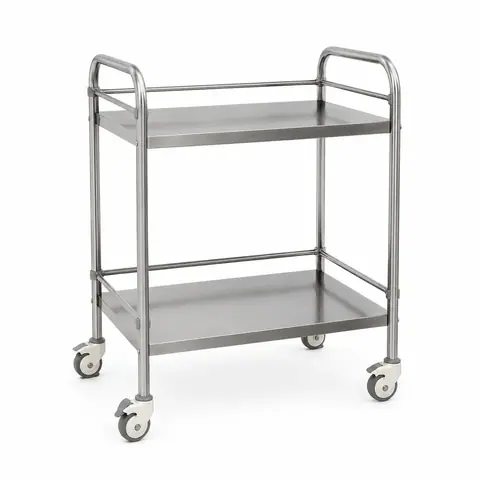
Instrument tables and carts in the department should be stainless steel so they tolerate repeated cleaning; examples are the two-tier KL-TC036 Instrument Trolley instrument trolley and closed storage cabinets with glass upper doors such as the KL-TC063 Stainless Steel Cabinet.
What does a sterile processing technician do?
A sterile processing technician, also called an SPD technician or central sterile technician, reprocesses reusable medical devices. Core sterile processing technician responsibilities are:
- Receiving and sorting contaminated instruments, wearing proper PPE.
- Manual and mechanical cleaning to each device's IFU.
- Inspecting instruments for cleanliness, function and damage.
- Assembling trays accurately to count sheets.
- Packaging, labeling and loading sterilizers.
- Running sterilizer cycles, Bowie-Dick tests and biological indicators, and documenting results.
- Storing and distributing sterile items, and assembling case carts for surgery.
- Tracking instruments, reporting defects and supporting recalls.
Many hospitals require or prefer certification from a recognized sterile processing certification body, and training usually includes supervised clinical hours in a working department. A department also needs a manager or lead technician, an educator for competency checks, and support from biomedical engineering for sterilizer maintenance and from infection prevention for policy.
Planning or upgrading a sterile processing department
When planning a new CSSD, or a sterilization room in a smaller hospital, work through these steps:
- Estimate peak daily volume: surgical sets, ward items, dental and outpatient instruments.
- Map the one-way flow from receiving to distribution, with physical barriers between zones.
- Size washers and sterilizers for the peak, with at least one redundant unit of each.
- Confirm utilities: steam or electric generation, treated water, drainage, three-phase power, ventilation.
- Plan storage for sterile sets and consumables, and space for carts.
- Write a documentation and traceability system from day one.
- Budget for validation, staff training and preventive maintenance.
Our operating room equipment checklist helps align the CSSD with the number and type of surgical suites it serves.
Next steps
Start from your surgical workload, design a strict dirty-to-clean flow, and equip each zone for its task. Keling Medical supplies sterilizers, trays and stainless steel furniture for sterile processing areas; browse the laboratory and sterilization range and request a quote with your room plan and volumes.
Frequently asked questions
What is a sterile processing technician?
A sterile processing technician is a hospital staff member who reprocesses reusable medical devices, mostly surgical instruments, so they are safe to use on the next patient. Technicians work in the central sterile processing department and handle decontamination, inspection, tray assembly, packaging, sterilization and distribution. Many employers require or prefer a recognized certification.
What does a sterile processing technician do day to day?
A typical shift includes receiving used instruments from the operating rooms, manually and mechanically cleaning them, inspecting each item for cleanliness and damage, assembling trays to count sheets, wrapping or containerizing sets, running and documenting sterilizer cycles and indicator tests, and restocking case carts. Technicians also track instruments with barcodes or software and report defects.
What is the primary method for sterilizing surgical instruments?
Steam sterilization is the primary method for surgical instruments because most stainless steel instruments tolerate heat and moisture, and steam is fast, reliable and leaves no residue. Instruments that cannot tolerate steam, such as some powered devices, cameras and flexible scopes, are processed by low-temperature methods like hydrogen peroxide or ethylene oxide as their instructions specify.
What should be done to instruments prior to sterilization?
Instruments must be cleaned, rinsed, dried and inspected before sterilization. Cleaning starts at the point of use by wiping off gross soil and keeping instruments moist, continues with manual and mechanical cleaning in decontamination, and ends with inspection under magnification. Then instruments are assembled, opened or disassembled as required, and packaged in wraps, pouches or rigid containers.
What are the AAMI temperature and humidity guidelines for sterile processing?
US guidance from ANSI/AAMI ST79 and ASHRAE 170 keeps sterile storage at or below about 24°C (75°F) with relative humidity generally not above 60–70% and positive air pressure. Decontamination areas are kept at negative pressure with a higher air change rate. Check the current editions, because limits have been revised over time.
How long do sterile instruments stay sterile?
Most hospitals use event-related shelf life: a packaged item stays sterile until an event compromises it, such as a torn wrap, moisture, a broken seal or a drop to the floor. Storage conditions, packaging material and handling all matter. Some facilities still add time-based expiry dates according to national rules or their own policy.