Buying guides
Surgical lights: ceiling, wall-mounted, mobile and portable compared
Surgical lights compared: ceiling, wall-mounted, mobile and portable operating room lights, plus surgical headlights. Specs, uses and a tender checklist.

Surgical lights come in four mountings: ceiling-mounted, wall-mounted, mobile on a wheeled stand, and portable or compact units. Ceiling-mounted LED surgical lights are the standard for main operating rooms, while mobile and wall-mounted lights serve procedure rooms, backup and minor surgery. Surgical headlights are a fifth, wearable option that complements overhead lights.
Types of surgical lights at a glance
The right surgery light depends mainly on the room, the procedures and the ceiling.
| Type | Typical use | Domes | Strengths | Limitations |
|---|---|---|---|---|
| Ceiling-mounted | Main operating rooms, hybrid and day-surgery theaters | 1, 2 or 3 | Full reach around the table; clear floor; camera and monitor options | Needs ceiling structure, installation and planning |
| Wall-mounted | Small procedure rooms, emergency treatment rooms | 1 | No floor footprint; simpler installation than ceiling | Limited reach; covers one side of the table well |
| Mobile (floor stand) | Backup, minor surgery, rooms without a ceiling mount | 1 or 2 | No installation; can move between rooms | Base takes floor space; cable and stand in the workflow |
| Portable / compact | Field hospitals, outreach, veterinary, clinics | 1 | Light, easy to transport, often battery-powered | Lower output; smaller light field |
| Surgical headlight | Deep, narrow fields: ENT, spine, plastic, dental | n/a (head-worn) | Light follows the surgeon's line of sight | Weight on the head; battery management; small field |
Ceiling-mounted surgical lights
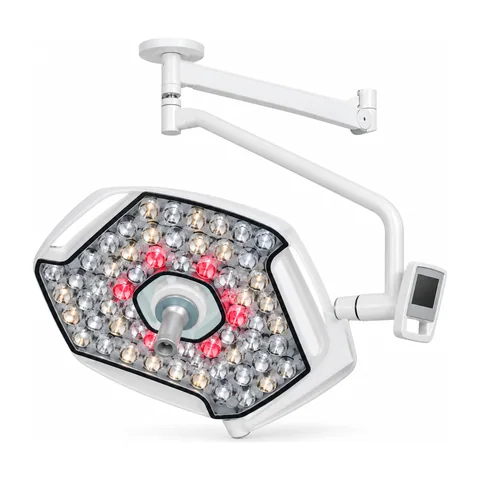
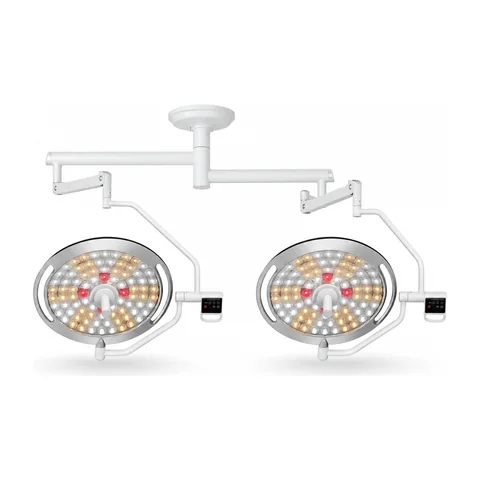
A ceiling mounted surgical light hangs from a central axis on articulated arms that let each dome move around the table. It is the default for operation theatre lights in general surgery, orthopedics, cardiac, neuro and obstetric theaters.
Why ceiling mounts dominate:
- Reach: arms cover both sides of the table and the head and foot ends.
- Multiple domes: two domes approach the field from different directions, which improves shadow control and gives redundancy if one head fails. Triple systems add a third dome for complex cases.
- Clean floor: nothing stands on the floor, so cleaning and traffic are easier.
- Integration: cameras, monitor arms and pendants can share or neighbor the same axis.
Keling's ceiling range includes the single-dome KL-LED-STR78 Single-Dome LED Shadowless Operating Lamp and the double-dome KL-LED-D78 Double-Dome LED Shadowless Operating Lamp, both rated at 160,000 lux per dome, and the KL-LED-DTR78 Double-Dome LED Shadowless Operating Lamp with Camera, a double-dome model with an integrated camera system for teaching and documentation.
Planning points: confirm slab strength and the anchor plate early, check finished ceiling height against arm length, and coordinate positions with medical pendants and booms and laminar airflow canopies so arms do not collide. The operating room design and layout guide covers clearances.
Wall-mounted surgical lights
A wall-mounted surgical light places one dome on a jointed arm fixed to a structural wall. It suits small procedure rooms, emergency treatment rooms and clinics where the ceiling cannot carry a load or where a false ceiling would make installation costly.
The trade-off is reach. A wall arm covers the side of the table nearest the wall well but struggles to light the far side without the head being pulled to the end of its range. Place the table with the main working side toward the wall, and check arm reach in mm against the room drawing before ordering.
Mobile surgical lights
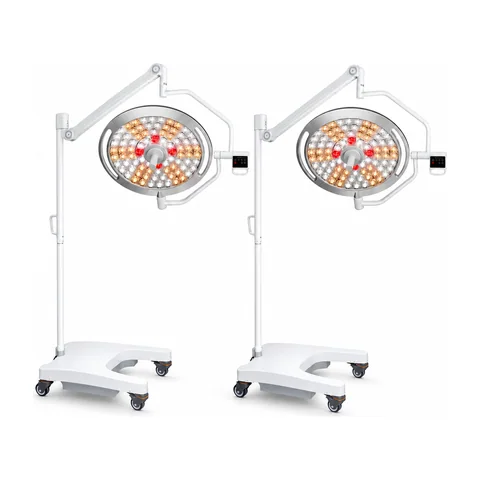
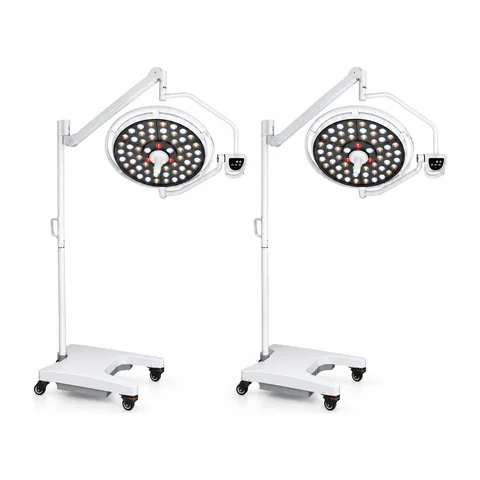
A mobile surgical light mounts the lamp head on a wheeled floor stand with a counterweighted base. It is the most flexible option and needs no installation.
Typical roles:
- Backup: a second light that can be wheeled in if the ceiling light fails or more light is needed.
- Minor surgery and procedures: treatment rooms, emergency departments, maternity and day-surgery units.
- Temporary or phased projects: rooms awaiting ceiling work, or hospitals expanding capacity.
- Shared resources: one light moved between several rooms.
Mobile lights are no longer only small. The KL-LED-MD78 Mobile LED Shadowless Operating Lamp is a mobile single-dome LED light delivering 160,000 lux at 1 m, and the KL-LED-MDT6I Mobile Double-Dome LED Shadowless Operating Lamp puts two domes on one mobile stand.
When comparing mobile units, check the base footprint and stability at full arm extension, castor brakes, the height range of the head, and a built-in battery for mains failures.
Portable surgical lights
A portable surgical light is built to be carried: compact, light, often battery-powered and sometimes foldable into a case. It is used in field and military hospitals, mobile clinics, disaster response, outreach surgery and some veterinary practices.
Expect lower output and a smaller light field than a full surgical light. For a fixed facility that only needs occasional flexibility, a mobile stand is usually a better buy than a portable light.
Surgical headlights: when overhead light is not enough
A surgical headlight is a head-worn LED surgical lamp that projects a spot of light along the surgeon's line of sight. Because the light comes from the same direction as the eyes, almost nothing between the surgeon and the field can block it.
Headlights are common in ENT, spine, cardiac, vascular, plastic, breast and dental surgery, where fields are deep and narrow. Most current LED surgical headlights are cordless, with a rechargeable battery on the headband or belt.
What separates a good headlight from a poor one:
- Light quality: even spot without a dark center or hot ring, good color rendering, adjustable spot size
- Comfort: low weight, balanced headband, adjustable fit for long cases
- Battery: runtime longer than the longest case, with hot-swappable packs
- Optics: compatibility with loupes and a coaxial or near-coaxial beam
- Heat and cleaning: low heat at the forehead; wipeable materials
Headlights supplement overhead operating room lights; they do not replace the room light that the rest of the team works under.
What makes LED operating room lights better than halogen
LED operating room lights have largely replaced halogen in new projects, but halogen lights are still bought where budget matters most.
| Feature | LED surgical lights | Halogen surgical lights |
|---|---|---|
| Heat at the field | Low radiant heat | Higher; needs heat filters |
| Lamp life | Long; individual LEDs rarely replaced | Bulbs replaced regularly |
| Color temperature | Often adjustable | Fixed |
| Energy use | Lower for the same output | Higher |
| Purchase price | Higher | Lower |
How many surgical lights does each room need?
The number of domes follows the complexity of the work done in the room, not the size of the room alone.
- Major theaters (general, orthopedic, cardiac, neuro, obstetric): a ceiling-mounted double-dome system is the common baseline, with a triple system or an added camera where cases are long or teaching matters.
- Day-surgery and minor theaters: a single ceiling dome is often enough, with a mobile light available for backup.
- Procedure and emergency treatment rooms: one ceiling or wall-mounted dome, or a mobile light shared between rooms.
- Departments overall: keep at least one mobile surgical light per theater suite so a failed light never stops a list.
When budgets are tight, it is usually better to fit fewer rooms with properly specified overhead surgical lights and cover the rest with good mobile units than to spread low-output lights across every room.
Specifications that matter for every mounting
Whatever mounting you choose, the light must meet IEC 60601-2-41, the standard for surgical luminaires. Compare offers on:
- Central illuminance (Ec) at 1 m; the standard allows 40,000 to 160,000 lux
- Light field diameters d10 and d50, and whether the field size is adjustable
- Color rendering Ra (85 to 100) and R9, plus color temperature range
- Depth of illumination (L1 + L2)
- Shadow dilution results with masks and a simulated cavity; see why surgical lights cast almost no shadow
- Total irradiance at maximum output
- Backup behavior: how quickly light returns after a power or source failure, and battery runtime
- Endo or ambient mode for minimally invasive surgery
- Camera resolution and video output, if needed
- Arm reach, rotation and ceiling height range (for ceiling and wall mounts)
The detailed meaning of each figure is in the guide on how to choose an LED surgical light.
Buying surgical lights for sale: what to ask the manufacturer
When you request quotations for operating room lights, ask each supplier for:
- The IEC 60601-1 and IEC 60601-2-41 test reports for the exact model offered
- The manufacturer's ISO 13485 certificate and the registration that applies in your country
- Ceiling mount drawings, load data and installation requirements
- Spare parts list and price, including LED boards, handles and power supplies
- Warranty terms, service manual and training for biomedical engineers
- Lead time and packing method for the lamp heads and arms
Ask for documents that apply to the model and destination country, not a generic brochure.
Next steps
Start from the room list: main theaters usually get ceiling-mounted double domes, procedure rooms a single ceiling or wall dome, and every department at least one mobile light for backup. Browse Keling's surgical lights, or request a quote with your room drawings and the export team will propose a configuration.
Frequently asked questions
What are the main types of surgical lights?
There are four mounting types: ceiling-mounted (single, double or triple domes on articulated arms), wall-mounted (one dome on a wall arm), mobile (a lamp head on a wheeled floor stand) and portable or compact lights for field and minor use. Surgical headlights, worn by the surgeon, are a separate category that supplements overhead lighting.
Is a ceiling mounted surgical light better than a mobile one?
For a main operating room, yes. A ceiling mounted surgical light reaches across the whole table, supports two or three domes, does not take floor space and is easier to keep clean around. A mobile surgical light is cheaper and needs no installation, which makes it the better choice for backup, minor procedures and rooms without ceiling structure.
How bright are LED operating room lights?
IEC 60601-2-41 requires central illuminance between 40,000 and 160,000 lux at 1 m for a surgical luminaire. Many LED operating room lights for general surgery reach the upper end, around 160,000 lux per dome. Minor-surgery and dental lights often deliver about 80,000 lux, which is enough for shallow fields.
What is a surgical headlight used for?
A surgical headlight is a head-worn LED light that shines along the surgeon's line of sight into narrow or deep fields where overhead light is easily blocked, for example in ENT, spine, cardiac, plastic and dental surgery. Most are cordless, with a rechargeable battery pack worn on a belt or headband, and are used together with overhead lights.
What should I look for in the best surgical headlight?
Look for even, color-accurate light with a sharp-edged spot, an adjustable spot size, a comfortable and well-balanced headband, battery life that covers your longest case with a hot-swap option, and low heat. Compatibility with loupes and easy cleaning matter as much as peak brightness.
Do mobile surgical lights need a battery?
They are not required to have one, but a built-in battery is strongly recommended. It keeps the light running during a mains failure and lets the light be moved without unplugging mid-case. Check how long the battery runs at full output and how the light behaves when switching to battery.
How much do surgical lights for sale cost?
Price depends on mounting, number of domes, illuminance, camera options and installation. Mobile single-dome lights are the entry point; ceiling-mounted double domes with cameras are at the top of the range. Request quotations on the same specification so the offers are comparable, and include installation, the ceiling mount and spare parts.