Buying guides
Electric or manual hospital beds? 2-, 3- and 5-function beds explained
What each hospital bed function does, when an electric bed is worth it, and how to choose between 2-function manual, 3-function and 5-function electric ICU beds.

"Function" is the word every hospital bed datasheet leads with, and it causes more confusion than any other. This guide explains what each function does clinically, which combinations suit which ward, and what else to check before you sign a purchase order.
What a bed "function" is
A function is an independent adjustment of the bed. On a manual bed each one has a crank; on an electric bed each has a motor (actuator) controlled from a handset or nurse panel.
| Function | What it does | Why it matters |
|---|---|---|
| Backrest | Raises the head section | Breathing, feeding, reading, reducing aspiration risk |
| Knee-rest | Raises the knee section | Stops the patient sliding down; reduces shear on the sacrum |
| Height | Raises and lowers the whole platform | Safe transfers at low height, ergonomic care at working height |
| Trendelenburg | Tilts head-down | Shock positioning, central line insertion |
| Reverse Trendelenburg | Tilts head-up | Respiratory and post-operative positioning, reflux |
Two-function manual beds
A 2-function manual bed adjusts backrest and knee-rest with two cranks. It is simple, needs no power and is easy to maintain, which makes it the backbone of general wards, rural hospitals and field deployments. Keling's KL-BC107 Manual Hospital Bed is a typical example.
Its limit is height. A fixed platform height forces either the patient (at transfer) or the nurse (during care) into a poor position.
Three-function beds
A 3-function bed adds height adjustment. The bed can drop low for getting in and out, then rise to a comfortable working height for washing, dressings and examinations. That one function makes a large difference to back injuries among nursing staff. The KL-BC104 Electric Hospital Bed is a 3-function electric bed with height adjustment.
Five-function electric beds: the ICU standard
A 5-function electric bed adds Trendelenburg and reverse Trendelenburg tilt. In intensive care, surgical recovery and high-dependency units, these positions are used daily, and electric control lets one nurse make them quickly. The Keling KL-BC101 Electric Hospital Bed is a 5-function ICU bed with:
- backrest to 70° and knee-rest to 40°
- height range 480–760 mm
- Trendelenburg and reverse Trendelenburg of 13°
- CPR instant release that drops the backrest flat in one action for chest compressions
- a nurse lock to stop the patient changing settings
- a 0–90° backrest angle indicator
- 240 kg safe working load, with optional weighing and battery backup
Beyond the function count
Two 5-function beds can still be very different products. Compare these points as well:
Safe working load. It must cover patient, mattress and accessories. Bariatric patients need a higher rating.
CPR release. On ICU beds this is essential. Check it works mechanically, without power.
Side rails. Gaps between rails, headboard and mattress are an entrapment risk. IEC 60601-2-52, the safety standard for medical beds, sets dimensional limits; ask for the test report.
Castors and brakes. Central locking from one pedal saves time. Larger castors roll more easily over thresholds.
Battery backup. Lets staff lower or flatten the bed during a power cut or while moving it.
Cleanability. ABS head and foot boards and smooth, sealed joints are easier to disinfect than open steel frames.
Mattress. Order the right mattress with the bed. Long-stay ICU patients benefit from an alternating air mattress such as the KL-P003 Air Mattress.
Which bed for which ward?
| Ward | Typical choice |
|---|---|
| ICU, CCU, HDU | 5-function electric with CPR release |
| Surgical and elderly care wards | 3-function electric |
| General medical wards | 2-function manual, or 3-function electric where budget allows |
| Maternity | Electric birth bed such as the KL-BC110 Electric Gynecological Birth Bed for labour rooms |
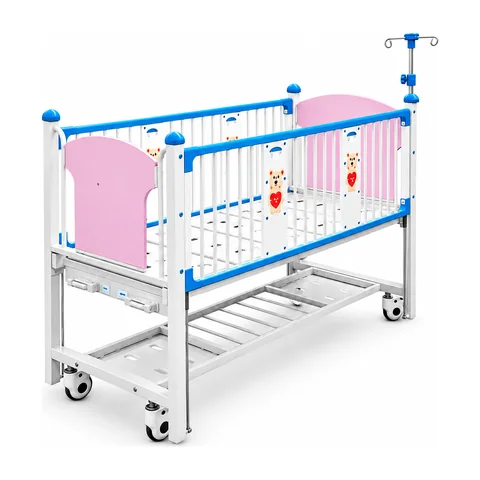
| Paediatrics | Child cots with full-length rails, such as the KL-BC114 Child's Cot |
Ordering tips for projects
- Confirm voltage and plug type for electric beds before production.
- Order accessories with the beds: IV poles, drainage hooks, headboards, mattresses. Mixing suppliers later rarely saves money.
- Ask for the packing list and carton dimensions to plan container loading.
Browse Keling's hospital beds or send your ward list through the quote form.
Frequently asked questions
What does "5-function" mean on a hospital bed?
It means the bed has five independent adjustments - backrest, knee-rest, bed height, Trendelenburg (head down) and reverse Trendelenburg (head up). Each has its own motor on an electric bed.
Is an electric hospital bed worth the extra cost?
For ICUs, surgical and elderly wards it usually is, because electric height adjustment cuts manual handling for nurses and lets patients reposition themselves. For low-acuity wards with unstable power, a manual bed is often the more reliable choice.
What safe working load should a hospital bed have?
Many hospital beds are rated around 170–250 kg. The safe working load must cover the patient, mattress and any accessories. Keling's KL-BC101 ICU bed is rated at 240 kg.