Buying guides
Portable suction machines: choosing a suction unit for home and hospital
How to choose a portable suction machine for home or hospital: battery vs AC power, vacuum and flow, jar size, noise, manual pumps and a buyer's checklist.

A portable suction machine is a compact electric or manual suction pump with a collection jar, used to clear mucus, saliva, phlegm, blood or vomit from a patient's mouth, nose or tracheostomy wherever wall suction is unavailable. Hospitals use portable suction units on crash carts, in transport and as backup; patients use home suction machines for long-term airway care under their clinicians' direction.
This guide explains the types of portable suction device, the specifications that matter for home and hospital use, manual backups, and a buyer's checklist. For a general primer on free air flow, vacuum classes and collection jars, see our medical suction machine guide.
What is a suction machine?
A medical suction machine is a vacuum pump connected through a filter and overflow valve to a collection jar, with patient tubing leading to a suction tip or catheter. The pump creates negative pressure, which draws fluid from the patient into the jar.
The terms overlap:
- Suction machine, suction unit, suction device and suction equipment are general terms.
- Aspirator machine or suction aspirator means the same thing; "surgical aspirator" usually refers to high-flow theater units.
- Sputum, phlegm, mucus and saliva suction machines are airway suction machines, usually portable, used for oral, nasal and tracheostomy suctioning.
Portable, mobile and wall suction compared
Facilities usually need all three. The difference is where the vacuum comes from and how the unit moves.
| Type | Vacuum source | Typical collection | Mobility | Best for |
|---|---|---|---|---|
| Portable suction unit | Electric pump, AC or AC/DC with battery | About 1,000 ml | Carried by hand | Home care, wards, crash carts, transport |
| Mobile suction machine | Electric pump on castors | Two jars of 2,000–2,500 ml | Rolled between rooms | Operating rooms, emergency departments, delivery rooms |
| Hospital wall suction | Central pipeline vacuum | Wall-mounted canisters | Fixed at bed head or pendant | ICU, wards, theaters with pipeline vacuum |
| Manual suction pump | Hand or foot | Small jar or bag | Very portable | Backup, field and disaster use |
Portable and mounted suction units serve different roles. A portable unit goes with the patient; a mounted or wall system stays with the bed space. Most hospitals plan at least one portable unit per area that lacks pipeline vacuum, plus portable units for every crash cart and transport team.
Portable suction in the hospital
In hospitals, portable suction machines fill four gaps:
- Resuscitation. Every crash cart and emergency bag needs reliable suction that does not depend on a nearby wall outlet.
- Transport. Patients moving between departments, or between hospitals, need suction en route.
- Areas without pipeline vacuum. Outpatient clinics, dialysis units, imaging rooms, older wards.
- Backup. If pipeline vacuum or power fails, battery units keep airway suction available.
For these uses, a battery or AC/DC unit is the most flexible choice. Keling's DFX-23B-II Portable Electric Suction Machine portable electric suction machine delivers 28 L/min or more free air flow, a negative pressure range of 0.013–0.085 MPa (about 100–640 mmHg), AC/DC dual power compatible with vehicle supply and up to 2 hours of self-stored battery operation, with a 1,000 ml medical-grade plastic vessel.
Portable suction machines for home use
A portable suction machine for home use is prescribed for people who cannot clear their own airway secretions. Common reasons include a tracheostomy, neuromuscular conditions that weaken coughing and swallowing, stroke with swallowing difficulty, and palliative care, where clearing saliva and mucus improves comfort.
What matters most in a home suction machine:
- Adjustable vacuum and a clear gauge, so the caregiver can set the pressure the care team prescribes.
- Quiet operation. Home units may run day and night in a bedroom.
- Simple, washable jar and lid that a caregiver can disassemble and reassemble correctly.
- Overflow valve and bacterial filter, with spares easy to obtain.
- Battery option if the patient goes out, attends school or day care, or lives where power cuts are common.
- Local service and consumables, including catheters, tubing and filters.
The patient's clinicians should choose the suction settings and catheters and train caregivers before discharge. A home suction machine is often part of a wider home-care setup; our guide to hospital beds for home care covers the bed side of that plan.
Oral and saliva suction machines
An oral suction machine for home use is typically a portable unit fitted with a Yankauer tip, used to clear saliva and mucus from the mouth. Saliva suction machines are often used by people with drooling caused by neurological conditions. Low noise and a fast start matter here, because the unit may be used many times a day.
Mucus suction machines for adults
A mucus suction machine for adults with a tracheostomy needs adjustable vacuum, sterile or clean catheters as prescribed, and a reliable backup. Technique, catheter size and pressure are set by the care team; see suctioning explained for background on tracheostomy suctioning.
Nasal suction devices for babies and children
Simple nasal suction devices and nose suction machines sold for children are designed to clear a blocked nose, not for clinical airway suctioning. For most infants, saline drops and a bulb syringe are enough. Parents should seek medical advice for any breathing difficulty and use a powered infant suction device only if a clinician recommends it.
Specifications that matter in a portable suction unit
These figures separate a dependable portable medical suction machine from a frustrating one.
| Specification | Why it matters | What to look for |
|---|---|---|
| Free air flow (L/min) | How quickly the unit clears fluid | Airway units commonly 15–30 L/min; higher for emergency use |
| Vacuum range (MPa, kPa or mmHg) | Must reach the prescribed setting, and go low enough for gentle suction | Adjustable regulator with a readable gauge |
| Collection jar | Fewer changes, easy cleaning | About 1,000 ml for portable units; clear graduations |
| Power | Where the unit can run | AC only, or AC/DC with battery and vehicle power |
| Battery runtime | Transport and power cuts | Stated runtime and charge time |
| Noise (dB) | Comfort at home and on wards | 55–65 dB or less |
| Input power (VA) | Running cost, compatibility with backup power | Lower VA eases inverter and generator use |
| Protection | Pump life and infection control | Overflow valve and bacterial filter |
Keling's portable sputum suction machines show how these trade off:
- The DFX-23A-I Electric Sputum Suction Machine provides 18 L/min or more free air flow, a 0.013–0.08 MPa (about 100–600 mmHg) negative pressure range, a 1,000 ml plastic vessel, 55 dB or less noise and 150 VA input power.
- The DFX-23A-II Electric Sputum Suction Machine provides 15 L/min or more free air flow, a 0.013–0.07 MPa (about 100–525 mmHg) range, the same 1,000 ml vessel and noise level, and a low 50 VA input power.
Manual suction pumps and handheld suction devices
A manual suction pump creates vacuum when the user squeezes a hand pump or presses a foot pedal. Manually powered suction equipment is covered by ISO 10079-2. Because a manual suction device needs no power or battery, it is valuable:
- As a backup for home tracheostomy patients during power cuts
- In ambulances, first-aid kits and disaster response
- In remote clinics with unreliable electricity
The limits are that flow is intermittent, sustained use tires the operator, and collection volume is small. Treat a hand-held suction pump as a backup to an electric unit, not a replacement.
Devices that are not suction machines
Several products appear in searches for mucus and suction devices but do a different job:
- Flutter (oscillating positive expiratory pressure) mucus removal devices are breathing devices that help loosen and move mucus by vibration during exhalation. They do not apply suction and are prescribed as part of airway clearance therapy.
- Anti-choking devices are consumer plunger-type products. They are not medical suction machines or a substitute for recognized first aid.
- Urine suction devices for incontinence care use external collection systems designed for that purpose. An airway suction machine should never be used for urine collection.
How to use a suction machine safely
Users must be trained, and the manufacturer's instructions for use always take priority. In general terms, safe use includes:
- Check the jar, lid, seals, overflow valve and filter are fitted correctly
- Connect the tubing and the prescribed tip or catheter
- Switch on, occlude the tubing and confirm the gauge reaches the required vacuum
- Set the vacuum to the prescribed level
- Suction as trained, keeping each pass brief
- Rinse the tubing with clean water after use
- Empty and clean the jar at least daily, or when it reaches the fill line
- Replace filters, tubing and catheters at the intervals in the IFU
- Keep the battery charged and test the unit regularly, including backup units
Buying portable suction machines: a checklist
For hospitals, home-care programs and distributors comparing suction machines:
- Intended use: home airway care, ward, crash cart, transport or field use
- Free air flow and vacuum range, with gauge units your staff use (mmHg or kPa)
- Power: voltage, plug, battery type, runtime, charge time, vehicle adapter
- Jar size and material, and availability of spare jars
- Overflow protection and bacterial filter, with spare filter part numbers
- Noise level and input power
- Compliance with ISO 10079-1, the manufacturer's ISO 13485 certificate, and the registrations that apply in your country
- IFU in local language, training materials and warranty terms
- Consumables plan: tubing, catheters, Yankauer tips, filters
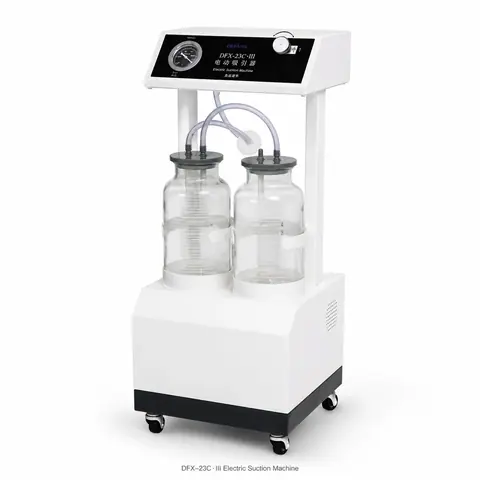
If you also need high-flow theater units, the mobile DFX-23C series covers that role; the DFX-23C-III Electric Suction Machine delivers 60 L/min or more free air flow, with 80 L/min optional. Our guide to Yankauer suction tips, canisters and tubing helps standardize the consumables across all units.
Next steps
Decide where each portable suction machine will be used, by whom and on what power, then fix flow, vacuum, jar and battery requirements in your specification. Browse Keling's suction machines or request a quotation with quantities and destination country.
Frequently asked questions
What is an aspirator machine?
An aspirator machine is another name for a suction machine: a device that uses a vacuum pump to draw fluids and secretions out of the body into a collection jar. Small airway models are often called sputum, phlegm or mucus aspirators, while larger, high-flow models used in operating rooms are called surgical aspirators.
What is the best portable suction machine for home use?
The best portable suction machine for home use is the one that meets the settings the patient's care team prescribes, with an adjustable vacuum and clear gauge, low noise, an easy-to-clean jar, an overflow valve and filter, and a battery if the patient leaves the house. Local service support and access to spare jars, filters and tubing matter as much as the specification.
How do you use a suction machine at home?
Caregivers should be trained by the patient's clinicians before using a home suction machine. In general, they check the jar, lid and filter are fitted, connect the tubing and catheter, switch on and set the prescribed vacuum, suction briefly as taught, rinse the tubing with clean water afterwards and empty and clean the jar at least daily.
What is the difference between a mucus suction machine and a nasal suction device?
A mucus suction machine is a powered pump with adjustable vacuum, a collection jar and tubing for oral, nasal or tracheostomy suction, usually prescribed for patients with long-term needs. A nasal suction device is typically a simple handheld or battery aspirator for clearing a child's blocked nose, with much lower power and no clinical vacuum control.
Can a portable suction machine run on battery?
Many can. Battery or AC/DC portable suction machines run from an internal rechargeable battery and often from a vehicle power socket, which suits ambulances, home patients who travel and backup during power cuts. Check runtime, charging time and whether the unit can run while charging. Keling's DFX-23B-II provides up to 2 hours of self-stored battery supply.
Do I need a manual suction pump as a backup?
A manual suction pump is a sensible backup wherever an interruption in suction would put a patient at risk, such as home tracheostomy care, ambulances and areas with unreliable power. Hand- and foot-operated pumps need no electricity, but they produce intermittent rather than continuous flow and tire the user, so they are a backup, not a replacement.
Are anti-choking suction devices the same as medical suction machines?
No. Consumer anti-choking devices are handheld plunger-type products marketed for choking emergencies. They are not medical suction machines and are not a substitute for recognized choking first aid and calling emergency services. Ask a certified first-aid trainer for current guidance.