Clinical guides
Why surgical lights cast no shadow: how shadowless OR lights work
Why surgical lights cast almost no shadow: multiple light sources, a large lamp head and converging beams. Learn how shadow dilution is tested and specified.

Surgical lights cast almost no shadow because their light does not come from one point. A shadowless operating lamp spreads many light sources across a wide lamp head and aims them all at the same spot, so a surgeon's head, hands or instruments block only some of the beams while the rest still reach the wound. The shadow is diluted, not erased.
Why surgical lights cast no shadow: the physics in one minute
A single small light source creates a hard shadow. Anything between the source and the surface blocks all the light along that line, producing a dark core called the umbra.
A large source behaves differently. Light arrives at each point of the wound from many directions at once, so an obstruction removes only a fraction of it. What remains is a soft, pale penumbra. This is the whole principle behind the "no shadow" surgical light:
- Many sources: dozens of LEDs with individual lenses, or a halogen bulb with a multi-faceted reflector, each acting as a separate emitter.
- Wide spread: the sources sit across a lamp head often 500 mm (about 20 in) or more in diameter.
- Converging beams: every source is angled toward a common light field roughly 1 m (39 in) below the head.
Because the beams cross at different angles, a hand above the incision blocks light from one side while light from the other side still fills the field.
Do surgical lights cast shadows at all?
Yes, but faintly. No luminaire can make an opaque object transparent, so some light is always lost behind an obstruction. A good surgical light keeps that loss small enough that the surgeon keeps working without repositioning the lamp.
There is also a practical reason not to chase absolute zero. Some contrast helps the eye read depth, surface texture and the edges of tissue planes. The design goal is a shadow too weak to hide anything, not a perfectly flat, contrast-free image.
How shadowless lamps evolved
Early operating rooms relied on daylight from large windows and skylights, which failed whenever staff stood in the way or the weather changed. Electric lighting arrived in the late 19th century, but single bulbs threw hard shadows and a lot of heat.
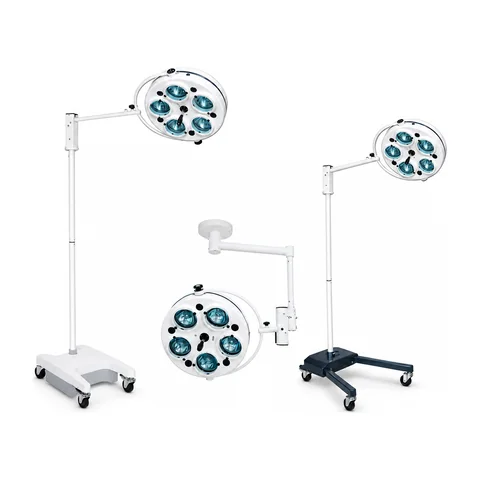
Multi-reflector halogen heads were the first widely adopted fix. One bulb sits inside a reflector made of many small facets, and each facet throws its own beam toward the field. Keling's KL04L Halogen Surgical Light (five-hole head) and KL05L Halogen Surgical Light (six-hole head) are halogen lights built on this principle.
LED surgical lights, in use since the late 2000s, made the approach easier. Each LED is its own small source with its own lens, so engineers can arrange dozens of them across one or more petals of the dome. The ceiling-mounted KL-LED-STZ5 Ceiling-Mounted LED Shadowless Operating Lamp uses five petal domes with 45 LEDs per dome, the kind of layout that spreads light across a wide area.
What actually controls shadows in an operating lamp
Shadow control is not one feature. It is the combined result of several design choices.
| Design factor | Why it matters for shadows | What to look for |
|---|---|---|
| Lamp head diameter | A wider emitting area means more angles of approach around an obstruction | Compare the light-emitting diameter, not just the housing size |
| Number and spread of sources | More separate sources share the load, so blocking one matters less | Sources spread to the edge of the head, not clustered in the center |
| Beam convergence | Beams must meet at the working distance to overlap fully | A stated focus or working distance range |
| Depth of illumination | Keeps light even from the skin surface down into a deep cavity | Declared L1 + L2 value |
| Number of domes | A second dome attacks the field from a different direction | Single, double or triple configurations |
| Positioning | Even the best head casts shadows if it is placed directly behind a head | Easy-moving arms, sterile handle, adequate arm reach |
How shadow dilution is tested under IEC 60601-2-41
IEC 60601-2-41 is the international safety and performance standard for surgical luminaires and luminaires for diagnosis. It replaces vague claims such as "100% shadowless" with a repeatable measurement called shadow dilution.
The test places obstructions between the lamp head and the measuring point and records how much light still arrives, as a percentage of the unobstructed central illuminance:
- One mask: a flat disk about the size of a human head (210 mm) simulates one surgeon leaning over the field.
- Tube: a narrow tube about 50 mm (2 in) wide and 75 mm (3 in) deep simulates a deep wound cavity.
- One mask plus tube: one surgeon working over a deep cavity.
- Two masks plus tube: two surgeons over a deep cavity, the toughest case.
When you compare quotations, ask for these four figures from the test report. A light that keeps a high percentage with two masks and the tube will perform better in real deep-cavity surgery than one that only looks bright on an open field.
Depth of illumination: shadows inside the wound
A surgeon does not only look at the skin surface. In abdominal, thoracic or orthopedic surgery the working site can be several centimeters deep, and the walls of the cavity create their own shadows.
The standard measures depth of illumination as L1 + L2: the distance above and below the reference point over which illuminance stays at or above 60% of the central value (the threshold since the 2009 edition). A larger figure means the surgeon can move deeper, or the table can be raised or lowered, without the light fading or needing to be refocused.
Some double-dome lights quote a combined depth; the ceiling-mounted KL-LED-DT6I Double-Dome LED Shadowless Operating Lamp, for example, states a 108 cm combined depth of illumination.
How the surgical team can reduce shadows
Equipment design does most of the work, but positioning finishes it. General principles that theater teams apply, always alongside the manufacturer's instructions for use and local practice:
- Position the lamp head above and slightly behind the surgeon's head, angled toward the incision, rather than directly overhead.
- With two domes, approach the field from two sides, often one from the surgeon's side and one from the assistant's side.
- Keep the head within its rated working distance so the beams converge on the field instead of in front of or behind it.
- Use the light field size control to match the field to the incision instead of flooding the whole table.
- Refocus or reposition when the depth of the cavity changes significantly.
Room planning matters too. Arm reach, ceiling height and the position of medical pendants all affect whether the team can place the light where it controls shadows best. The operating room design and layout guide covers those clearances.
Color shadows and heat: two related problems
Some early LED surgical lights mixed red, green and blue LEDs with separate optics. When an obstruction blocked part of the head, the remaining light was no longer balanced, and shadows had colored fringes. Modern white-LED designs with good optics avoid this, but it is worth checking on a demonstration.
Heat is the other side effect of concentrating a lot of light. More light sources at lower individual output can reduce hot spots, and the standard limits total irradiance at the field, which protects exposed tissue from drying. Ask for the declared irradiance alongside the shadow-dilution results.
What to put in a specification for shadow control
If shadow performance matters for your theaters, write it into the tender instead of accepting the word "shadowless" on its own:
- Conformity with IEC 60601-2-41, with the test report available on request
- Shadow dilution percentages for all four mask and tube configurations
- Depth of illumination (L1 + L2) at 60%
- Central illuminance (the standard allows 40,000 to 160,000 lux at 1 m) and light field diameters d10 and d50
- Color rendering (Ra and R9) and color temperature range
- Number of domes and the arm system's reach and range of movement
- Total irradiance at maximum output
For mobile or backup use, the same principles apply on a stand. The KL-LED·MSTZ4 Mobile LED Surgical Light is a floor-standing four-petal LED light for rooms without a ceiling mount.
Next steps
Shadow control is one of several specifications that separate a good surgical light from a merely bright one; the companion guide on how to choose an LED surgical light covers the rest, and the overview of ceiling, wall and mobile operating room lights explains mounting choices. Browse Keling's surgical lights or send your theater specification to receive the test documents that apply to the model and destination country.
Frequently asked questions
Do surgical lights cast shadows?
They cast very faint ones. A surgical light sends light from many points across a wide lamp head, so when a hand or instrument blocks some beams, the others still reach the field. The result is a pale, diluted shadow instead of a dark one. Truly zero shadow is not possible, and a little contrast helps surgeons judge depth and tissue texture.
Why are surgical lights called shadowless lamps?
The term describes the effect, not a literal absence of shadow. Multi-source lamp heads were developed so the surgeon's head and hands would not black out the operative site. Manufacturers and tender documents still use 'shadowless operating lamp' as the standard trade name for both halogen and LED surgical lights.
How is shadow dilution measured?
IEC 60601-2-41 places opaque masks the size of a human head between the light and the measuring point, alone and combined with a tube that simulates a narrow, deep wound cavity. The illuminance that still reaches the bottom is expressed as a percentage of the unobstructed value. Higher percentages mean better shadow control.
Do LED surgical lights control shadows better than halogen?
Not automatically. LED heads make it easy to spread many small sources over a large area, which helps, but a poorly designed LED light can still cast hard shadows. Older multicolor LED designs could even produce colored edges. Compare measured shadow dilution and depth of illumination, not the light source type.
Does a double-dome surgical light reduce shadows?
Yes, when positioned well. Two domes approach the field from different directions, so an obstruction that blocks one dome rarely blocks the other. Double domes are common in general surgery and deep-cavity work, and they also provide redundancy if one head fails during a case.
Where should a surgical light be positioned to minimize shadows?
Place the lamp head above and slightly behind the surgeon's head, angled toward the incision rather than straight down from directly overhead. Keep the head within its rated working distance so the light field stays focused. Staff should follow the manufacturer's instructions and local theater practice for positioning.