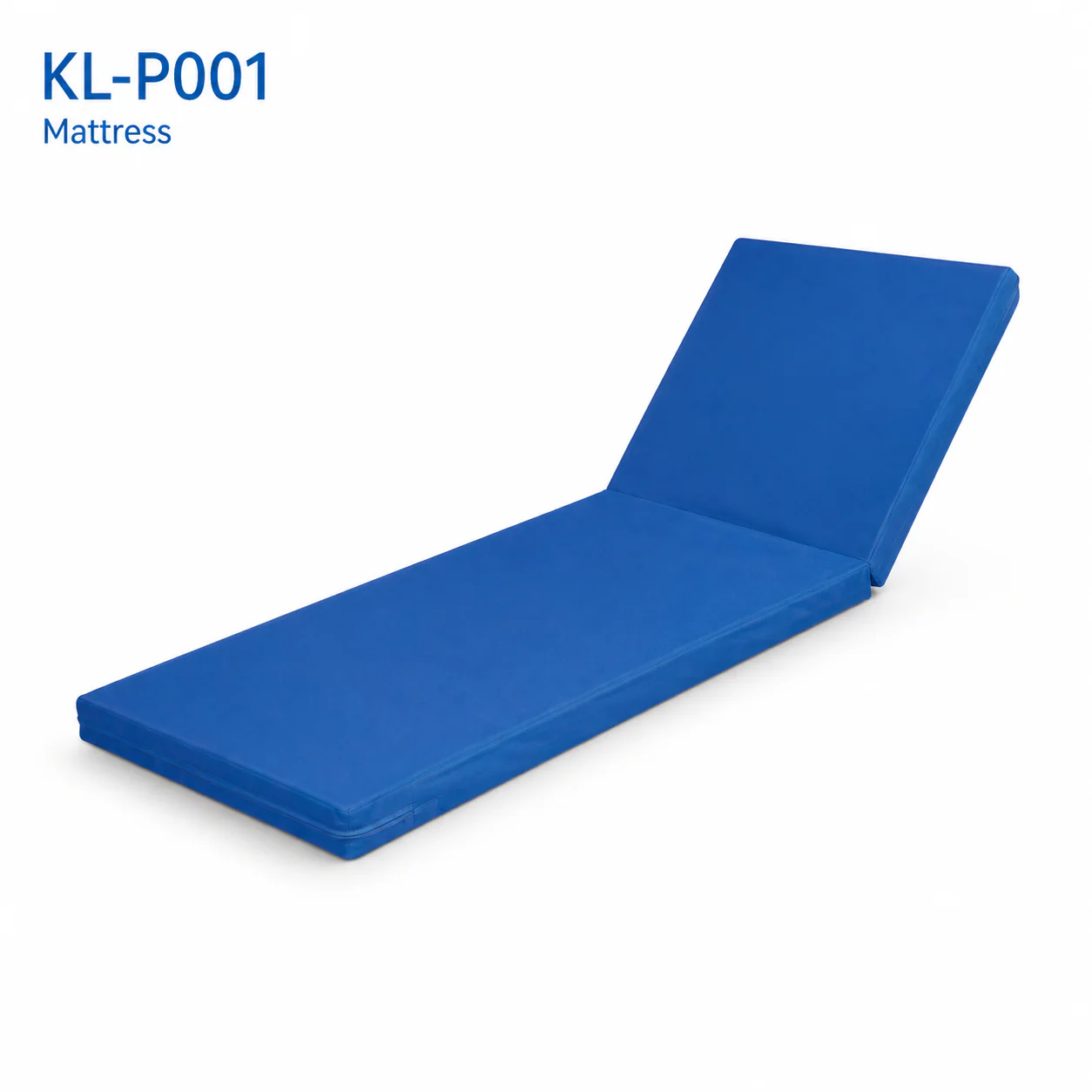
# KL-P001 Mattress — Hospital Bed Mattress in Multiple Fills and Thicknesses
Quick answer: The Keling KL-P001 is a hospital bed mattress with a base size of 190 × 90 mm and five thickness options (60, 80, 100, 120 and 150 mm), available in three fill materials: PU cover, common sponge and high-density sponge. It is manufactured by Keling Medical (Keling Medical) and is applicable to a variety of hospital scenarios.
Quick Facts
- The Keling KL-P001 is a hospital bed mattress available in three fill and cover material options.
- The mattress base footprint is 190 × 90 mm, compatible with standard hospital bed surfaces.
- Five thickness options are available: 60 mm, 80 mm, 100 mm, 120 mm and 150 mm.
- Fill and cover materials include PU, common sponge and high-density sponge.
- The KL-P001 is described as applicable to a variety of hospital scenarios, covering general ward and specialist clinical use.
- The KL-P001 is produced by Keling Medical, a Chinese medical equipment manufacturer with more than 20 years of industry experience.
Overview
The KL-P001 hospital bed mattress is a versatile ward mattress designed to fit the 190 × 90 mm sleeping surface of standard hospital beds and to be specified according to the clinical needs of the patient population. By offering five distinct thickness grades and three fill and cover material options, the KL-P001 allows hospital procurement teams to match mattress specification to ward type, patient dependency level and budget without sourcing from multiple suppliers.
The PU variant combines a polyurethane foam body with a PU or PU-coated surface that is liquid-impermeable and easy to wipe clean — suitable for surgical recovery, ICU and high-dependency wards where fluid contamination is a common concern. The common sponge option provides a cost-effective general-ward mattress for lower-dependency patients, while the high-density sponge variant offers improved pressure distribution and durability for extended inpatient stays or heavier patients.
Thickness selection further tailors patient comfort and clinical performance: thinner options (60–80 mm) suit beds where height adjustment range or rail clearance constrains overall mattress depth, while the 120–150 mm options provide additional cushioning for patients at risk of pressure injury during longer admissions. The combination of size standardization and material flexibility makes the KL-P001 a practical mattress solution for hospital procurement across multiple ward types.
Key Features
- Five thickness options — 60, 80, 100, 120 and 150 mm thickness grades allow specification for different patient comfort and clinical pressure-relief requirements.
- PU cover variant — liquid-impermeable surface layer for infection control in high-dependency and surgical recovery environments.
- Common sponge variant — cost-effective general ward option providing basic comfort for standard inpatient care.
- High-density sponge variant — improved pressure distribution and durability for patients with extended stays or elevated body weight.
- Standard 190 × 90 mm footprint — designed to fit the standard hospital bed surface compatible with Keling Medical and general-specification ward beds.
- Applicable to a variety of hospital scenarios — described on the product sheet as suitable across different clinical environments.
Technical Specifications
| Parameter | Value |
|---|---|
| Model | KL-P001 |
| Product type | Hospital bed mattress |
| Mattress size (L × W) | 190 × 90 mm |
| Thickness options | 60 mm / 80 mm / 100 mm / 120 mm / 150 mm |
| Fill / cover materials | PU cover; Common sponge; High-density sponge |
| Application | Applicable to a variety of hospital scenarios |
Specifications are subject to change; dimensional tolerances may apply. Contact Keling Medical for the latest datasheet.
Applications
The KL-P001 mattress is suitable for general medical wards, surgical recovery areas, ICUs, orthopedic wards, rehabilitation units and long-term care facilities. The PU version suits high-acuity and post-surgical environments; the high-density sponge version is appropriate for extended-stay patients; the common sponge version suits observation bays and lower-dependency ward beds.