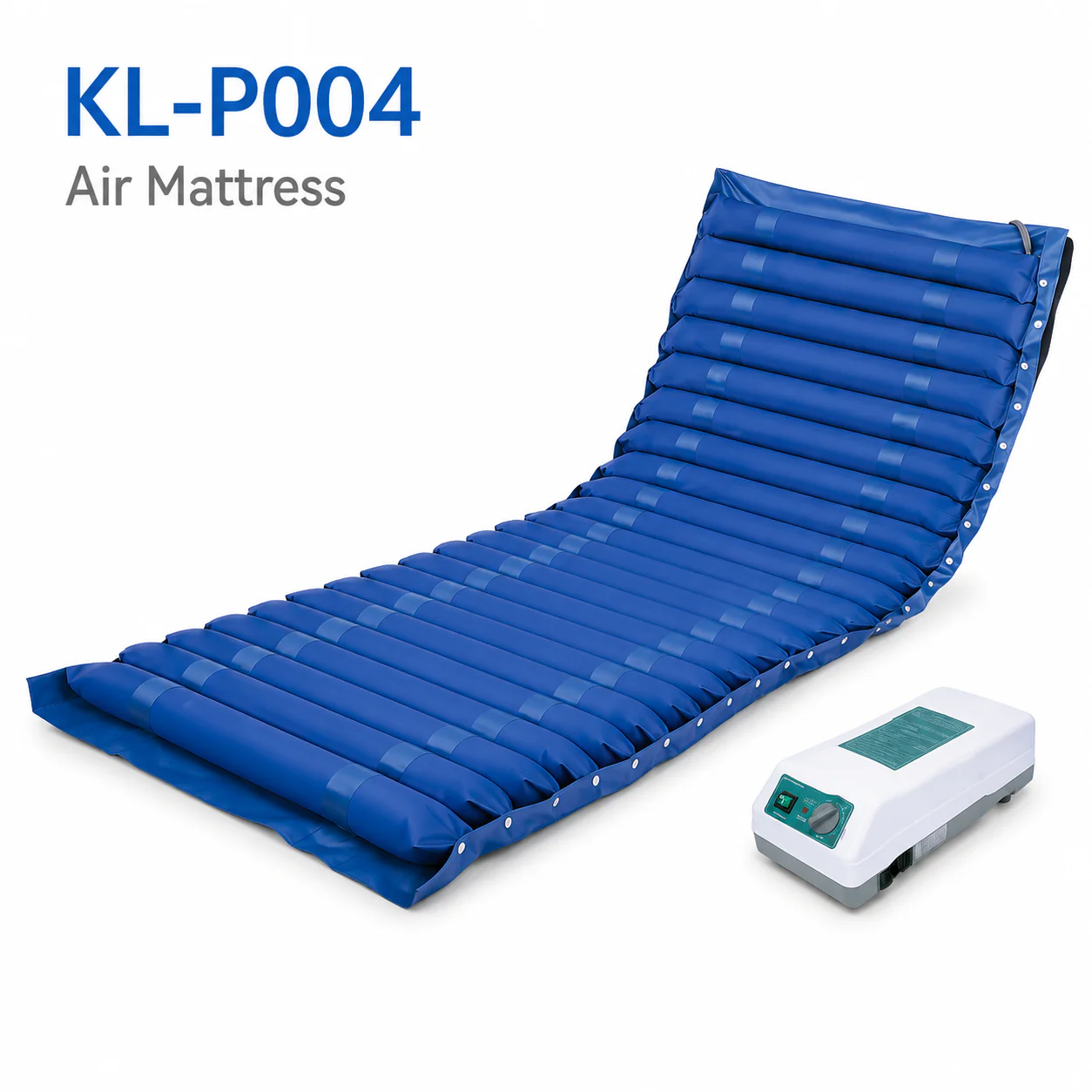
# KL-P004 Air Mattress — Tubular Alternating Pressure Mattress for Hospital Beds
Quick answer: The Keling KL-P004 is a hospital bed air mattress with tubular air-cell construction and a size of 190 × 90 mm, supplied with an electric pump featuring a digital control panel. It is manufactured by Keling Medical (Keling Medical) for pressure-relief and anti-decubitus use across a variety of hospital scenarios.
Quick Facts
- The Keling KL-P004 is a tubular air-cell hospital bed mattress for alternating pressure and anti-decubitus applications.
- The mattress measures 190 × 90 mm, compatible with standard hospital bed frames.
- The KL-P004 is supplied with an electric pump featuring a digital controller for pressure setting and adjustment.
- The tubular cell construction differs from the bubble-cell design of the KL-P003, providing larger-diameter air channels for deeper pressure redistribution.
- Applicable to a variety of hospital scenarios requiring dynamic pressure relief.
- The KL-P004 is produced by Keling Medical, a Chinese medical equipment manufacturer with more than 20 years of industry experience.
Overview
The KL-P004 air mattress is a tubular alternating pressure mattress that provides a step up in pressure-redistribution capability from bubble-cell designs. Where the KL-P003 uses small rounded bubble cells, the KL-P004 uses larger tubular (cylindrical) air channels arranged across the mattress surface. The greater air volume per cell translates to deeper pressure relief under the patient's body contours, making the KL-P004 more appropriate for higher-risk patients or longer-duration immobility situations.
The electric pump supplied with the KL-P004 includes a digital controller, allowing nursing staff or clinicians to set and monitor the inflation pressure precisely and adjust it for the patient's body weight and risk assessment. Digital control improves consistency of therapeutic pressure delivery compared to analogue dial systems and makes it simpler to verify and document the mattress pressure setting as part of pressure injury prevention protocols.
The tubular cell pattern visible on the mattress surface — with both horizontal tube rows and connector ridges — is the established format for alternating pressure systems in clinical use. The KL-P004 deploys this technology in a 190 × 90 mm format that mounts over existing standard hospital beds, bringing advanced pressure management to ward environments without requiring dedicated air-loss bed frames or replacement bed investment.
Key Features
- Tubular air-cell construction — large-diameter cylindrical air channels provide deeper body-contour pressure redistribution than bubble-cell designs, suited to higher-risk patients.
- Digital pump with controller — electric pump unit includes a digital control panel for precise pressure setting, monitoring and adjustment based on patient weight and risk.
- Alternating pressure function — cells inflate and deflate in alternating cycles to prevent sustained pressure on any skin area, reducing pressure injury risk for immobile patients.
- Standard 190 × 90 mm footprint — fits directly onto standard hospital bed frames without requiring bed replacement.
- Wide clinical applicability — described as applicable to a variety of hospital scenarios from general wards to high-dependency environments.
- Complete kit — supplied as a mattress-and-pump system, ready for clinical deployment.
Technical Specifications
| Parameter | Value |
|---|---|
| Model | KL-P004 |
| Product type | Air mattress (tubular cell, alternating pressure) |
| Mattress size (L × W) | 190 × 90 mm |
| Inflation | Electric pump with digital controller (supplied) |
| Construction | Tubular air-cell |
| Application | Applicable to a variety of hospital scenarios |
Specifications are subject to change; dimensional tolerances may apply. Contact Keling Medical for the latest datasheet.
Applications
The KL-P004 tubular air mattress is deployed in general wards, ICUs, surgical recovery areas, geriatric and rehabilitation wards, and long-term care facilities for patients at moderate to high risk of pressure injury development. It is placed on standard hospital beds as a pressure-redistributing overlay surface, and its digital pump facilitates integration into pressure injury prevention care pathways.