Buying guides
Spinal surgery table, fracture table and orthopedic table: a buyer's guide
How to choose a spinal surgery table, fracture table or orthopedic surgical table: positions, radiolucent tops, C-arm access, traction, loads and a checklist.

A spinal surgery table supports the patient prone with the abdomen free and gives unobstructed, radiolucent access for a C-arm along the spine, while a fracture table holds the leg in controlled traction for hip and femoral fracture fixation. Many hospitals cover both with one electro-hydraulic table with a carbon fiber top plus spine and orthopedic traction accessories; high-volume centers add dedicated tables.
This buyer's guide is for orthopedic and spine surgeons, theatre managers, biomedical engineers and procurement teams. It explains the types of orthopedic surgery table, the positions and imaging needs that drive the choice, and what to specify. For general operating table choices such as drive type, see the operating table buying guide.
Types of orthopedic and spine surgery tables
There are three broad ways to equip orthopedic and spine theatres: a general operating table with accessories, a dedicated fracture (traction) table, and a dedicated open-frame spinal table. Each trades flexibility against specialist performance.
| Table type | Main procedures | Strengths | Limitations |
|---|---|---|---|
| General table with orthopedic accessories | Mixed orthopedics, trauma, shoulder, knee, hip | One table for many specialties; lower cost | Accessory changeovers; less imaging clearance |
| Fracture table (orthopedic traction table) | Hip fractures, femoral and tibial nailing | Precise, sustained traction; good C-arm access to the hip | Mostly single-purpose; setup time and training |
| Open-frame spinal surgery table | Posterior spinal fusion, deformity, long-segment instrumentation | Abdomen free; radiolucent, 360° imaging access | Limited to prone and some lateral work |
| General table with spine frame | Lumbar decompression, discectomy, short fusions | Converts a general table into a back surgery table | Less radiolucent area and positioning range |
What is a spinal surgery table?
A spinal surgery table is an operating table designed for prone spine procedures, where the patient lies face down supported at the chest and pelvis so the abdomen hangs free. The top or frame is radiolucent so a C-arm can take anteroposterior and lateral images along the spine without moving the patient.
Dedicated spine surgery operating tables use an open frame with adjustable chest, hip and thigh pads, and some can rotate the patient between supine and prone. A general table becomes a practical operating table for back surgery when fitted with a convex spine frame or a set of prone positioning pads, which suits lumbar decompression and short fusions.
When comparing surgical tables for spinal surgery, check:
- Radiolucent length: enough to image from the upper thoracic to the sacral spine without frame members in the beam.
- C-arm clearance: free space under the top for the C-arm to swing for lateral images, and for 3D intraoperative imaging if you use it.
- Prone support: adjustable pads, an abdomen-free zone and a face support that keeps pressure off the eyes.
- Height range: a low enough minimum for tall surgeons working on a prone patient, who is already high on pads.
- Tilt and flex: lateral tilt, Trendelenburg and a break or bridge to open or close the lumbar spine.
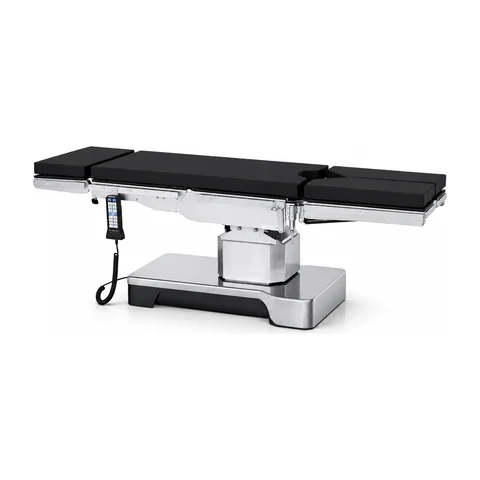
Keling's KL-D-III-III Electric Operating Table has a carbon fiber free-backboard tabletop, with a 1,100 mm (43.3 in) carbon fiber backboard, compatible with C-arm and 360° X-ray imaging. The KL-D-IA-II Electric Operating Table includes a lumbar bridge function and leg plate abduction of ≥180°.
What is a fracture table?
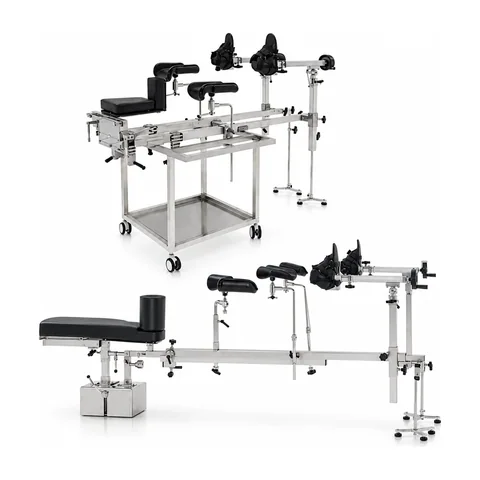
A fracture table, often called a fracture table ortho setup or orthopedic traction table, holds the patient supine with the injured leg in a traction boot and a padded perineal post for countertraction. The surgeon or assistant can then apply measured traction and rotation to reduce the fracture and hold it while it is fixed under fluoroscopy.
Typical components are:
- a short torso section that leaves the hip and thigh free for imaging
- a padded perineal post
- one or two traction arms with traction boots and fine adjustment for length and rotation
- a well-leg holder that lifts the uninjured leg out of the C-arm's path
- arm supports and a chest support for the lateral position on some designs
Keling's KL-6 / KL-6C Orthopaedics Tractor series is a carbon fiber orthopedic traction frame with horizontal rotation of 0–180° and an adjustable traction distance of 0–200 mm. The KL-6B & KL-6D Orthopaedic Traction Frame traction frames assist fracture and dislocation procedures; the KL-6D is used for traction and reduction of fractures or dislocations. These attach to compatible operating tables, so one theatre can switch between trauma and general cases.
Perineal post pressure is a recognized risk in traction procedures. Follow the manufacturer's IFU and your surgical team's protocol for padding and traction limits; some teams now use post-less traction techniques for hip arthroscopy.
Positions in orthopedic surgery and what the table must do
Orthopedic surgery uses more positions than almost any other specialty, so list your procedures before you choose an orthopedic surgical table. Each position adds requirements.
| Position | Typical procedures | Table and accessory needs |
|---|---|---|
| Supine with traction | Hip fracture fixation, femoral nailing | Fracture table or traction attachment, well-leg holder |
| Supine, free leg | Knee arthroscopy, knee replacement | Leg holder, lateral post, removable leg plates |
| Lateral decubitus | Hip replacement, some spine approaches | Pelvic and chest positioners, strong lateral tilt |
| Prone | Spinal fusion, decompression, posterior approaches | Spine frame or open-frame table, radiolucent top |
| Beach chair | Shoulder arthroscopy and surgery | Shoulder section that removes, head positioner, back raise |
| Supine, arm out | Hand and wrist surgery | Hand table, radiolucent arm board |
Leg sections that split, abduct and detach widen the range of procedures. The KL-D-III-II Electric Operating Table offers a 650–1,100 mm (25.6–43.3 in) height range, ≥30° Trendelenburg and reverse Trendelenburg, leg plate abduction of ≥180° and a one-key V position.
Imaging: radiolucency and C-arm access
Most orthopedic and spine procedures use intraoperative fluoroscopy, so imaging access often decides the table. A carbon fiber top is the standard, but the radiolucent area, the column position and the base shape matter just as much.
- Longitudinal slide: sliding the top along the base moves the column out of the imaging area without moving the patient.
- Reversible orientation: some tables let the head board mount at the foot end, so the patient can be positioned over the radiolucent part. The KL-D-V Electric Operating Table head board inserts into the leg plate position for whole-body C-arm imaging.
- Base clearance: the C-arm must reach under the area of interest in both planes.
- No metal in the field: check rails, clamps and accessory frames for radiopaque parts in the beam.
Run a mock setup with your C-arm during evaluation. A table that looks radiolucent on paper can still block a lateral image because of a frame member.
Load ratings, stability and patient safety
Orthopedic and spine cases put unusual loads on a table: a heavy patient on pads in prone, traction forces through the leg, or the full weight at one end of a slid top. Compare safe working load for normal and for extreme positions, and check stability with the top slid fully.
Patient safety depends on positioning as much as on the table:
- pad all pressure points, including the face, chest, iliac crests, knees and heels in prone
- keep the eyes free of pressure in prone positions
- secure the patient with straps and supports before tilting
- use accessories only as the manufacturer allows, and check their load ratings
Operating tables are tested to IEC 60601-2-46, the particular standard for operating tables, which covers mechanical strength and stability. Ask for the test report for the configuration you will use, including accessories.
General table with accessories or dedicated table?
For most hospitals, a multi-purpose electro-hydraulic table with a carbon fiber top, a traction attachment and a spine frame is the better first purchase: it keeps the room usable for other specialties and reduces capital cost. A dedicated spinal table or fracture table is justified when one theatre runs a full list of spine or trauma cases every day.
Questions that settle the choice:
- How many spine and trauma cases per week, and in how many rooms?
- Do you need long-segment or deformity spine work, which favors open-frame tables?
- Will the room use 3D intraoperative imaging, which needs more clearance?
- Can staff change accessories quickly, and where will accessories be stored?
Ward-level traction is a separate need; overhead traction frames on hospital beds are covered under types of hospital beds.
Orthopedic table specification checklist
Include these items in a tender for an orthopedic surgery table or spine table:
- Table type and drive (electro-hydraulic or electric), with handset and backup controls.
- Height range, Trendelenburg and reverse, lateral tilt, back and leg ranges.
- Radiolucent top material and radiolucent length; longitudinal slide distance.
- Safe working load in normal, prone and traction configurations.
- Orthopedic traction set: traction arms, boots, perineal post, well-leg holder.
- Spine accessories: spine frame or prone pads, face support, arm supports.
- Other accessories: shoulder positioner, lateral supports, leg holders, hand table.
- Power supply and battery backup.
- Documents: the manufacturer's ISO 13485 certificate, IEC 60601-2-46 test report, instructions for use in the required language, and registration for your country.
Next steps
List your orthopedic and spine procedures by position and imaging need, then decide between a multi-purpose table with accessories and a dedicated table. Keling Medical manufactures electric operating tables with carbon fiber tops and orthopedic traction frames in one ISO 13485-certified factory. Browse the operating tables range, plan the room with our operating room design and layout guide, or request a quotation with your procedure mix and imaging equipment.
Frequently asked questions
What table is used for spine surgery?
Spine surgery uses either a dedicated open-frame spinal surgery table, which supports the chest and pelvis on pads with the abdomen free, or a general operating table fitted with a radiolucent spine frame or prone positioning system. Both need a radiolucent top and clearance for a C-arm to image the spine in two planes without moving the patient.
What is a fracture table used for?
A fracture table is used to hold a patient in controlled traction during fracture reduction and fixation, most often for hip fractures and femoral shaft nailing. The injured leg sits in a traction boot, a padded perineal post provides countertraction, and the other leg is supported out of the way so a C-arm can image the hip.
Why is the abdomen kept free on a spinal surgery table?
Keeping the abdomen free of pressure in the prone position lowers intra-abdominal pressure, which reduces pressure on the vena cava and epidural veins. This can reduce bleeding in the surgical field and helps ventilation. Correct padding of the chest, pelvis and face is part of the positioning protocol set by the surgical and anesthesia team.
What is the difference between an orthopedic table and a general operating table?
A general operating table is designed for many specialties and becomes an orthopedic surgical table when fitted with accessories such as traction frames, leg holders and shoulder positioners. A dedicated orthopedic table is built around traction or spine positioning, with more radiolucent area and imaging clearance, but is less flexible for other procedures.
What table is used for hip surgery?
Hip fracture fixation is usually done on a fracture table or a general table with an orthopedic traction attachment, with the patient supine. Hip replacement is commonly performed in the lateral position using body positioners on a general table, or supine with a leg positioner for anterior approaches. Hip arthroscopy uses traction with distraction of the joint.
How much weight can a spinal surgery table hold?
It depends on the model and the position. Manufacturers state a safe working load for normal positions and often a lower load for extreme tilt, prone or traction configurations. Check both figures and whether the load applies with the accessories you will use, especially for bariatric spine surgery.
Do orthopedic surgery tables need a carbon fiber top?
For any procedure using intraoperative fluoroscopy, a radiolucent top is strongly preferred, and carbon fiber is the usual material because it is strong, light and transparent to X-rays without visible artifacts. Check the radiolucent length and whether frame members or columns block the C-arm in the area you need to image.